

Picture these two new franchisees.
The first opens her doors with a clear destination in mind. She knows what she wants her business to be worth, roughly when she wants to transition, and that knowledge shapes how she builds her team, manages her costs, and grows her top line. Every good decision she makes today compounds toward that future value.
The second is talented, optimistic, and hardworking. His plan is to keep his head down and hope for the best.
The first owner will go further. Not because she’s smarter or luckier, but because she knows where she’s going.
Here’s the uncomfortable truth: most franchise systems have more of the second type of owner than first. Not because they don’t care about franchisee success. They do. The problem is that nobody is having the conversation that would change the outcome.
Why the Conversation Doesn’t Happen
Franchise leaders and business coaches avoid the exit planning franchise for understandable reasons. It feels like bad timing. It can almost feel insulting to talk to a new franchisee about leaving before they’ve even opened. And for a struggling unit, it can feel like pulling a ripcord. There is an even quieter fear for franchisors: what if bringing it up signals that we see trouble ahead?
So, the conversation gets deferred. There’s always something more urgent. And year after year, franchisees make decisions about cost savings, staffing, systems, owner dependence, and reinvestment that quietly undermine the value they could be building. By the time exiting is on the table, the options are limited, and the runway is short.
The irony is that the franchisors who avoid this conversation in the name of protecting the franchisee’s confidence are responsible for leaving their franchisees unprepared.
Starting Early Changes Everything
Think of it this way: pilots file flight plans before takeoff, not because they’re in a hurry to land, but because knowing the destination determines every decision in the air.
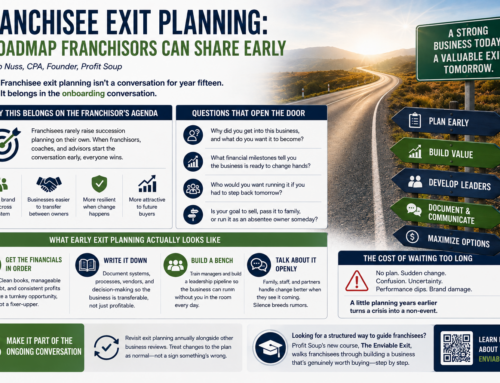
The same is true for franchise owners. Franchisees who understand from the beginning that their business will be valued on owner’s discretionary cash flow, not sales volume alone, make fundamentally different decisions. They invest in systems that don’t depend on them to run. They keep their financials clean and their documentation organized. They build teams that a future buyer could inherit. They know their number, and they manage toward it.
There’s a bonus that franchise leaders often overlook. Franchisees who set clear profit targets are likely to hit or even exceed them – because a plan creates focus, and focus creates results. More profit means more opportunities to pay themselves, to pay down debt, and to reinvest in growth. Exit planning and profitability aren’t separate conversations; they are the same conversation.
Introduce exit planning early, not as a closing conversation; you aren’t talking about leaving. Instead, position it as the foundation for long-term business strategy. That is, building something worth having. That’s a conversation any franchisee, at any stage, can get behind.
What Franchisors Can Do
Don’t wait for franchisees to bring it up. They almost never do. Build exit planning conversations into the rhythm of the support model: into onboarding, annual planning sessions, and an important strategic conversation franchise business coaches revisit every year.
Help franchisees understand what drives business value and what erodes it. Use performance data to show franchisees where they stand relative to the system and what it would take to improve their profit – because profit drives value. Have the courage to go beyond “how was last month?” to “what are you building, and what do you want it to be worth when you’re done, and what are today’s priorities that contribute to that vision?”
The result is a network of owners who are more engaged, more profitable, and more likely to exit on their own terms, with the return they planned for, on the timeline they chose. It’s what we call an Enviable Exit. That’s good for franchisees. And it is very good for the brand.
Join Us on July 29
The Franchise Consortium is hosting a live webinar on this topic: The Enviable Exit: Are You Brave Enough to Talk About It?.
Join moderator Keith Gerson, CFE, along with panelists Barbara Nuss, CPA and founder of Profit Soup and Paul Pickett, Chief Development Officer and EVP of Wild Birds, for a straight-talking conversation on why exit planning is the strategy your franchise system might be missing — and how to start the conversation without spooking anyone.
Tuesday, July 29 | 9:00 AM PT / 12:00 Noon ET