

One of the traps in franchising is assuming your job is done once you’ve recruited capable franchisees, given them some initial training, and helped them establish their operations.
Of course, good recruitment and initial training matter enormously. But they are only the beginning.
Franchisees operate in a constantly changing environment. And franchisees themselves move through different stages as their businesses and personal circumstances change.
This means successful franchise networks need to keep developing their franchisees.
Our Franchisor Wheel of Excellence identifies five important responsibilities of a successful franchisor:
Recruit quality franchisees.
Mentor franchisees for performance.
Listen to franchisee feedback.
Engage franchisees with the brand.
Lead with credibility.
While all five pieces of the Wheel work together, in this article I’ll focus on Mentor franchisees for performance.
Here, I use mentor as a verb. It refers to anything a franchisor does to enhance the motivation, capability or performance of its franchisees.
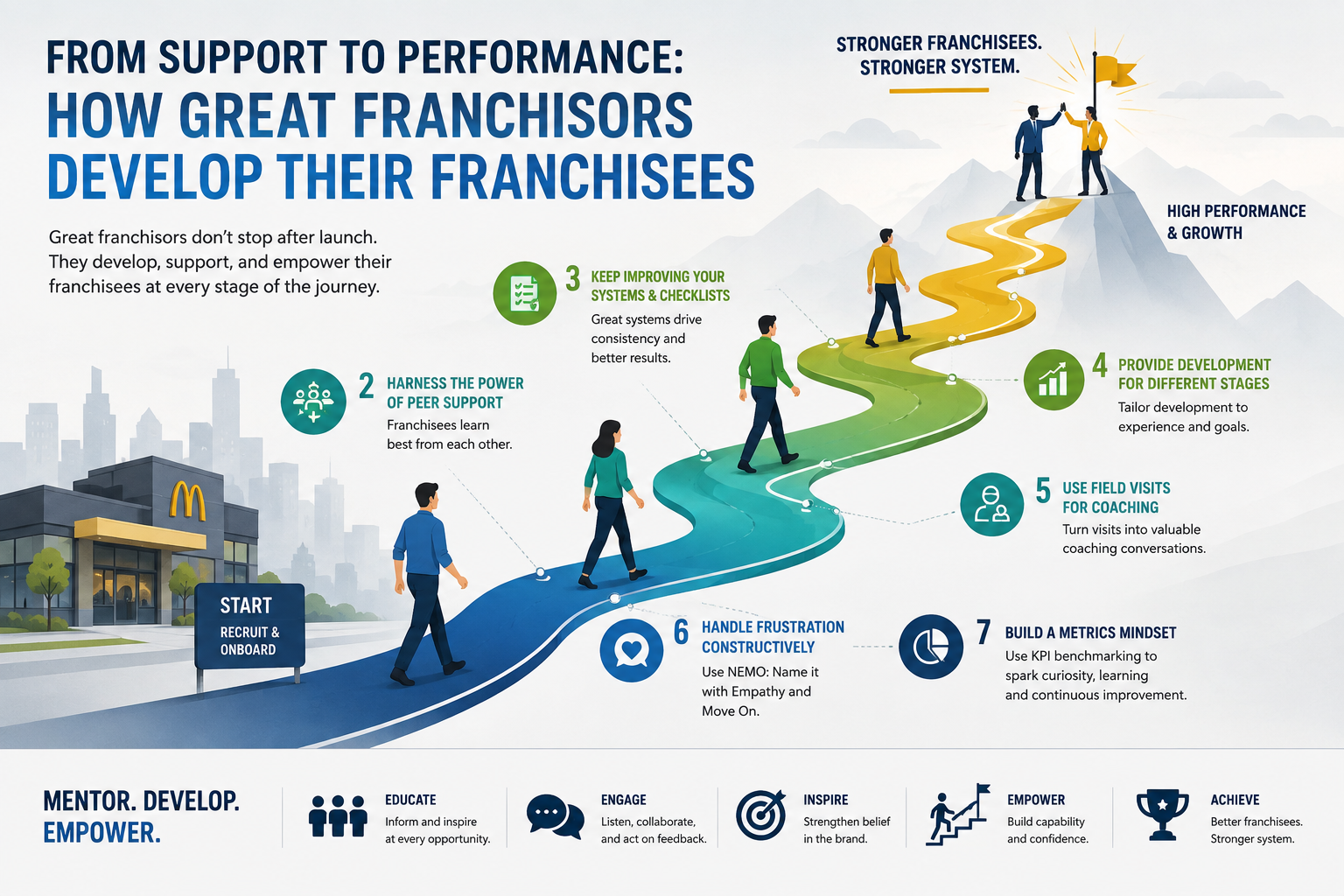
Here are seven ways to do this.
1. Make conferences and meetings genuinely developmental
Franchise meetings should do more than communicate information from head office.
The best meetings educate, inform and inspire — while also enabling franchisees to learn from each other.
A useful rule is to aim for franchisees to be doing at least 50% of the talking through roundtables, panels, facilitated discussions and open forums.
Remember, some of the most valuable expertise in a franchise network sits with the franchisees themselves.
2. Harness the power of peer support
Franchisees can learn an enormous amount from other franchisees who understand the realities of running the same business.
Small peer groups can provide a safe environment for people to share their metrics, goals and challenges, exchange ideas, and hold each other accountable.
There is also something particularly powerful about hearing another franchisee say, “I had the same problem. Here’s what worked for me.”
Your job as franchisor is not always to provide the answers. Sometimes it is to create the conditions where franchisees can help each other find them.
3. Keep improving your systems and checklists
Good systems are one of the great strengths of the franchise business model.
They reduce unnecessary variation, improve efficiency and enable franchisees to benefit from the collective experience of the network.
But systems should never become sacred cows.
They need to be regularly reviewed to ensure they remain relevant, practical and commercially useful. And franchisees need to understand not just what the systems are, but why they matter.
4. Provide development for different stages of the journey
A new franchisee has very different developmental needs from someone who has been operating successfully for ten years.
Training and diagnostic tools therefore need to cater for different levels of experience and capability.
For example, an experienced franchisee considering a second or third location may benefit from a Multi-Unit Capability assessment to identify whether they have the leadership, financial and management capability to successfully make that transition.
5. Use field visits for coaching, not just compliance
Field consultants are one of a franchisor’s most important resources for improving franchisee performance.
While maintaining standards will always be part of their role, the greatest value often comes from helping franchisees think clearly about their businesses, set meaningful goals and follow through on their commitments.
Our research consistently shows that franchisees particularly value good-quality coaching and follow-up from their field consultants.
A useful question for every field manager is:
“What will this franchisee do differently as a result of my visit?”
If the answer is “nothing”, the visit probably hasn’t achieved much.
6. Know how to handle frustration constructively
Even successful franchisees will experience periods of disappointment, frustration or resentment.
Ignoring these feelings seldom makes them disappear. Nor does becoming defensive or immediately trying to prove why the franchisee is wrong.
This is where our NEMO process can help.
NEMO stands for Name the issue with Empathy and Move On by focusing on solutions.
The principle is simple: acknowledge what is going on, demonstrate that you understand the franchisee’s perspective, and then help shift the conversation towards what can constructively be done next.
7. Build a metrics mindset
Finally, help franchisees understand and use their numbers.
KPI benchmarking can be particularly powerful because it gives franchisees context. Rather than simply knowing their own numbers, they can see how their performance compares with relevant benchmarks across the network.
This becomes increasingly valuable as franchisees mature.
Good benchmarking should not be about embarrassing poor performers or creating league tables. It should generate curiosity by asking the questions: Why are some businesses achieving better results? What are they doing differently? And what can we learn from them?
In summary
Mentoring franchisees for performance does not mean constantly telling them what to do.
In fact, effective mentoring often involves doing the opposite.
It means asking good questions. Creating opportunities for peer learning. Providing useful data. Building capability. Encouraging accountability. Listening when people are frustrated. And giving franchisees the tools and confidence to make better decisions for themselves.
That is why Mentor is one of the five interconnected pieces in the Franchisor Wheel of Excellence.
While recruiting quality franchisees is important, it’s how you develop them that separates good franchisors from great franchisors.