
Mastermind, Advisory Board or Consultant: Which One Does Your Franchise Business Need?
When a franchise leader gets stuck, the instinct is to bring in outside help. The trouble is that “outside help” covers at least three very different things, and choosing the wrong one is how smart people spend a year and a good chunk of budget without moving the problem. A franchise mastermind, an advisory board and a consultant each do a specific job. Here is a simple way to match the tool to the problem.
A Consultant Answers a Question You Already Know How to Ask
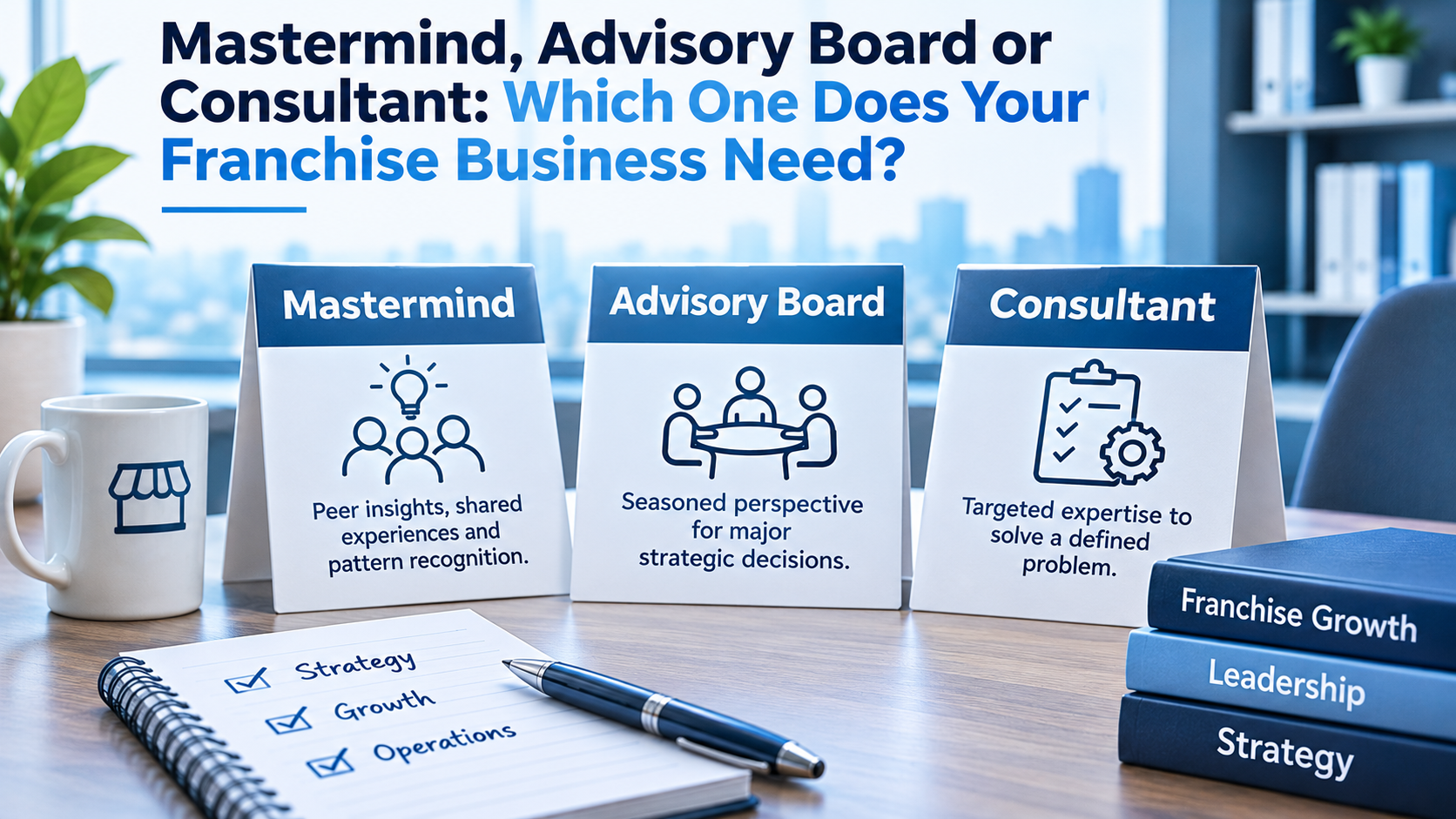
A consultant is the right call when the problem is defined and the answer is expertise you do not have in house. Redesigning franchisee onboarding, building a Franchise Advisory Council or restructuring fees all fit. You hire for a deliverable, the work has a start and a finish, and it is easy to tell whether it worked.
The limit is built into the arrangement. A consultant works on the problem you hand over. If the real issue is one you have not noticed yet, nobody is being paid to find it.
An Advisory Board Brings Judgment to Decisions That Are Yours to Make
A board of advisors suits the leader who wants seasoned, independent perspective on big and infrequent decisions: entering a new market, taking on outside capital, planning the handoff from founder to professional CEO. Members typically meet a few times a year, see the business from a high level, and earn their seat by challenging strategy and asking the questions the team is too close to ask.
The limit is frequency and visibility. A board sees the business a handful of times a year, and mostly the parts you choose to show it. It is a poor tool for the week-to-week problems that eat your calendar.
A Mastermind Surfaces the Problem You Did Not Know You Had
A franchise mastermind is a small, standing group of peers at a similar stage who meet on a steady rhythm and put real situations on the table. Nobody is there to sell anything or to play the expert. The value is pattern recognition. One person describes what they are wrestling with, and two others say, “I ran into that, and here is what happened next.”
I saw the power of this early. As a young executive at Cost Cutters, I watched a few owners decide on their own to meet, compare notes and share their best ideas. Nobody organized it, and those owners consistently outperformed the rest of the system. Years later at PostNet, we built peer groups on purpose, with structure and accountability, and learned the part that matters most: they only work when people are honest about what is not working.
Four things separate a real mastermind from a standing lunch:
-
The right peers at the right stage. A founder at 15 units and an executive team at several hundred have different problems. Groups work best at six to eight members, with direct competitors kept out of the same room.
-
Confidentiality that is real. People share actual numbers and actual mistakes only when they trust that it stays in the room.
-
A consistent rhythm. Monthly meetings build trust and let members report back on what they tried, which is where most of the learning happens.
-
A facilitator who keeps it a working session. Without one, groups drift into status updates and small talk.
The limit here is that a mastermind will not hand you a finished deliverable. It pays off only if you bring real problems and act on what you hear.
How to Choose
Match the tool to the shape of the problem:
-
You can describe the problem in one sentence and need it built or fixed. Hire a consultant.
-
You face a large, infrequent decision and want independent judgment. Build an advisory board.
-
Something feels off, but you cannot name it, or you are the most experienced person in your own room and it is lonely. Join or form a mastermind.
Plenty of strong leaders use all three at different points in a company’s life. The mistake is asking one of them to do another’s job: expecting a board to solve weekly operating problems, or expecting a mastermind to deliver a finished manual.
Three questions can sharpen the choice:
-
Can I state the problem in a sentence?
-
Is this a one-time decision or an ongoing grind?
-
Who in my world will tell me the truth when it is uncomfortable?
Where to Go From Here
If you want to see how a mastermind works in practice, I will be presenting a Franchise Consortium member webinar on the topic, “The Mastermind Advantage: Solve Bigger Problems Faster and See Them Coming,” on December 9 at 2:00 PM ET.
If you would like to talk through which option fits your situation, book a quick 15-minute call with me, or call 612-868-0745.