

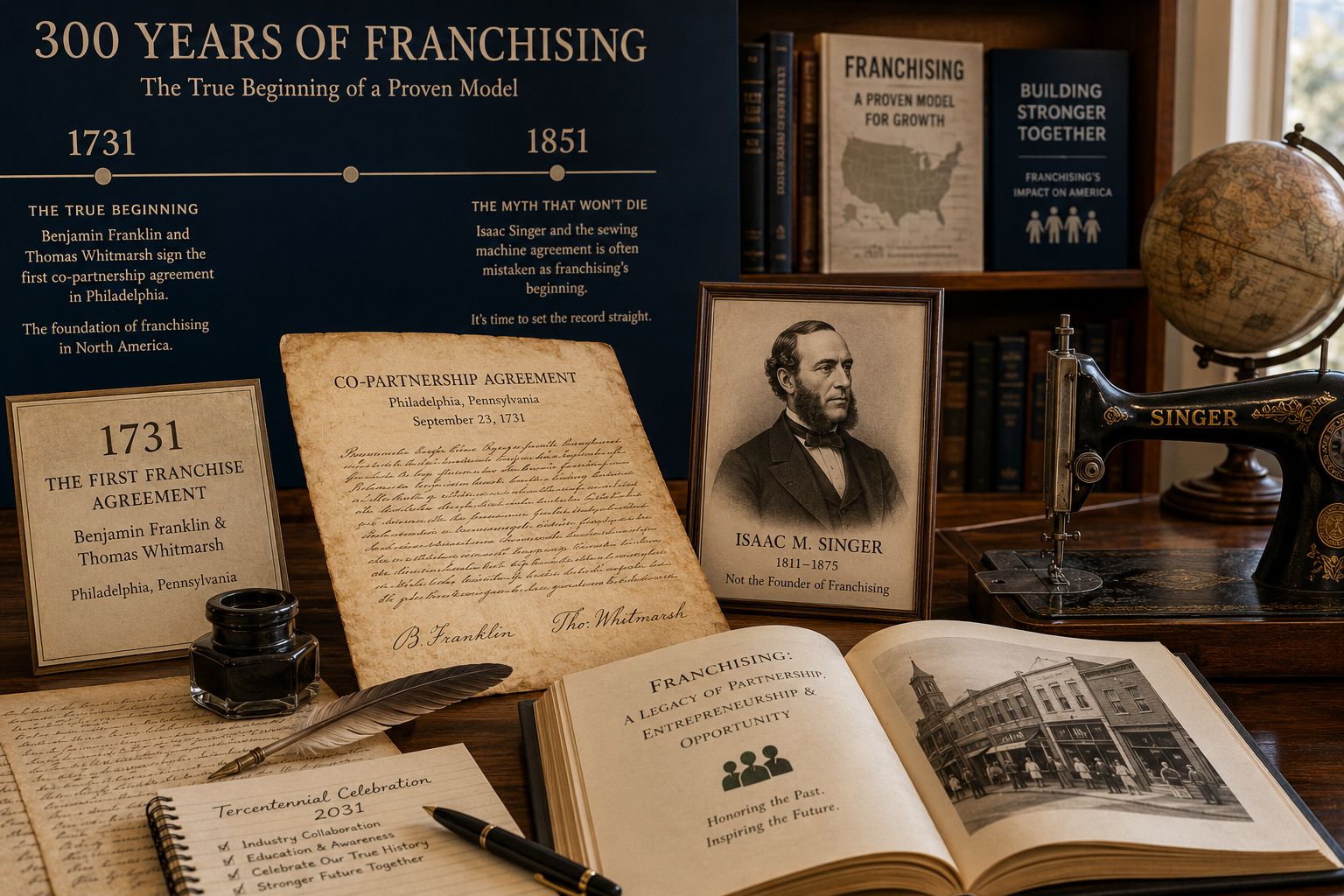
As Americans prepare to celebrate the nation’s 250th birthday on July 4, 2026, franchising has its own milestone on the horizon — one that deserves to be planned now. In 2031, the agreement that founded franchising in North America turns 300 years old. Three centuries of a distribution method that today supports hundreds of thousands of small business owners, millions of jobs, and a meaningful share of the American economy — an anniversary that deserves an industry-wide tercentennial celebration.
But before franchising can celebrate its 300th birthday properly, it needs to celebrate the right founder. And right now, it isn’t.
Ask almost anyone in franchising when the industry began, and you will get the same confident answer: 1851, Isaac Singer, the sewing machine. It is a tidy story. It has a household brand name, an industrial-era birthdate, and the comfortable feel of settled history.
It is also wrong. Not slightly wrong — wrong at the foundation.
I have spent decades in franchising building franchise systems, advising franchisors, teaching the discipline, and testifying about it. And I have spent a good portion of that time watching the Singer story get repeated, footnoted, and recycled until repetition did the work that evidence never could. It is time to retire it. And it’s time to replace it with the actual document — signed, dated, and sitting in the historical record — that marks the true beginning of franchising on this continent: the co-partnership agreement between Benjamin Franklin and Thomas Whitmarsh, executed in Philadelphia in 1731.
The exploration for who was the first franchisor came from a discussion I had with Dave Thomas, founder of Wendy’s while we were writing Franchising for Dummies. Dave’s question of who was the first franchisor sent me on a search of the historic records including the history of the Singer company, discussions with the researchers at Yale University, which houses the Papers of Benjamin Franklin, discussions with the Library of Congress in D.C. and a concerted and supported effort to find the first Franklin agreement — which we finally located in a land office in Pennsylvania.
The Man Behind the Machine
John Ford once said about the man who killed Liberty Valance – “When the legend becomes fact, print the legend.” Let’s meet the man the textbooks have crowned the first franchisor.
Isaac Merritt Singer was born October 27, 1811, in Pittstown, New York, the youngest child of poor German immigrants. He left home at twelve, spent years as an itinerant actor and machinist, and patented improvements to a wood-carving machine before turning his attention, in 1850, to a poorly designed Lerow & Blodgett sewing machine in a Boston shop. His improvements worked and in 1851 he received his patent and, with capital and legal firepower supplied by attorney Edward Cabot Clark, formed the I.M. Singer & Company. Isaac Singer was thirty-nine years old.
The company’s commercial genius — the patent pool that ended the “Sewing Machine War,” was the installment payment plan that put machines in ordinary households. Attorney Clark is credited with Singer’s early and aggressive international expansion. Clark’s leadership was no accident and he spent much of his partnership with Singer keeping Isaac as far from the public face of the company as possible, because Isaac Singer’s private life was a scandal of remarkable proportions even by the forgiving standards of the Gilded Age.
While legally married to Catharine Maria Haley, Singer lived for years with Mary Ann Sponsler, who bore him ten children. Simultaneously — and secretly — he maintained a third household with Mary McGonigal under the alias “Mr. Matthews,” and a fourth with Mary Eastman Walters as “Mr. Merritt.” In 1860 he was arrested in New York on a bigamy charge. Mary Ann Sponsler had him arrested for assault after he beat her and one of their daughters and facing public disgrace, Singer fled to Europe, eventually settling in England with his second legal wife, Isabella Eugenie Boyer. He died at his estate in Paignton, Devon, in 1875, leaving a fortune — and roughly two dozen children — behind.
I might point out that Isaac Singer is not a person we should ever want associated with franchising.
Naming the Children: There Was No Albert
The myth names Albert Singer as the first franchisor — and because the Singer story attracts embellishment the way the man attracted households, it is worth putting the genealogy on the record. Among Singer’s documented children: With Catharine Maria Haley, his first wife: William and Lillian. With Mary Ann Sponsler: ten children, including Isaac Augustus, Vouletti, John, Fanny Elizabeth, Jasper, Mary, Julia, and Caroline. With Mary McGonigal, the “Matthews” family: children including Ruth and Charles. With Mary Eastman Walters: Alice. And with Isabella Boyer, his second wife: Adam Mortimer (later Sir Mortimer Singer, the aviation patron), Winnaretta (the Princesse de Polignac, one of the great music patrons of her age), Washington, Paris Eugene (famous for his long affair with the dancer Isadora Duncan), Isabelle-Blanche, and Franklin.
Singer’s children were a roll call of ambition and eccentricity – and yet there was not an Albert among them. I raise this because the Singer legend has accumulated phantom details over the decades, names and dates that appear in no primary source and survive purely by citation of other people who also never checked. “Albert Singer” is one such phantom. He does not exist in the record – and neither does Singer franchising.
What Singer Actually Did in 1851 — and What He Didn’t
Here is what the historical record shows. I.M. Singer & Company, for a short period in its early years, sold through territorial agents who were granted the right to sell machines in a geographic area. That is the entire factual kernel from which the “first franchisor” legend grew.
Now consider what those arrangements were not. There was no operating system, no training, no standards manual, no ongoing royalty tied to the use of a business method. The dealers were simply product distributors who also distributed non-Singer products — full stop. They were wholesale account holders and had nothing to do with anything a franchise professional would recognize — and besides, the system didn’t work. Singer’s agents provided poor service, ignored territorial discipline, and damaged the brand.
By the 1860s, Edward Clark was systematically dismantling the dealer network in favor of company-owned branch offices. The supposed pioneer of franchising is, on the actual evidence, an early case study in a company abandoning third-party distribution because it couldn’t control it. What Clark retained in the company-owned locations were managers who had a bit more flexibility to operate the location than a typical employee of the time was granted.
The Singer Manufacturing Company historic records are housed at the Hagley Museum and Library in Wilmington Delaware; the University of Wisconsin-Madison; and the Newberry Library in Chicago, IL. When you research the materials at the Hagley Museum there are records from the Singer offices with requests for employment, and the very structure of the archives reflects a company managing an employed sales force and branch offices, not a network of independent agents. In the records of the Newberry Library, the Singer records describe how Singer expanded by establishing branch offices, including one in Chicago, as exclusive sales outlets for its machines. These were branch offices — company operations — not independent contractors or franchisees. Most tellingly is an 1885 Singer contract, found in the Western Kentucky University library archives, discussing a local Singer employee, J.C. Webb, who signed on as a full-time employee in 1880 and received a salary of $15 per week plus a 3% commission on sales. His contract also stipulated that he was “to furnish one Horse to be used in the business and to pay for its keeping.”
So where did the legend come from? Not from Singer. No Singer document from the period uses the franchise concept. The relabeling came later — when franchise textbook writers of the 1960s, looking for a respectable industrial pedigree for a then-maturing field, retrofitted the word “franchising” onto territorial product licensing. Once it appeared in print, it became a copy-paste origin story and every citation since points to another secondary source. Follow the footnotes back far enough and you find absolutely nothing. No agreements and no primary document — just an anachronism with good publicity.
Franchising, as I have argued for decades, is not an industry. It is a method of distribution built on identifiable structural elements: a license to operate under a brand, a prescribed business format, an ongoing financial relationship, a defined term, a defined territory and defined rights and obligations. Measure Singer’s dealer arrangements against those elements and the 1851 claim collapses. Measure a document signed 120 years earlier, and something remarkable happens.
Philadelphia, 1731: Benjamin Franklin Becomes the First Franchisor
On September 13, 1731, Benjamin Franklin entered into a co-partnership agreement (the term used in England for a franchise at the time) with his journeyman printer Thomas Whitmarsh to establish a printing house in Charleston, South Carolina. I have a copy of the original agreement, and I can tell you that reading it as a franchise professional is an uncanny experience, because many of the structural elements we use today to define the franchising relationship are contained in the agreement.
Franklin supplied the press, the types, and the proven business format — the Philadelphia printing-house model he had built, down to its operating practices. Franklin sold Whitmarsh the paper to print on. Whitmarsh supplied the labor and operated the business in a defined territory under that format with requirements to keep accurate books and records. Franklin received one-third of all money the business took in — a royalty calculated on gross receipts (the same basis franchisors use today) — while bearing one-third of the operating charges. The agreement ran for a defined term of six years, with provisions for what we would today call succession and renewal. There were in-term non-competes for Whitmarsh but not for Franklin. When Whitmarsh died of yellow fever in 1733, Franklin replaced him with Lewis Timothy under a substantially similar agreement — and when Timothy himself died, his widow Elizabeth Timothy carried the business forward, which gives 1731’s lineage one more distinction: the first woman to run what was, structurally, a franchised business in the colonies. (Elizabeth goes on to be recognized as the first female publisher in the colonies.)
That is franchising. Not a resemblance to franchising. The thing itself, 120 years before Isaac Singer ever picked up a sewing machine.
Reading 1731 Like a Franchise Lawyer
The “Articles of Agreement made and indented the Thirteenth Day of September Anno Domini one thousand seven hundred and thirty one” — between “Benjamin Franklin of Philadelphia in the Province of Pennsylvania Printer of the one Part and Thomas Whitemarsh of the same place Printer of the other Part” — establish “a Copartnership for the carrying on of the Business of printing in Charlestown in South Carolina.” Set its clauses beside any modern franchise agreement, or beside the disclosure items the FTC Franchise Rule has required for nearly half a century, and you will see that the correspondence is not loose or metaphorical. It is clause for clause:
| The 1731 Agreement Says | The Modern Franchise Agreement Says |
|---|---|
| Franklin “shall be at the sole Charge and Expence of providing a printing Press with all its necessary Appurtenances… and shall cause the same to be transported at his own Risque” | The franchisor-specified initial equipment package, with allocation of cost and risk (FDD Items 5–7) |
| “The Business of printing… shall be under the Care, Management, and Direction of the said Thomas Whitemarsh and the working Part performed by him or at his Expence” | The franchisee as independent operator, responsible for day-to-day management and operating labor |
| “All Money received… shall be divided into three equal Parts of which the said Thomas… shall have two Parts and the said Benjamin Franklin shall have the remaining Third Part” | The ongoing royalty — calculated, as today, on gross revenues, not profits |
| All charges “for Paper, Ink, Balls, Tympans, Wool, Oil,” repairs, and shop rent “divided into three equal Parts” | Cost and expense allocation provisions |
| Whitmarsh “shall keep fair and exact Book of Accounts… and submit the same to the View of the said Benjamin Franklin… as often as there unto required” | Recordkeeping obligations, periodic reporting, and audit rights |
| Whitmarsh “shall not during the Term of the Copartnership aforesaid work with any other printing Materials than those belonging to the said Benjamin Franklin” | Designated and exclusive supplier provisions (FDD Item 8) |
| “Nor follow any other Business but Printing during the said Term, occasional Merchandize excepted” | The full-time, best-efforts covenant — complete with a negotiated carve-out |
| “The Loss by bad Debts shall be divided and sustained by both Parties in the same Proportion as the Money ought to have been divided” | Shared risk-allocation provisions |
| Partners “for and during the Term of Six Years next ensuing the Day of the Arrival of the said Thomas in the Port of Charlestown” | The defined initial term — with a defined commencement trigger |
| If Whitmarsh dies before the term ends, his executors “shall within one Year… deliver up the Press, Tipes, and all the Materials… in good Order” | Death, succession, and continuation provisions (FDD Item 17) |
| At the end of the term, Whitmarsh “shall have the Right of purchasing the abovesaid Printing Press, Materials, and Types… at their first Value in Philadelphia allowing only what shall be judged a reasonable Abatement for the Wear” | End-of-term purchase options at depreciated value, return-of-property obligations |
| If the first press and types “miscarry thro’ the Dangers of the Sea the Copartnership hereby made shall be disolved… unless the said Benjamin be willing to continue it” | Force majeure and conditional termination provisions |
Thirteen rows, and I have left clauses out. Read that left column again and remember: it was drafted by a twenty-five-year-old printer in 1731, more than two centuries before the first franchise lawyer hung a shingle.
In fairness, I will tell you what is not in the document: there is no express covenant by Franklin granting Whitmarsh territorial exclusivity in Charlestown. The territory is defined, but the protected-territory grant is a refinement later generations added to Franklin’s architecture. He built the frame; we have worked for three centuries finishing the rooms.
An Empire of Type: Where Franklin Franchised
The 1731 Charleston agreement was the founding document, but what makes Franklin’s claim to the title of first franchisor unassailable is what came after it: he replicated the model, deliberately and repeatedly, until he had built the largest printing network in colonial America — stretching, at its height, from New England to the West Indies.
Charleston, South Carolina came first, under Whitmarsh and then the Timothy family. New York followed in 1742, where Franklin set up his former journeyman James Parker on the familiar one-third structure. Philadelphia itself became part of the system in 1748, when Franklin converted his own flagship printing house into a co-partnership with David Hall, drawing his share of the profits for eighteen years. There were arrangements in Lancaster, Pennsylvania, and the network also crossed open ocean: Franklin established co-partnerships in Antigua in the British West Indies. Family ran through the whole system: Franklin’s brother James and later his sister-in-law Ann Franklin printed in Newport, Rhode Island.
Hold that network up against the Five Tenets I have used my entire career to define successful franchising, and Franklin checks every box. It was Consistent — the same agreement structure, the same one-third royalty, replicated from operator to operator. It was Sustainable — the Charleston operation alone ran profitably across multiple operators and more than two decades. It was Replicable by design — Franklin didn’t stumble into a second location or a third; he systematically extended the same model from Charleston to New York to Philadelphia to the West Indies, each time under substantially the same terms. It was built on Culture — Franklin recruited from his own trained journeymen and his own family, people steeped in his way of doing the work. And it ran on Communication — Franklin corresponded constantly with his operators, supplied them, advised them, and tracked their performance. Every franchise professional who reads Franklin’s network will recognize it immediately for what it is: the first franchise system in North America.
The Character of the First Franchisor
Origin stories matter because they tell an industry who it is. So it’s worth knowing the character of the man at the beginning of ours — particularly when set against the man the textbooks mistakenly put there.
Consider who Franklin chose as his third franchisee. When Lewis Timothy died in December 1738, the Charleston co-partnership did not terminate. The business passed to Lewis’s widow, Elizabeth Timothy, who took over the South-Carolina Gazette in January 1739 and ran it — by Franklin’s own account in his autobiography, with better books and sharper management than her late husband ever kept — until her son Peter came of age to succeed her. In 1739, married women in the colonies could not, as a general matter of law, own property in their own names or operate businesses independent of a husband. Franklin put a woman at the head of a franchised business anyway, honored the agreement, and praised her performance in print. Elizabeth Timothy is widely recognized as America’s first woman newspaper publisher. She was also America’s first woman franchisee — appointed by the first franchisor, 233 years before women could reliably obtain business credit in their own names in this country.
Franklin’s largeness of view ran well beyond his business. In 1788, when Congregation Mikveh Israel faced crushing construction debt, Franklin’s name was on the public subscription with his contribution — of a piece with a man who gave to virtually every congregation in Philadelphia, of every denomination. In 1789, he left £1,000 each to the cities of Boston and Philadelphia in trust — not for monuments, but for loans at modest interest to young married tradespeople just out of their apprenticeships. By the time the trusts matured in 1990 and 1991, they had grown to millions of dollars. Boston’s share built and sustains the Benjamin Franklin Institute of Technology. Franklin did not just invent the franchise — he franchised his own generosity across time.
And at the end of his life, Franklin took up the cause that mattered most. In 1787 he accepted the presidency of the Pennsylvania Society for Promoting the Abolition of Slavery — the first abolition society in America. In February 1790, in one of his final public acts, he put his name to the Society’s petition to the First Congress calling for the abolition of slavery and the end of the slave trade.
When franchising chooses its founder, it is also choosing its values. I know which story I want franchising to tell about itself.
What Franchising Financed
Here is the part of the story I most enjoy telling. When Franklin converted his Philadelphia printing house into the co-partnership with David Hall in 1748, he did something almost no working tradesman of his century could do: he retired at forty-two. The Hall arrangement alone paid Franklin a substantial share of the profits every year for eighteen years. Franklin had built what every modern franchisor recognizes instantly — recurring royalty income from businesses operated by others under his format. That income stream purchased the single most valuable commodity an eighteenth-century genius could own: his time.
Look at what he did with it. Within four years of the Hall agreement came the kite experiment and the lightning rod. And then the franchise income purchased something larger still. Because Franklin did not need to earn a living, he could give his remaining decades to public life — the Pennsylvania Assembly, the colonial agencies in London, and finally, in 1776, nine years in Paris as America’s envoy to the court of Louis XVI. It was Franklin who charmed, lobbied, and negotiated France into the 1778 Treaty of Alliance. It was French money that kept the Continental Army solvent, French arms that supplied it, and the French fleet that sealed the trap at Yorktown in 1781. No France, no Yorktown. No Yorktown, no independence — not then, and perhaps not for generations.
Follow the chain backward and it ends at a printing press in Charleston. I will say it with a smile, but I will say it: without franchising, we might all still be British. The next time someone dismisses franchising as a way to sell hamburgers, you may tell them that the business model in question helped finance American independence — and that the receipts run through Versailles.
What Franchising Professionals Can Do Before 2031
I am gratified that mine is no longer a lonely position. The 1731 Franklin–Whitmarsh agreement has been recognized as the origin point of American franchising by the International Franchise Association, and acknowledged by regulators and historians of the field. The record has been corrected.
Now the calendar presents an opportunity — and five years is not a long runway. The 2031 tercentennial of franchising deserves a coordinated, industry-wide response: recognition from the IFA, programming at every major franchise convention, curriculum in every business school that teaches the discipline, and formal acknowledgment from the institutions of the city where it began. Philadelphia gave America its founding documents. One of them, signed in 1731, founded franchising.
Here is what you as a franchise professional can do now: correct the record in your own materials. If your firm’s website, onboarding materials, or conference presentations still credit Singer and 1851, update them. Share this article with a colleague who doesn’t know the Franklin story.
And — since Ben is no longer around to thank in person — this Fourth of July, celebrate the 250th Anniversary of the Founding of Our Nation by thanking a franchisee. Walk into one of the franchised locations in your neighborhood – the coffee shop, the burger counter, the hair stylist – the chiropractor if you’re feeling a bit stiff or maybe even a Fast Signs – since Ben franchised print shops – and tip your hat to the heirs of Thomas Whitmarsh, who have been quietly keeping the Republic in business ever since.
Mark the dates! July 4, 2026 — it’s going to be a grand celebration. And 1731, not 1851. In 2031, I’ll see you in Philadelphia, where it all started.
Michael Seid is the Founder and Managing Director of MSA Worldwide, a long-serving member of the IFA’s Board of Directors, and co-author of Franchising for Dummies and Franchise Management for Dummies.