

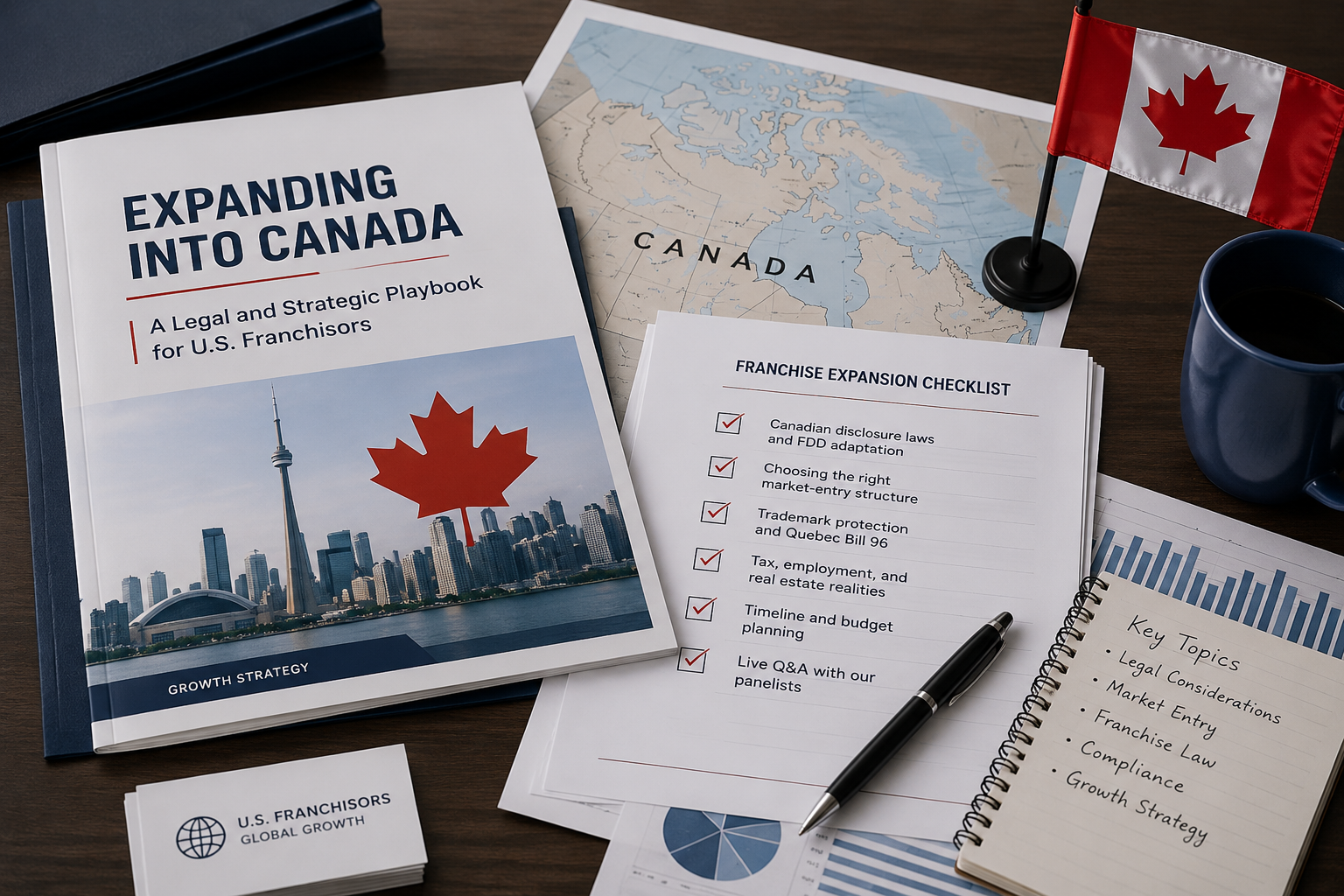
International expansion often begins with a simple assumption:
“Canada should be easy.”
The language is familiar. The culture feels similar. Consumers recognize many of the same brands. For many U.S. franchisors, Canada appears to be the logical first international market.
Ironically, those similarities create one of the greatest risks.
That was the central message of our recent executive webinar, The Great White North Growth Strategy, featuring Joseph Adler, Partner at KMB Law, one of Canada’s leading franchise attorneys. With more than three decades of advising Canadian, U.S., and international franchisors—and as a registered trademark agent—Joseph has helped countless brands successfully navigate the legal, operational, and strategic realities of cross-border expansion.
Throughout our discussion, one theme surfaced repeatedly:
Successful franchisors don’t treat Canada as another state. They treat it as another country.
That distinction changes everything.
Canada Is Familiar—But It Isn’t Simple
Many executives underestimate the complexity of Canadian expansion because the market appears so accessible.
The reality is considerably different.
Canadian franchise law operates on a provincial basis. Trademark protection must be established separately. Disclosure requirements differ significantly from those in the United States. Employment law, taxation, supply chains, real estate, and consumer expectations all require thoughtful planning.
The brands that struggle are rarely those with weak franchise concepts.
More often, they are successful U.S. systems that assume what works domestically will automatically work north of the border.
Expansion Should Be a Strategy, Not a Reaction
One of the strongest recommendations from the webinar centered on preparation.
Many franchisors begin exploring Canada after receiving interest from a prospective franchisee.
Joseph cautioned against allowing market interest to dictate expansion strategy.
Instead, successful international growth begins long before the first candidate expresses interest. It starts with leadership making a deliberate decision that Canada is part of the company’s long-term growth strategy, followed by the development of the infrastructure necessary to support that decision.
International expansion should never be opportunistic.
It should be intentional.
Documentation Is Not Translation
Perhaps the most overlooked issue discussed during the webinar was franchise documentation.
Canadian expansion is not accomplished by taking a U.S. Franchise Disclosure Document and making a few edits.
Disclosure requirements differ significantly across Canadian jurisdictions, and improperly prepared disclosure documents can expose franchisors to rescission rights extending up to two years after a franchise agreement is signed.
Likewise, franchise agreements must reflect Canadian legal requirements, standards of good faith, and provincial legislation.
As Joseph emphasized, successful Canadian expansion requires documents built for Canada—not simply documents modified from the United States.
Intellectual Property Should Be Protected Before Growth Begins
Another common misconception involves trademarks.
Many U.S. franchisors assume that a registered U.S. trademark automatically protects their brand in Canada.
It does not.
Trademark protection is territorial.
Waiting until expansion begins can expose brands to unnecessary legal challenges, delays, or even situations where another party has already secured similar rights.
Protecting intellectual property early is one of the least expensive—and highest-value—investments a franchisor can make.
Economics Must Be Revalidated
Financial models that succeed in the United States do not necessarily produce the same results in Canada.
Labor costs, occupancy expenses, distribution logistics, product sourcing, taxation, exchange rates, and purchasing behaviors all influence franchise economics.
One of the webinar’s strongest recommendations was straightforward:
Validate the business model before asking franchisees to invest in it.
Successful franchisors adapt their economics to fit the Canadian market rather than expecting Canadian franchisees to adapt to U.S. assumptions.
Build the Right Team Before Crossing the Border
International expansion is not a legal project.
It is a business initiative requiring coordinated expertise.
Joseph emphasized the importance of assembling experienced Canadian professionals, including franchise counsel, accountants, banking partners, consultants, and other specialists who understand the nuances of operating within Canada.
Equally important, organizations should designate internal leadership responsible for international growth rather than treating Canadian expansion as an extension of existing domestic responsibilities.
The Executive Takeaway
Canada continues to represent one of the most attractive international growth opportunities available to U.S. franchise brands.
The opportunity is substantial.
The market is sophisticated.
The demand exists.
Success, however, belongs to organizations willing to invest in proper planning before investing in expansion.
International growth is not simply about entering a new geography.
It is about entering a different business environment with a strategy specifically designed for that market.
As Joseph Adler demonstrated throughout this discussion, thoughtful preparation reduces risk, protects the brand, and creates a stronger foundation for sustainable long-term growth.
About the Featured Speaker
Joseph Adler is a Partner at KMB Law in Toronto and is widely recognized as one of Canada’s leading franchise attorneys. With more than 30 years of experience advising Canadian, U.S., and international franchisors, Joseph combines deep expertise in franchise law, trademark protection, distribution, and cross-border strategy. He has served as General Counsel and former Chair of the Legal Committee for the Canadian Franchise Association and continues to advise franchise systems expanding throughout North America.
His practical, business-focused approach has made him a trusted advisor to franchise brands seeking to enter and grow successfully within the Canadian market.