
Part Two of a four-part series on the American Franchise Act
Every franchise field consultant faces the same question on every visit, whether or not they recognize it. When they tell a franchisee something, are they describing the result the customer is entitled to receive, or are they making a decision about a particular employee? The first is the franchisor’s job. The second belongs to the franchisee.
The American Franchise Act (H.R. 5267) is, at its core, an effort to write that distinction into federal law. Part One of this series describes what the bill does. This installment is narrower and more practical: how the Act separates the standards a franchisor must enforce from the employment decisions that make a company someone’s employer, and why that separation matters to franchisors, franchisees, suppliers, and the lawyers who advise them.
The Starting Point: There Is No Single Federal Test Today
The debate over the AFA is often framed as though Congress were deciding whether to keep or discard one settled national joint-employer standard. Both sides do this, and both oversimplify. Federal employment law runs on at least two separate tracks, each with its own statute, history, and line of authority.
Labor relations under the National Labor Relations Act
The National Labor Relations Board’s 2023 joint-employer rule, which would have counted reserved and indirect control toward joint-employer status, never took effect. A federal district court in Texas vacated it in 2024. In February 2026, the Board removed the vacated language and returned its regulation at Section 103.40 to the text that preceded the 2023 rule.
Wages and hours under the Fair Labor Standards Act
The Department of Labor has not had a generally applicable FLSA joint-employer regulation since 2021, and the Department itself acknowledges that the federal circuits apply differing judicial tests. In April 2026, the DOL proposed a four-factor framework for vertical joint employment. It remains a proposal.
The result for a multi-state franchise system is that one analysis may govern a union-organizing charge, another may govern a wage claim, and the wage analysis may depend on which circuit hears the case. Each layer can shift when agency leadership changes. That is not a legal vacuum, but it is a moving target, and it gives Congress a sound reason to adopt a rule written specifically for the franchise relationship.
How the American Franchise Act Defines Employer Control
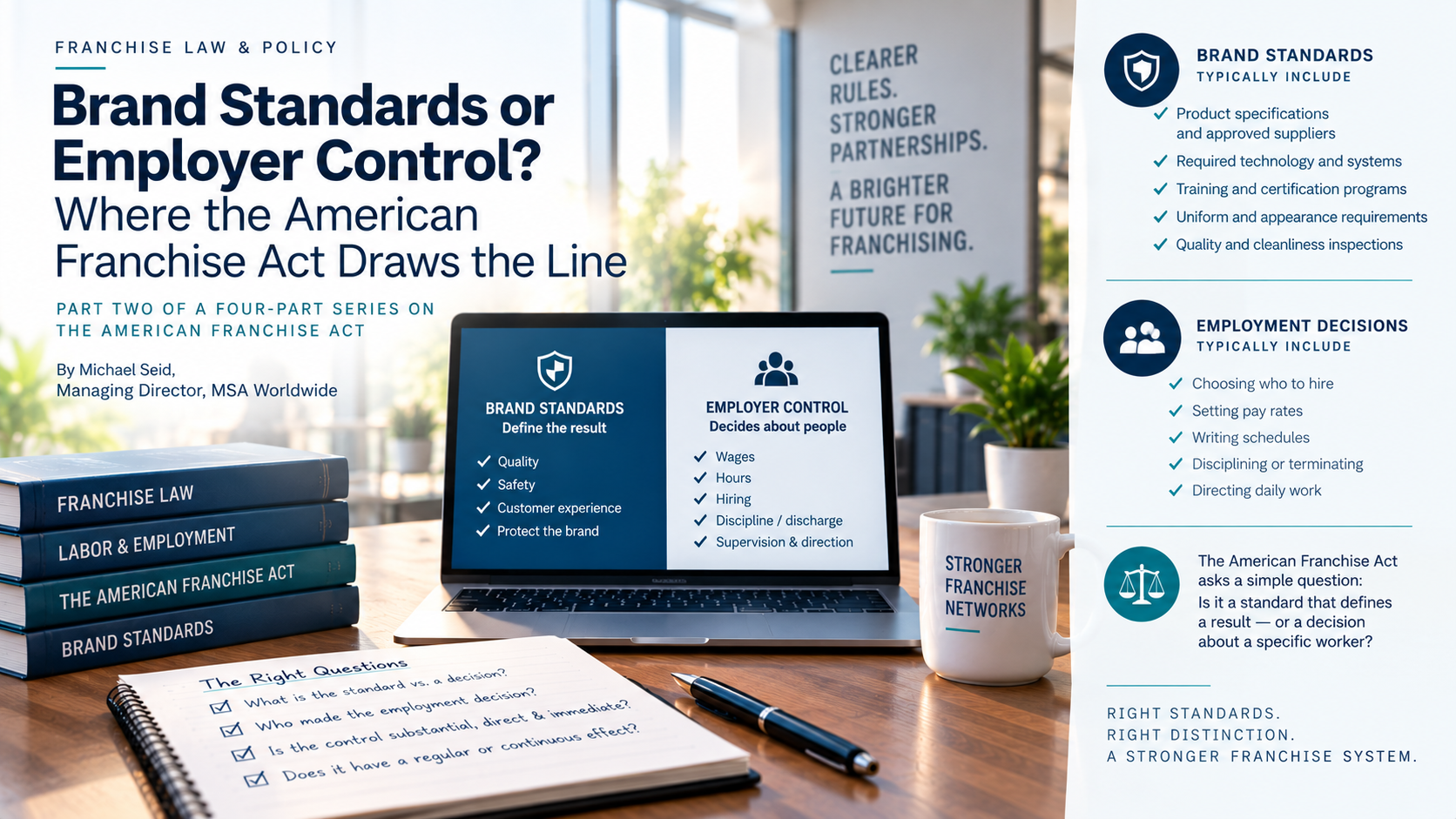
Under the bill, a franchisor may be treated as a joint employer only if it possesses and exercises substantial, direct, and immediate control over one or more essential terms or conditions of the franchisee’s employees’ employment. The amended version approved in committee goes further than a general standard: it names the conduct that crosses the line and the conduct that, standing alone, does not.
For each essential term of employment, the bill distinguishes between the two:
- Pay. The franchisor actually setting wage rates or salaries points toward employer status. Pricing products, recommending labor-cost targets, or discussing industry conditions does not, by itself.
- Hours. The franchisor actually setting employee schedules or hours points toward employer status. Requiring operating hours or minimum staffing to meet a service standard does not.
- Hiring. The franchisor deciding which individuals are hired points toward employer status. Setting lawful, safety-related, or brand-protection hiring standards does not.
- Discipline and discharge. The franchisor making the actual employment decision points toward employer status. Reporting misconduct, raising a concern, or setting minimum conduct standards does not.
- Supervision and direction. The franchisor consistently and directly instructing employees, or assigning them to schedules, positions, and tasks, points toward employer status. Providing training materials, demonstrations, brand standards, or optional tools does not.
The control must also matter. Involvement that is sporadic, isolated, or de minimis does not qualify; the bill requires control that has a regular or continuous consequential effect. In practical terms, a court is directed to ask who actually made the employment decision in dispute, rather than whose brand appears on the uniform.
Standards Define the Outcome. Employers Decide About People.
Customers do not read franchise agreements. They expect the same food safety, cleanliness, and customer service at every location carrying the brand. Meeting that expectation is not a franchisor preference; it is a legal obligation. Under the Lanham Act, a trademark owner that licenses its marks without controlling the quality of the goods and services sold under them puts the validity of those marks at risk. Trademark law requires franchisors to set and enforce standards. The problem arises when labor law treats those same standards as evidence of employment. The AFA reconciles the two obligations by asking whether a standard defines a result or whether the franchisor has made a decision about a specific worker.
A few illustrations make the difference concrete:
- A fitness brand requires every class instructor to hold a current CPR certification. This is a qualification standard. The brand has not chosen which instructor teaches the evening class or what that instructor is paid.
- A home-services brand requires background checks before any technician enters a customer’s home. This is a safety standard. The franchisee still decides whom to hire from the candidates who pass.
- A tutoring brand mandates its proprietary curriculum. This defines what students receive. It does not set tutor compensation or decide who is let go for missing sessions.
Franchise training follows the same logic. Teaching a franchisee’s managers how the system works, certifying them, and supplying materials they use with their own teams is franchisor support. If the franchisor’s staff begin directing the franchisee’s employees shift by shift, rating their performance, and deciding the consequences, the franchisor has moved from instructor to supervisor, and the Act would treat it that way.
What the Case Law Shows, Read Carefully
Two decisions appear frequently in this debate. Both are useful illustrations. Neither is a universal rule, and both were decided under California law rather than a federal joint-employer test under the NLRA or FLSA.
Patterson v. Domino’s Pizza, LLC (California Supreme Court, 2014)
The case arose from a harassment claim and turned on employment and agency principles, including vicarious liability. The court focused on the franchisee’s day-to-day authority over hiring, supervision, discipline, discharge, and workplace conduct. It also made clear that a franchisor could still be liable if it retained or assumed general control over the relevant aspects of the workplace.
Salazar v. McDonald’s Corp. (Ninth Circuit, 2019)
Workers alleged wage violations, some of which they tied to the franchisor’s technology and system settings. Applying California wage law, the court held that brand standards, training, and operating systems did not make McDonald’s the employer where the franchisee hired workers, set pay and schedules, supervised, and disciplined. The court did not say technology can never matter. It found that this record did not establish employer status under the applicable tests.
The lesson for franchise professionals is that facts decide these questions. The cases demonstrate that the distinction between brand control and employer control is real; they do not immunize anyone from inquiry.
When the Software Becomes the Supervisor
Critics of franchising make one point that deserves a straight answer: control can be exercised through a dashboard as effectively as through a district manager. Technology should not get a pass. Equally, it should not create liability simply by being deployed.
Signs that a system’s technology has become employer control:
- Wage fields are locked so the franchisee cannot change pay rates.
- The platform generates schedules the franchisee cannot override.
- The franchisee cannot correct a setting that produces a legal violation.
- Software configured by the franchisor selects which employee is disciplined or terminated.
Signs that it remains support:
- A scheduling tool the franchisee configures and controls.
- A model employee handbook the franchisee adapts with its own counsel.
- A staffing recommendation the franchisee is free to accept or reject.
DOL’s 2026 proposal moves in a similar direction. It gives more weight to control actually exercised than to authority merely reserved, recognizes that mandatory indirect direction can count, and declines to decide joint-employer status based on a business model in the abstract. The American Franchise Act goes further by setting a statutory line for franchising specifically. That is a policy choice Congress is entitled to make.
The Real Cost of Leaving the Line Blurry
Legal uncertainty changes behavior inside franchise systems. When counsel cannot say where support ends and employment begins, the cautious advice is to do less: limit field staff conversations about staffing, retreat from HR templates and compliance resources, and keep management coaching at arm’s length. Each of those choices may reduce the franchisor’s litigation exposure.
But the franchisee pays for that caution. Owners who invested their savings in a system for its know-how receive less of it; their managers receive less training; their employees work in businesses with fewer compliance resources. A legal standard that rewards franchisors for being less helpful protects no one.
The better rule, and the one the AFA adopts, is straightforward: hold franchisors accountable when they act as employers, and let them support independent owners when they do not.
Practical steps while the bill is pending
The AFA is not yet law, so current standards still govern. Franchise systems can reduce risk now without withdrawing support:
- Review field-staff communications to confirm they address outcomes and standards, not decisions about individual employees.
- Audit technology configurations to determine who can change pay, schedules, and personnel actions in practice.
- Make sure tools labeled “optional” are genuinely optional in how they are deployed and enforced.
- Confirm that franchisee managers make, and document, their own hiring and disciplinary decisions.
- Work with experienced franchise counsel; these steps are management practices, not legal advice.
Moving the American Franchise Act Forward
What happens next: House leadership must schedule a floor vote. The Senate must then act, either through a HELP Committee markup or by taking the bill directly to the floor, where legislation of this kind typically needs 60 votes to overcome a filibuster. The White House has publicly signaled support. Time is the constraint: the 119th Congress ends on January 3, 2027, and any bill not enacted by then must be reintroduced and start over in the next Congress.
What You Can Do This Week
Members of Congress hear from trade associations regularly. They hear far less often from constituents who own, operate, or supply businesses in their own districts. That direct contact carries weight.
- Find your lawmakers. Use the “Find Your Representative” tool at house.gov and the senator directory at senate.gov.
- Introduce yourself as a constituent. State your role (franchisee, franchisor, supplier, or advisor) and, where relevant, how many locations and employees you have in the district or state.
- Make a specific request. Ask your House member to support H.R. 5267 and urge leadership to schedule a floor vote, and to cosponsor it if they have not. Ask your senators to cosponsor S. 3525 and press for HELP Committee action.
- Tell them what the uncertainty costs. One or two sentences about the support you give or receive, and what an unclear standard does to it, is more persuasive than a page of talking points.
The International Franchise Association also maintains advocacy resources for members who want help preparing outreach.
Conclusion
Franchising works because responsibility is divided. The franchisor is responsible for the brand: its standards, its systems, and the customer’s experience. The franchisee is responsible for its business and its people. The American Franchise Act asks courts to respect that division and to hold franchisors fully accountable when they step across it. That clear rule will serve workers, owners, and brands better than one that shifts with each administration.
Congress has the opportunity to draw that line before this session closes. Whether it does may depend on how many people who work inside franchise systems take the time to explain why it matters.
This is Part Two of a four-part series. Part One describes the American Franchise Act. Part Three examines the progressive case against franchising. Part Four presents the case for passage of the Act.
Michael Seid is Managing Director of MSA Worldwide. You can reach him at mseid@msaworldwide.com or 860-523-4257.