
The seller you hire becomes the voice of your brand
Every franchise relationship begins with a conversation. Someone explains the opportunity, answers the prospective franchisee’s questions, walks through the Franchise Disclosure Document, and helps the prospect decide whether to write a very large check. If you have outsourced that conversation to a franchise sales organization (FSO), the person across the table is not your employee. To the buyer, though, that person is your brand.
This is why the Federal Trade Commission’s recent action involving the Premier Martial Arts franchisor and its former FSO deserves attention from every franchisor that relies on outside sellers. The FTC’s action puts a practical question on the table: if the company selling your franchises has settled an enforcement action over its sales practices, should your prospective franchisees hear about it?
My business answer is yes. I want to be clear about where I stand, however. I am not an attorney, and nothing here is legal advice. What I offer is the view of someone who has spent decades helping franchisors build their systems and who has served as an expert witness in franchise litigation, where I have watched sales decisions get picked apart after the relationship has failed. Franchise counsel must decide what the law requires, and where the information belongs. Management must decide what kind of recruitment process it wants to defend.
If it were my system, I would need a compelling reason to keep a relevant piece of my seller’s history from someone I was asking to invest their savings in my brand.
The FTC case in brief
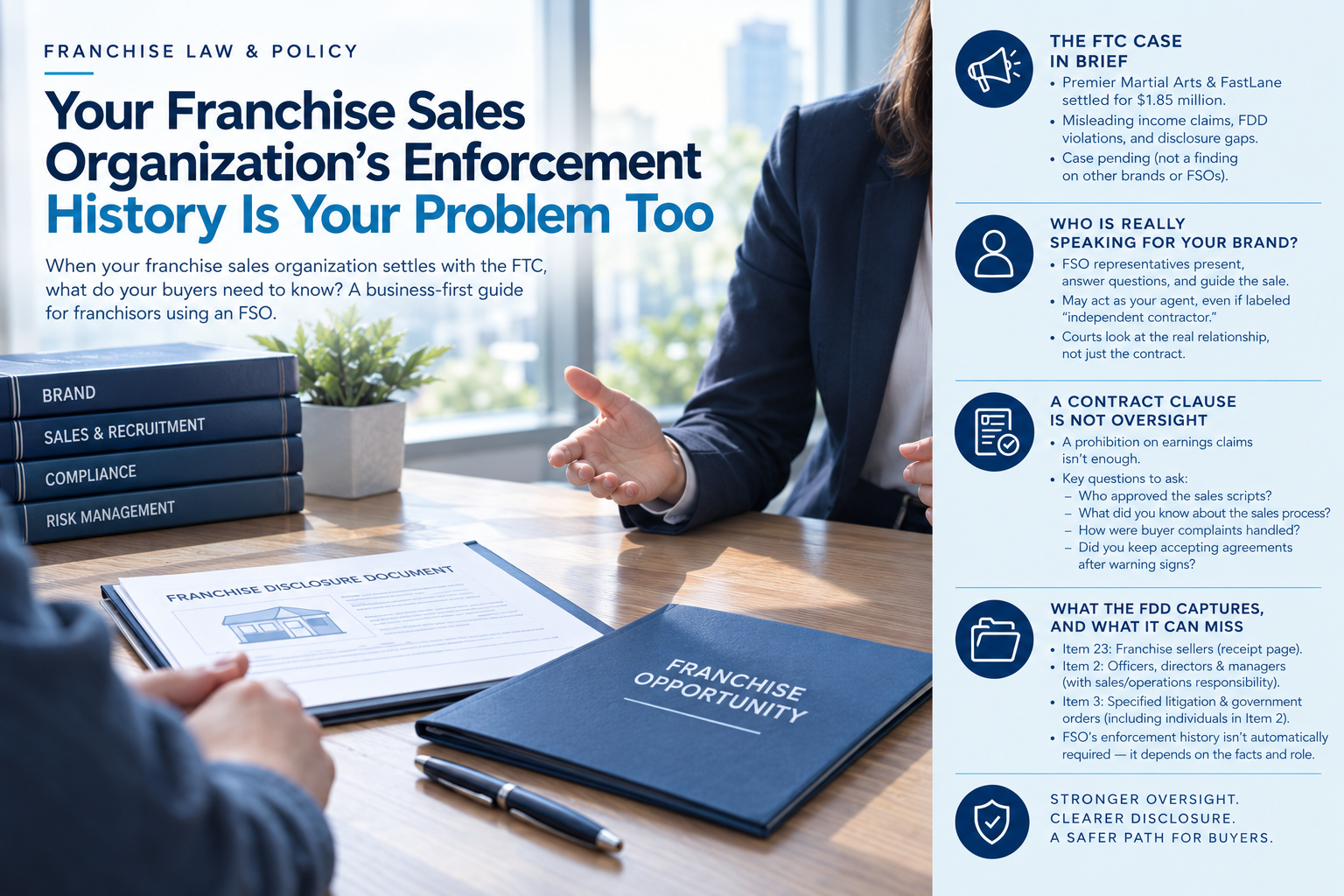
In early October 2026, the FTC announced proposed settlements with Premier Franchising Group, LLC (PFG), franchisor of Premier Martial Arts, and Franchise Fastlane, LLC (FastLane), the FSO that previously handled its sales. The two would pay $1.85 million combined: $1.2 million from FastLane and $650,000 from PFG.
The allegations center on how the franchise opportunity was pitched. According to the FTC, prospects were told that people without martial arts experience could run one or more studios profitably on a semi-absentee basis, working under 15 hours a week. The agency also alleges Franchise Rule violations including financial performance representations that did not appear in the FDD. Under the proposed order with PFG, certain franchisees would be allowed to cancel their franchise agreements without penalty.
One allegation should get every franchisor’s attention: The complaint asserts that PFG did not identify FastLane personnel who had management responsibility for franchise sales. In other words, the people actually running the sale mattered for disclosure purposes, even though they worked for a different company.
As of this writing, the FTC lists the case as pending, and the proposed orders still need court approval. The case is not a finding about any other brand or any other FSO.
Who is really speaking for your brand?
Think about the sale from the buyer’s side of the table. You hand the lead to the FSO. Its representatives present the opportunity, explain the FDD, schedule Discovery Day, coordinate approval, and shepherd the buyer to signing. At no point does the buyer have reason to think of these people as anything other than your representatives.
Your FSO agreement may call the firm an independent contractor. That label helps, but it does not settle the matter. An outside company can still act as your agent when it sells your franchises, and courts look at how the relationship actually operates, not only at what the contract says. Many states, California among them, recognize that a business can be bound when it leads others to believe someone speaks for it, or when it accepts the benefits of that person’s conduct after the fact. Ask counsel to review both the contract and the day-to-day reality.
A contract clause is not oversight
Most FSO agreements prohibit unauthorized earnings claims. Good. But a prohibition you never check is a hope, not a control. If a sale is challenged, expect questions like these:
- Who approved the sales presentation and scripts?
- What did the franchisor know about how its franchises were being sold?
- How were buyer complaints handled, and by whom?
- Did the franchisor keep accepting signed agreements after warning signs appeared?
None of those questions depends on whether the FSO’s prior settlement belonged in your FDD. They go to how you supervised your own recruitment process.
What the FDD captures, and what it can miss
Three FDD items bear directly on outside sellers. Item 23 is the receipt page that names the franchise sellers involved in the offer. Item 2 identifies the franchisor’s officers, directors, and others with management responsibility for selling or operating franchises. Item 3 requires disclosure of specified litigation and government orders involving the franchisor and certain related parties, including the individuals listed in Item 2.
Notice what is not automatically there. The Franchise Rule does not, on its own terms, require an outside sales company’s enforcement history to appear in your FDD. Whether it must depends on the facts, and the most important fact is the role the FSO’s people actually play.
Referrer or manager?
FTC guidance distinguishes a broker who simply refers prospects from someone with genuine management responsibility for franchise sales. Working for a separate company does not, by itself, keep a person out of Item 2. So start with an honest description of the arrangement. Is your FSO introducing prospects and handing them to your team? Or are its people running the recruitment process from first call to signature?
Once FastLane’s proposed order takes effect, it will bind certain of its officers, agents, employees, and others who receive notice of it. If any of those individuals manage sales for another franchisor, counsel should consider whether that franchisor now has something to disclose. Not appearing as a named defendant does not necessarily resolve the question. The proposed order also makes clear that a franchisor does not become subject to it merely because it once hired FastLane.
You cannot simply add everything
The FDD is not an open notebook. The Franchise Rule generally bars franchisors from adding information it does not require unless state law requires or permits it. Counsel has to decide whether an FSO’s settlement belongs in Item 3, in a state-specific addendum, or in a separate written notice delivered during the sales process. What I would not accept is the assumption that, because it may not belong in the FDD, it belongs nowhere.
Your exposure does not end at the Franchise Rule
A franchisee cannot sue under the FTC Franchise Rule itself. That fact gives some franchisors more comfort than it should. State law offers other paths.
A number of state franchise statutes make it unlawful to sell a franchise through an untrue statement of material fact, or by leaving out a material fact needed to keep what was said from being misleading. Several of those laws allow buyers to recover damages, and some permit rescission of the franchise agreement. State deceptive trade practices laws can come into play as well. Satisfying federal disclosure requirements, in short, does not close the question of how a franchise was sold.
How an omission claim takes shape
Picture a franchisor whose recruitment materials praise the experience and integrity of its sales partner, while saying nothing about that partner’s recent settlement over franchise sales practices. Two years later, a struggling franchisee’s lawyer asks a simple question: did that flattering description tell the whole story?
The franchisor will answer that the settlement involved a different brand and different facts. That may be entirely true. But the franchisor chose that company to run its sales process, and a judge, jury, or arbitrator may wonder why its history was treated as irrelevant. The franchisee still carries the burden of proving the omission mattered, that the required intent existed, and that it caused real harm. You do not want to be the test case for how hard that burden is to meet.
The selection decision itself
A buyer may also challenge your judgment in choosing the FSO and in keeping it after problems surfaced. Some courts have recognized claims for negligently selecting an outside contractor in other contexts. Those claims have real limits, and a franchisee’s financial loss does not prove the franchisor was careless. Still, you should be able to explain, with documents, what you did once you learned of the enforcement action:
- Did you compare the conduct alleged in the complaint with your own sales materials and scripts?
- Did you review buyer complaints and listen to how your brand was actually being presented?
- Did you change training, tighten approvals, or require better reporting from the FSO?
- Did you put that review in writing?
Disclosure is one part of a responsible response. Confidence that the FSO’s current work on your brand meets your standards is the other.
Regulators are turning their attention to third-party sellers
The recent FTC action is not an isolated signal. Over the past two years, regulators have been building rules aimed squarely at the people who sell franchises on someone else’s behalf.
California SB 919. Signed in September 2024, this law creates a registration and disclosure framework for franchise brokers, a definition broad enough to reach many FSOs because it turns on what a firm does rather than what it calls itself. Brokers will have to provide prospective buyers with a broker disclosure document. Implementation depends on state funding, with the program starting on the later of July 1, 2026, or one year after the necessary appropriation.
The NASAA Model Franchise Broker Registration Act. The North American Securities Administrators Association adopted this model act on May 4, 2026. It contemplates registration of broker firms and their individual representatives, disclosure to buyers before a specific opportunity is discussed, and coverage of material litigation and broker compensation. It would also bar franchisors from using unregistered brokers. A model act binds no one until a state adopts it, but it shows where state regulators are heading.
Seller disclosure forms you may already file. NASAA’s Form D, the franchise seller disclosure form used in state registration filings, asks about each seller’s background, specified litigation, and government orders. New York’s version expressly reaches independent third parties that provide sales services. A form filed with a regulator is not the same as information delivered to a buyer, so review both with counsel rather than assuming one satisfies the other.
The direction is unmistakable: Buyers will increasingly be expected to understand not only the franchise offering, but also the organization presenting it. Franchisors that get ahead of that expectation will have an easier time than those forced to catch up.
A working plan for franchisors that use an FSO
Here is how I would approach it if a client’s sales organization were the subject of an enforcement settlement.
- Hold a joint review with counsel. Management explains exactly how the FSO handles sales and who makes the key decisions. Counsel reviews the settlement, any order in effect, who must appear in Item 2, and the requirements of every state where you offer franchises.
- Choose the right channel. If the information belongs in the FDD, a side letter is no substitute. If it does not, ask counsel how to deliver it in a separate written notice that complies with the Rule and state law.
- Write it plainly. Name the company and describe the matter. State whether the settlement is still awaiting approval or has taken effect. Separate allegations from findings, describe the FSO’s role with your brand, and say so if your company was not involved. Describe improvements only if they have actually been made.
- Give the buyer time. Deliver the information early enough that the buyer can ask questions while walking away is still a real option. Keep a record of what was delivered and when.
- Make sure every channel tells the same story. Your website, sales calls, Discovery Day presentation, and FDD should all be consistent.
- Audit the seller, not just the paperwork. Review the FSO’s people, scripts, and practices on your brand, and document what you found and changed.
An indemnity from the FSO can help the two companies divide costs if something goes wrong. It will not make a buyer’s claim against you disappear.
Common mistakes I see
- Treating the FSO’s history as the FSO’s problem. The buyer signs your franchise agreement, not theirs.
- Relying on the contract instead of supervision. A no-earnings-claims clause means little if no one listens to the sales calls.
- Overcorrecting with an unreviewed disclosure. A well-meaning notice drafted without counsel can create new problems, including an inaccurate summary of the case.
- Disclosing at the signing table. Information delivered when the buyer has no practical chance to reconsider does little for the buyer or for you.
- Assuming silence is safer. Silence may be defensible. It is rarely the choice that best protects the system over time.
If you are the buyer: questions worth asking
Prospective franchisees do not have to wait for a franchisor to volunteer this information. Before you sign, ask:
- Am I speaking with an employee of the franchisor or with an outside sales organization? If outside, what is the firm’s name?
- How is the salesperson or firm paid, and does the compensation depend on my signing?
- Has the sales organization or any of its principals been involved in franchise-related litigation or regulatory action?
- Is everything I have been told about earnings or time commitment reflected in Item 19 of the FDD? If not, why not?
- Who at the franchisor can I speak with directly, without the sales organization present?
Then take the FDD and your answers to an experienced franchise attorney and talk with current and former franchisees. A seller who is uncomfortable with these questions has told you something useful.
Frequently asked questions
What is a franchise sales organization?
An FSO is an outside company a franchisor hires to recruit and sell franchises on its behalf. Depending on the arrangement, it may generate leads, present the opportunity, guide buyers through the FDD, and manage the process through signing. It is usually paid when a franchise agreement is signed.
Does the FTC Franchise Rule apply to FSOs?
The Franchise Rule applies to franchise sellers, and the Premier Martial Arts action shows the FTC is willing to pursue a third-party seller directly. Whether a particular FSO’s people must be identified in a franchisor’s FDD depends on their actual role and responsibilities, which is a question for counsel.
Must an FSO’s settlement appear in Item 3 of my FDD?
Not automatically. It depends on whether FSO personnel fall within Item 2, whether an order applies to them, and what state law requires. Counsel should make that call based on how the relationship actually works.
If it is not required, should I disclose it anyway?
From a business standpoint, I believe relevant enforcement history should reach the buyer in a form counsel has reviewed, whether in the FDD where required or permitted, or in a separate notice. The Rule limits what you can add to the FDD, so the channel matters.
Does an indemnity clause protect me?
It can shift costs between you and the FSO. It does not stop a franchisee from bringing a claim against you.
Recruitment is part of the system, not a department
No disclosure guarantees that a franchisee will never sue. What timely, accurate disclosure does is create a record that the buyer had the relevant facts before investing, and had time to weigh them. It also forces management to look hard at how its franchises are being sold. Both are worth having, even when counsel believes silence could be defended.
In my experience, the strongest franchise systems treat franchisee selection as part of the business model. The aim is franchisees who understand what they are buying, can operate successfully, and begin with realistic expectations. A sales process that promises what the system cannot deliver works against every one of those goals, and its consequences eventually land in operations, in field support, and in franchisee relations.
My recommendation for any franchisor using an FSO is straightforward. Disclose relevant enforcement settlements involving that organization factually and through the proper channel, including the FDD where it is required or permitted. Pair that disclosure with a documented review of the FSO’s people, presentations, and practices. Let counsel define what the law requires, and let management decide what protects the brand.
The people selling your franchises set the expectations on which every franchise relationship is built. Their conduct, and their history, are your business.
Michael Seid is Managing Director of MSA Worldwide. You can reach him at mseid@msaworldwide.com or 860-523-4257.