
Part Four of a four-part series on the American Franchise Act.
Every franchise system rests on a bargain. The franchisor contributes a tested concept, a trademark customers trust, and the operating knowledge to run the business well. The franchisee contributes capital, local judgment, and a willingness to answer for the results. That bargain only holds if the law recognizes who carries which responsibilities.
The American Franchise Act (H.R. 5267) asks Congress to write that recognition into federal labor law. Earlier installments in this series explained what the bill says, why brand standards are different from employment decisions, and how the arguments against the bill hold up. This final piece takes a step back and asks what we are actually protecting when we protect the franchise relationship. My answer is the independent owner, and the path into ownership that franchising opens for people who would otherwise never take it.
What Franchising Really Sells
Franchising does not sell success. Nobody should buy a franchise believing otherwise. Concepts that worked in one market can stall in another. Some franchisors grow faster than their support infrastructure can handle. Some franchisees choose poor sites, undercapitalize, or fail to meet the standards of the system they paid to join.
What franchising does sell is a better starting position. A person who never invented a product, never built a brand, and never designed an operating system can acquire all three, invest their own money and effort, and build equity in a business they own. In well-run systems, the progression from hourly employee to manager to franchisee to multi-unit operator is a real career path. It is not universal, and it is not automatic, but it happens often enough to matter to the economy and to the families involved.
Who Franchise Owners Actually Are
Policy debates about joint employment tend to picture a national corporation directing a workforce through local stand-ins. The data paints a different picture.
The International Franchise Association’s 2026 Franchising Economic Outlook projects roughly 845,000 franchised establishments, nearly 8.9 million franchise jobs, and about $921.4 billion in economic output this year. Those figures tell Congress how large the system is. They do not tell Congress whether every system is well run, and they should not be read that way.
More telling is who owns those locations. An IFA-commissioned report by Oxford Economics, drawing on a survey of nearly 3,000 franchisees and payroll data, found that 82% of franchisees own a single location, 85% live and work in the communities they serve, 64% are first-time business owners, and 30% say they would not own a business at all without franchising. Because the research was industry-sponsored, its methods deserve scrutiny. Even so, the findings describe a sector built largely on local, first-generation owners who spend their days on payroll, rent, staffing, and customer problems, not legal theory.
What the American Franchise Act Does, and What It Leaves Alone
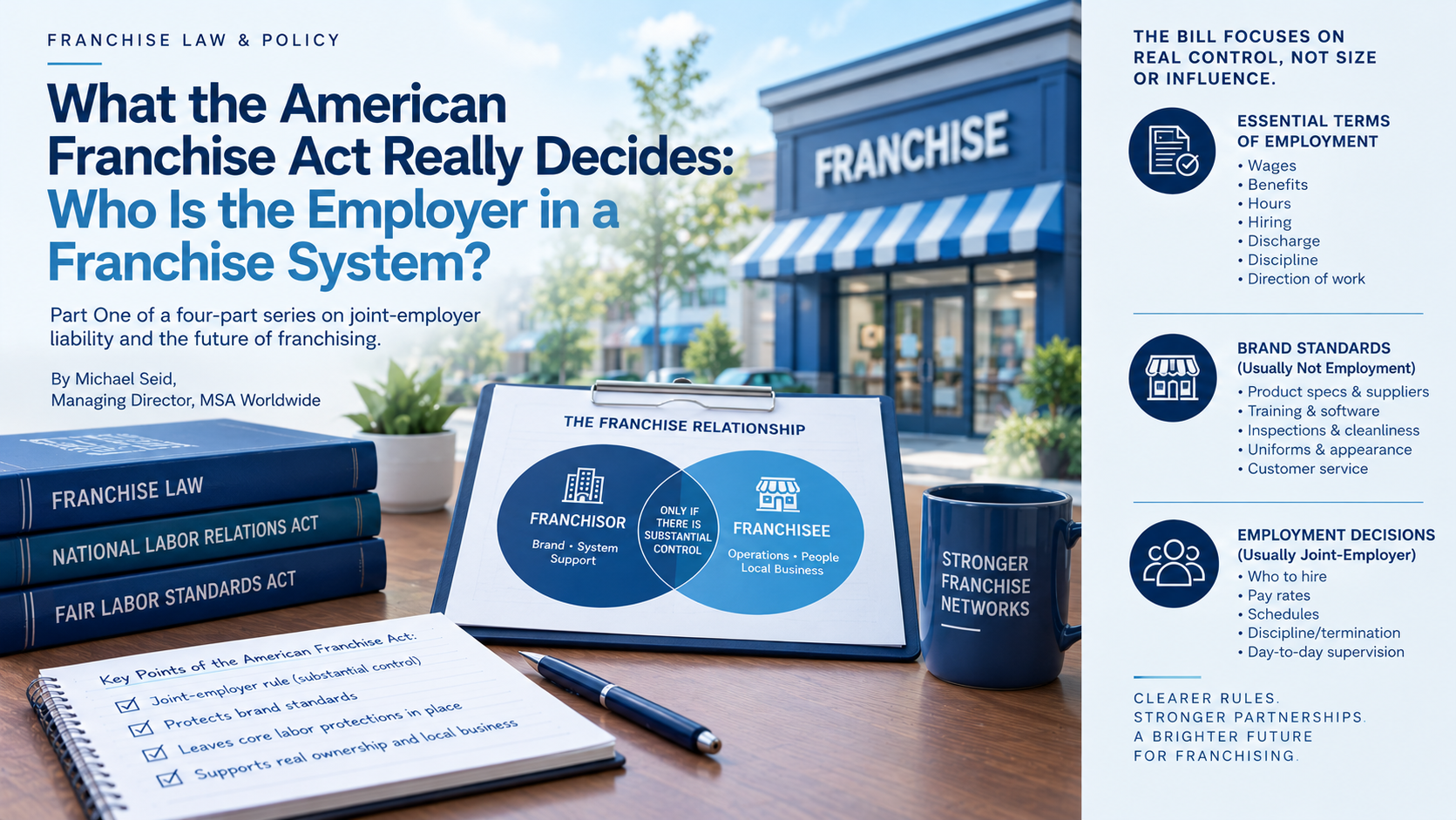
The bill creates a franchise-specific rule for joint-employer status. Under it, a franchisor is treated as a joint employer of a franchisee’s workers only if it possesses and exercises substantial, direct, and immediate control over essential terms of employment: wages, benefits, hours, hiring, discharge, discipline, supervision, and direction. The provision would be added to the National Labor Relations Act, and the same criteria would apply under the Fair Labor Standards Act.
Just as important is what the bill does not touch: Minimum-wage and overtime requirements remain. So do collective bargaining rights, federal anti-discrimination law, workplace-safety obligations, and state employment protections. The franchisee is still the employer, and still accountable for compliance.
I want to be precise here, because overstating the case helps no one. The bill does have consequences. It affects which parties a worker can name in a claim and which parties must come to a bargaining table. The argument for passage is not that it changes nothing — the argument is that employer liability should follow employer conduct, not the mere existence of a franchise agreement.
Brand Standards Are a Legal Duty, Not a Power Grab
There is a reason franchisors set standards in the first place. Under the Lanham Act, a trademark owner that licenses its mark is expected to control the quality of the goods and services sold under it. A licensor that fails to do so risks weakening or even losing its trademark rights. When a franchisor specifies recipes, cleanliness protocols, or service procedures, it is doing what trademark law expects of it. Treating that obligation as evidence of employment puts franchisors in an impossible position: protect the brand and risk joint-employer liability, or step back and risk the mark.
Where the Line Falls in Day-to-Day Operations
Joint-employer questions are always fact-specific, and franchisors should rely on qualified counsel for their own systems. As a practical matter, though, the distinction the AFA draws looks something like this:
- Activities that generally protect the brand include setting product, safety, and appearance standards in the operations manual; training franchisees on system procedures; requiring point- of-sale or other technology that keeps the customer experience consistent; and conducting field visits to evaluate compliance with those standards.
- Activities that move toward acting as an employer include setting pay rates for a franchisee’s staff, approving or rejecting individual hires, building employee schedules, disciplining or terminating franchisee employees, or supervising those employees’ daily work.
The first list describes a franchisor running a brand. The second describes a franchisor running someone else’s workforce. The AFA treats them differently, because they are different.
The Cost of a Moving Target
According to the IFA, the joint-employer standard has changed four times in the last decade. Each change sends franchisors back to their lawyers, and the advice that comes back is predictable: say less, help less, stay away from anything that touches staffing.
The result is that franchisees, especially first-time owners, receive the least support in the areas where an experienced system could help them most. Recruiting guidance gets watered down, and HR resources disappear from the intranet. Field consultants learn to change the subject when a franchisee asks how to handle a difficult employee. Lenders and investors, meanwhile, have to price in a rule that may look different after the next election.
No one should promise that the American Franchise Act will set off a wave of new business formation or end joint-employer litigation. It addresses two federal statutes; state-law theories such as vicarious liability will continue to be argued under existing state law. What a statute can do that an agency rule cannot is provide durability. Congress, not shifting agency majorities, would set the standard.
Mistakes Franchisors Should Avoid Regardless of What Congress Does
The AFA is not a license to manage franchisee workforces. A franchisor that actually exercises substantial, direct, and immediate control would still be a joint employer under the bill, and that is as it should be. Franchisors should use this moment to review their own practices:
- Watch for operations manuals that blend mandatory brand standards with employment policies. If you offer HR guidance, label it clearly as an optional resource the franchisee may adopt or reject.
- Look closely at mandated technology. Scheduling or labor-management software with franchisor-set parameters can quietly turn a support tool into a control mechanism.
- Train field staff on the boundary. A field consultant who weighs in on whether a franchisee should fire a specific employee can create exposure no manual language will undo.
Where the American Franchise Act Stands Now
What remains is the hard part. The full House must schedule and pass the bill. The Senate must act, either by moving the House-passed bill or advancing its own version. Any differences between the chambers must be resolved before the bill goes to the President for signature. And time matters, because the 119th Congress ends on January 3, 2027, and any bill not enacted by then expires and must start over in the next Congress.
What You Can Do This Week
Members of Congress respond to constituents, and franchising has an unusually strong constituent story: local owners, local jobs, local tax dollars. Ask your House member to vote yes on H.R. 5267 when it reaches the floor, and ask your senators to support the Senate companion bill and press for a vote before this Congress ends.
You can find your Representative at house.gov and your Senators at senate.gov.
The Question Congress Is Being Asked
Congress is not being asked whether franchising is perfect or whether every franchisor treats its franchisees fairly. It is being asked a narrower question: should responsibility under two of the country’s most important labor statutes follow actual control over employment, or a looser and ever-changing theory of commercial influence?
The American Franchise Act answers that question the right way. A franchisor that behaves like an employer would be treated like one. A franchisor that protects its brand, trains its network, and holds owners to the standards they agreed to would not. The franchisee, the person who signs the paychecks and makes the hiring decisions, remains the employer and remains accountable.
Ownership has to mean something, legally and practically, or fewer people will pursue it. Congress has a window to settle this before the session ends. Pick up the phone, send the email, and ask your representative and senators to pass the American Franchise Act.
Michael Seid is Managing Director of MSA Worldwide. He can be reached at mseid@msaworldwide.com or 860-523-4257.