
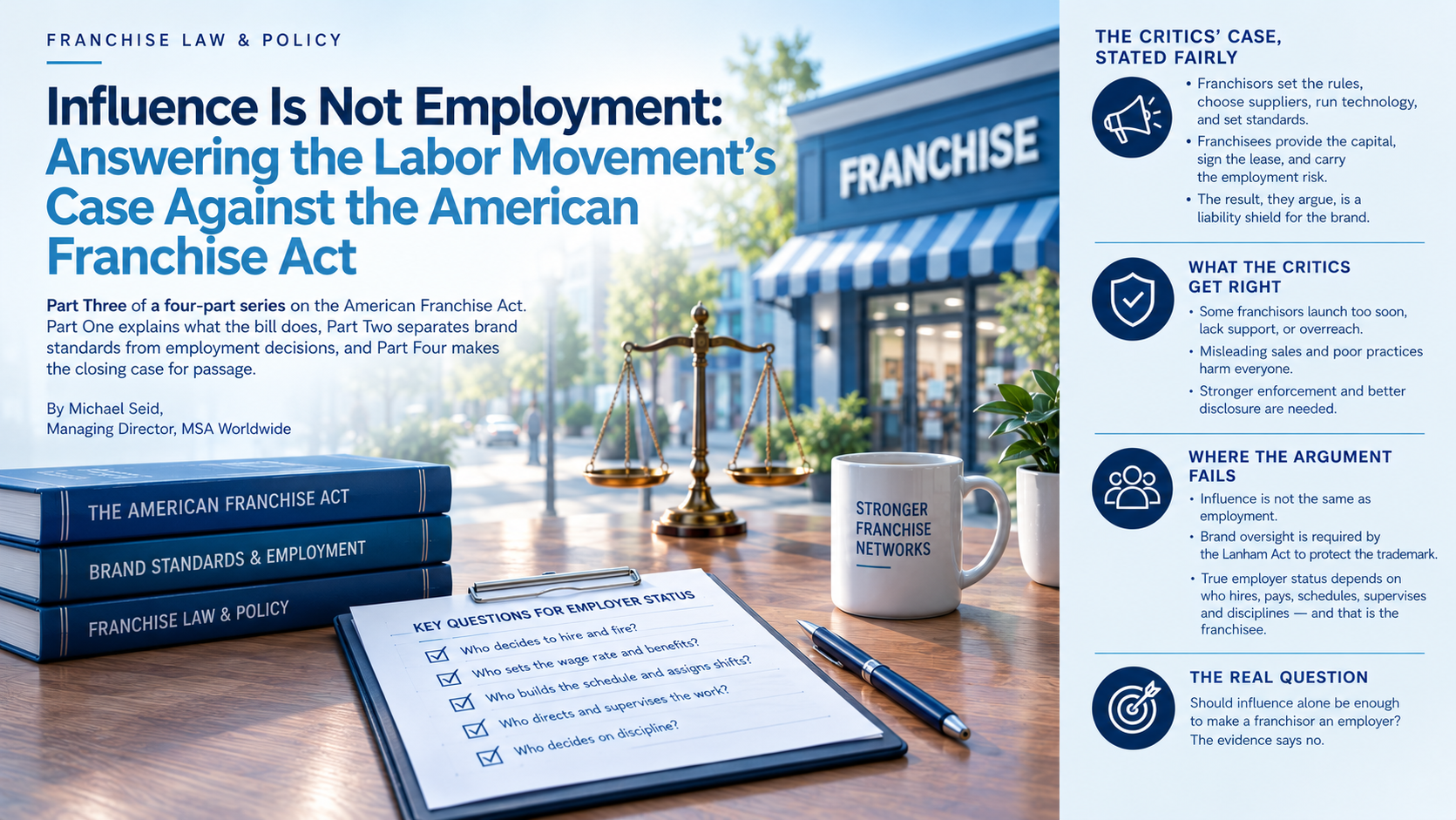
Part Three of a four-part series on the American Franchise Act. Part One explains what the bill does, Part Two separates brand standards from employment decisions, and Part Four makes the closing case for passage.
Every serious debate over the American Franchise Act eventually reaches the same question: when a national brand shapes nearly everything about how a local business runs, why shouldn’t the brand answer for the people who work there?
The Critics’ Case, Stated Fairly
The argument against the bill runs roughly like this. Franchisors write the rules, choose the suppliers, run the technology, and set the standards; franchisees put up the money, sign the lease, and carry the employment risk. When something goes wrong, such as unpaid overtime or an unfair labor practice charge, the franchisor points to the franchise agreement and says the franchisee is the employer. In this view, the local owner functions as a liability shield for decisions made at headquarters.
The most capable recent version of this argument is Brian Callaci’s Chains of Command: The Rise and Cruel Reign of the Franchise Economy, published this year by the University of Chicago Press. Callaci builds on the ground David Weil covered in The Fissured Workplace, and in my judgment he makes the case more effectively. I have written about his earlier work at length. A book this well constructed deserves a response, not dismissal.
Organized labor has carried the same theory into the legislative fight. The AFL-CIO sent House members a letter opposing the AFA in December 2025, and a coalition of labor and allied groups followed with a letter in March 2026 arguing that the legislation would leave franchisees and workers holding responsibility for conditions the brand dictates. In the interest of full disclosure, I belong to the National Writers Union, UAW Local 1981, which is affiliated with the AFL-CIO. I respect the labor movement. I also think it is wrong on this question.
What the Critics Get Right
Before explaining where the argument fails, it is worth being honest about where it lands.
Some franchisors launch before their unit economics are proven. Some collect initial fees and royalties without delivering the support their disclosure documents describe. Some impose new equipment, technology, or remodel requirements with little understanding of what those mandates cost an individual operator. Some hand franchisee recruitment to outside sales organizations that care more about closing a deal than finding the right owner, and then blame the franchisee when the fit is poor. And some franchisors want maximum control when control generates revenue, then claim complete separation the moment a lawsuit arrives.
Those practices are real, and they damage everyone in franchising, including the good systems. Workers who are owed wages should be paid; franchisees who were misled should have meaningful remedies. A franchisor that actually takes over employee hiring, pay, scheduling, or discipline should be treated as an employer.
But notice what those problems call for: stronger enforcement, better disclosure, and accountability for franchisors who cross the line. They do not call for a rule that treats every franchisor as the employer of workers it never hired, never paid, and never supervised.
The Step in the Argument That Fails
The critics’ reasoning starts on solid ground. Franchisors do have substantial commercial influence over their franchisees. The trouble is the next step, which treats that influence as though it were employment.
A franchisor’s influence is not optional. Under the Lanham Act, a trademark owner that licenses its mark is expected to control the quality of the goods and services offered under it. A brand that lets licensees do whatever they want risks weakening or even losing its trademark rights. In other words, the law requires franchisors to set and police standards. It would be strange for one body of federal law to require that oversight while another treats the same oversight as evidence of an employment relationship.
Consider the questions that actually identify an employer:
- Who decided to hire this person, and who can fire her?
- Who set her wage rate and her benefits?
- Who built this week’s schedule and assigned her shifts?
- Who directs and supervises her work during the shift?
- Who decides whether she is disciplined, and how?
In a properly run franchise system, the answer to each question is the franchisee. A franchisor’s approved supplier list, required point-of-sale system, operating hours, and customer service standards all affect the economics of the business. They do not answer any of the questions above.
Plenty of other parties shape small businesses this way. Lenders impose covenants; landlords restrict use and hours; insurers require safety practices; large customers dictate specifications and delivery terms. We regulate those relationships when they become abusive, but no one argues that a bank is the joint employer of its borrower’s staff. Expanding employer status to whichever party has the most recognizable name or the largest balance sheet is not a test of employment — it is a search for a more collectible defendant.
The same pattern shows up outside labor law. Franchisors regularly face vicarious liability claims under state tort law that try to convert brand oversight into responsibility for a franchisee’s day-to-day operations. The American Franchise Act does not address those state-law claims; its scope is the National Labor Relations Act and the Fair Labor Standards Act. But the underlying logic is the same: control over the brand is not control over the workforce.
The Person Missing from the Critics’ Story
The critique works best when the franchise owner fades into the background. Bring that person back into view, and the picture transforms.
The franchisee is the one who raises or borrows the capital, signs the lease, personally guarantees the debt, recruits and hires the staff, runs payroll, files the taxes, and absorbs the loss if the location fails. That is not a branch manager. That is a business owner.
Callaci describes franchisees as “tenant entrepreneurs,” and the label captures something real. Franchisees do operate inside a system someone else designed. But every business owner operates inside constraints set by others, including lenders, landlords, regulators, insurers, vendors, and customers. Working within constraints does not erase ownership, and it does not transfer employment decisions to whichever party in a contract has more bargaining power.
It is also a mistake to picture franchisees as uniformly small or inexperienced. Many are sophisticated multi-unit operators running several brands across multiple markets. Some are excellent employers, and some are not. Some follow wage-and-hour law carefully and some violate it. That variation is the point. These are independent owners making their own employment decisions, and they should be accountable for them. Any account of franchising that only holds together by making the owner disappear is incomplete.
Follow the Organizing Math
To understand why the joint-employer standard has become so contested, look at the labor market numbers.
According to the Bureau of Labor Statistics, union membership stood at 20.1 percent of wage and salary workers in 1983 and had fallen to 10.0 percent by 2025. In the private sector, it was 5.9 percent. In food services and drinking places, it was 1.8 percent. That last figure describes an enormous workforce with almost no union presence.
Franchising is a large part of why that workforce is hard to organize. The brand on the sign is national, but the employers behind it are local: thousands of separately owned companies, each with its own employees, managers, and labor market. Organizing one location at a time is slow, costly, and uncertain.
Callaci himself drew this contrast in a 2024 essay comparing the Starbucks union campaign with fast-food organizing. Starbucks offered organizers a single, vertically integrated national employer. Dunkin’ and most franchised restaurant systems present thousands of separate employers. A broad joint-employer rule is a way to close that gap by giving organizers one national company to pressure and, potentially, to bring to the bargaining table.
What the McDonald’s Case Actually Showed
The Service Employees International Union has been the leading institutional force behind this strategy. Its fast-food campaign, launched with strikes in 2012, was formally called the Fight for $15 and a Union, and SEIU’s own materials identify McDonald’s as the campaign’s central corporate target. The wage demand got the attention. The union objective was always part of the name.
McDonald’s became the test case. In July 2014, the NLRB’s General Counsel announced that McDonald’s USA could be named as a joint-employer respondent in unfair labor practice cases arising from the protests, and in December 2014 the General Counsel issued consolidated complaints against McDonald’s and a group of its franchisees. An SEIU local celebrated the move as a major win and declared that McDonald’s was the employer.
It is important to be precise about what happened next. The General Counsel’s complaints were a prosecutorial position, not a ruling. After years of litigation, a later General Counsel reached settlements covering the alleged violations, and in 2019 the Board ordered them approved. The employees received full remedies for the alleged substantive violations, but the settlements made no finding that McDonald’s was a joint employer and imposed no joint liability on it. SEIU and the Fast Food Workers Committee challenged the result, and in 2022 the D.C. Circuit upheld the Board’s approval.
McDonald’s did not win a declaration that it could never be a joint employer. SEIU did not get the precedent it set out to create. But the case made the strategy visible: the goal was a legal path from the local owner to the national brand.
The Real Policy Question: Sectoral Bargaining
SEIU has been open about where it wants to go. Its Build Power, Win Justice resolution calls for breakthroughs in fast food and for sectoral wins through legislative or executive action. When SEIU rejoined the AFL-CIO in January 2025, the two organizations committed to strategies that build worker power across employers and entire industries. This is a published plan, not a conspiracy.
The International Franchise Association’s message that franchising is local is accurate, but it does not engage SEIU’s argument. SEIU already knows employment in franchising is local. That is precisely the obstacle. A broad joint-employer standard is the bridge from thousands of local employers to one national point of leverage.
Seen that way, the choice before Congress is clear. One approach assigns employer obligations to the party that actually makes employment decisions. The other assigns them in whatever way makes chain-wide and sectoral organizing easier. Workers have every right to organize, and unions have every right to pursue strategies that serve their members. But the difficulty of organizing the real employer does not make someone else the employer.
If Congress believes fast food should move to sectoral bargaining, it can debate that proposal openly and vote on it. It should not arrive there indirectly by stretching the joint-employer doctrine until training, software, field support, and brand standards are relabeled as employment control.
Where Franchisor Conduct Does Cross the Line
None of this means franchisors are immune. Technology and operating systems can be used to control employment, and when they are, that conduct should count. Calling control “software” does not make it something else.
The American Franchise Act asks courts and agencies to look for actual control over essential terms of employment, such as wages, benefits, hours, hiring, discharge, discipline, supervision, and direction. A required operating schedule is not an employee’s work schedule. A staffing guideline is not the selection of a particular employee. A training module is not daily supervision. Passing along a customer complaint is not deciding whether to discipline someone.
For franchisors who want to stay clearly on the brand side of that line, a few practical habits matter regardless of what Congress does:
- Make scheduling and labor tools advisory. If your system recommends staffing levels or shift patterns, franchisees should be able to override the defaults, and they should know they can.
- Keep wage and benefit decisions with the franchisee. Market data can be shared. Rates should not be set or locked by the franchisor.
- Label HR materials accurately. Sample handbooks and policy templates should be clearly optional resources, with franchisees directed to their own employment counsel.
- Train field staff on the boundary. Field consultants evaluate brand standards. They should not be directing employees, recommending specific terminations, or approving individual hires.
- Review your manuals. Operations manuals often drift over the years into language that reads as employment direction. An audit with experienced franchise counsel is worth the time.
Well-run systems already operate this way. The bill would simply make the line predictable instead of having it move with every change in administration.
What the Act Leaves Intact for Workers
Opponents sometimes describe a vote for the American Franchise Act as a vote against workers. The bill does not support that description.
Where the American Franchise Act Stands Now
- House leadership must bring H.R. 5267 to the floor, and the full House must pass it.
- The Senate must then act, either by advancing S. 3525 through committee or by taking up the House-passed bill.
- Any differences between the chambers must be resolved, and the final bill must be signed by the President.
Time is the biggest obstacle. The 119th Congress ends in early January 2027. Any bill not enacted by then expires, and the process starts over with reintroduction in the next Congress. Observers have noted that the remaining 2026 calendar is compressed and that the bill is competing with many other priorities for floor time. This means the weeks after the November elections may be the last practical window this year.
What You Can Do This Week
Floor time goes to bills that members hear about from their own constituents. Franchisors, franchisees, suppliers, and franchise attorneys are exactly the constituents House and Senate offices need to hear from.
Call or email your U.S. Representative and ask them to support H.R. 5267 and urge House leadership to schedule a floor vote. Then contact both of your U.S. Senators and ask them to cosponsor and support S. 3525. You can find your Representative at house.gov and Senators at senate.gov.
Keep your message short and specific: who you are, how many people your business employs or supports, and what a stable joint-employer standard would mean for your decisions about hiring, expansion, and support. If your Representative already cosponsors the bill, thank them and ask them to press for a vote this year.
The Line Congress Should Keep
The case against the American Franchise Act is not frivolous. It identifies real abuses in parts of franchising, and it comes from people who genuinely care about workers. But it depends on treating commercial influence as employment, and on treating the franchise owner as a stand-in rather than the person who actually built and runs the business.
Congress has every tool it needs to police bad franchisors: disclosure rules, fraud enforcement, wage-and-hour enforcement, and liability for any franchisor that truly takes over employment decisions. It does not need to redefine who an employer is to serve an organizing strategy. The American Franchise Act keeps employer responsibility with the party that makes employment decisions. That is the right line, and Congress should vote to hold it.
Michael Seid is Managing Director of MSA Worldwide. He can be reached at mseid@msaworldwide.com or 860-523-4257.