
It is the busiest hour of the day. The line at the front desk is growing, and an employee finishing a booking skips the email field. Nobody ever said it really mattered, and the next customer is waiting.
Yet that one blank costs more than it looks. Ad platforms can credit a booking to the ad that produced it by matching customer emails and phone numbers captured at intake. Without them, the campaign that brought this customer in gets no credit, and next month’s local budget drifts toward the wrong channels. Three months later, when headquarters launches a loyalty program, that customer cannot be reached either.
Why franchise data is so hard to get right
Data problems rarely look dramatic from the outside. They look like a blank field, an inconsistent label or a definition that shifts from one location to the next, and they are more common than most leaders assume. In a 2025 Salesforce survey, data and analytics leaders estimated that more than a quarter of their organizations’ data was untrustworthy.
A franchise system generates something no single business can: a view of customers, operations and performance across hundreds of locations. Pooled together, bookings, service calls and campaign responses reveal patterns no individual operator could see alone.
The same structure that makes this data valuable makes it hard to manage. Independent owners, different tools and constant staff turnover mean the same field gets filled in a dozen different ways. What the system needs is a universal language for its data. That does not mean turning frontline staff into data scientists. It means making the important definitions clear and shared.
Why AI raises the stakes for franchise data quality
Franchise brands are moving quickly. According to the 2026 Annual Franchise Development Report, 52% of brands already use AI tools in franchise development, yet only about a quarter of leaders feel “very confident” in how they use them. Gartner predicted that through 2026, organizations would abandon 60% of AI projects that lack AI-ready data.
The research on what improves AI points the same way. In a steel-inspection project described by AI pioneer Andrew Ng, more work on a well-tuned model added essentially nothing to its 76.2% accuracy; improving the data lifted it to 93.1%. A recent analysis of language model training reached a similar conclusion: better data delivered roughly 12 times the efficiency gains, against under 4 times from better model design.
This matters most for the AI that is most valuable to a franchise system. An off-the-shelf tool knows general industry practice. A tailored assistant first searches the system’s own records, then builds its answer from what it finds, so it can answer questions a generic tool never could. Which campaigns produce booked appointments in a given market? Where are cancellations rising? What separates the strongest locations from the rest?
But a tailored assistant cannot tell a mistagged record from a correct one. It relies on tags and definitions to find information and presents what it finds with the same confidence either way. Feed it pristine data, and it becomes the most knowledgeable analyst in the system. Feed it inconsistent data, and it repeats the inconsistency, fluently, to everyone who asks. The more tailored the AI, the more its value depends on the people entering the data.
To a franchisee, data stewardship can sound like paperwork for corporate. In practice, the owner is often the first to benefit. Clean intake data means local ad dollars get credited to the campaigns that work. Shared definitions make it possible to answer the question every owner asks: how is my location doing compared with similar ones? A tailored assistant can answer questions about their own customers instead of offering generic advice. And when the time comes to sell, a unit with complete, consistent records is simply easier for a buyer to understand and value.
Franchisees have reasons to be wary. Owners want to know who owns the customer list, whether information will be used against them in audits, and what happens to it if they leave the system. Franchisors who want better data should name that tension rather than avoid it. Be explicit about who owns what and how it will be used. Give data back as insight before asking for more of it.
DataOps: data quality as a two-way conversation
Data quality is often treated as a one-time cleanup before a launch. But definitions drift and locations invent workarounds. DataOps offers a better model. In plain terms, it is the routine of checking data as it arrives, flagging what looks wrong and telling the people who entered it. If DevOps builds the pipes, DataOps keeps the water clean. The conversation runs both ways. Headquarters says which fields matter and why. Locations speak up when a new report or tool will need new data, ideally before it launches, and say what is realistic at the counter on a busy Saturday.
Because frontline teams turn over quickly, that conversation cannot rely on a single training session. It has to live in onboarding and in the workflow itself: fewer fields, required only where they truly matter, on a screen that makes the right entry the easy one.
People take care of data they can see being used. If a manager enters information and gets back only a generic report months later, data entry feels like busywork. If they see their own entries in a view of their location they trust, entering data well becomes part of doing the job well.
Clean data earns trust. Trusted numbers get used. Visible use gives people a reason to keep the data clean. A simple data hygiene score for each location, framed as a coaching tool rather than a compliance stick, makes the cycle visible.
What one blank field really costs
Picture the front desk again. Same busy hour, same growing line. This time the employee knows the email field is how the business connects each customer to the ad that brought them in, because they have seen the report that shows it. They ask, confirm the spelling and move on in seconds.
Quality practitioners have long described the economics of that moment with the 1-10-100 rule: preventing an error at the point of entry costs about $1, correcting it later costs about $10, and letting it flow into decisions costs about $100.
Now run the numbers. Take a 100-location system where each location signs up 25 new customers a week. That is 130,000 new records a year. If one in five goes in without an email, that is 26,000 incomplete records. Under that rule of thumb, getting them right at the counter costs about $26,000. Finding and fixing them later costs about $260,000. Letting them flow into ad budgets, loyalty campaigns and AI tools costs about $2.6 million.
For a single location, that is the difference between about $260 and $26,000 a year, decided a few seconds at a time by someone who either knew why the field mattered or did not.
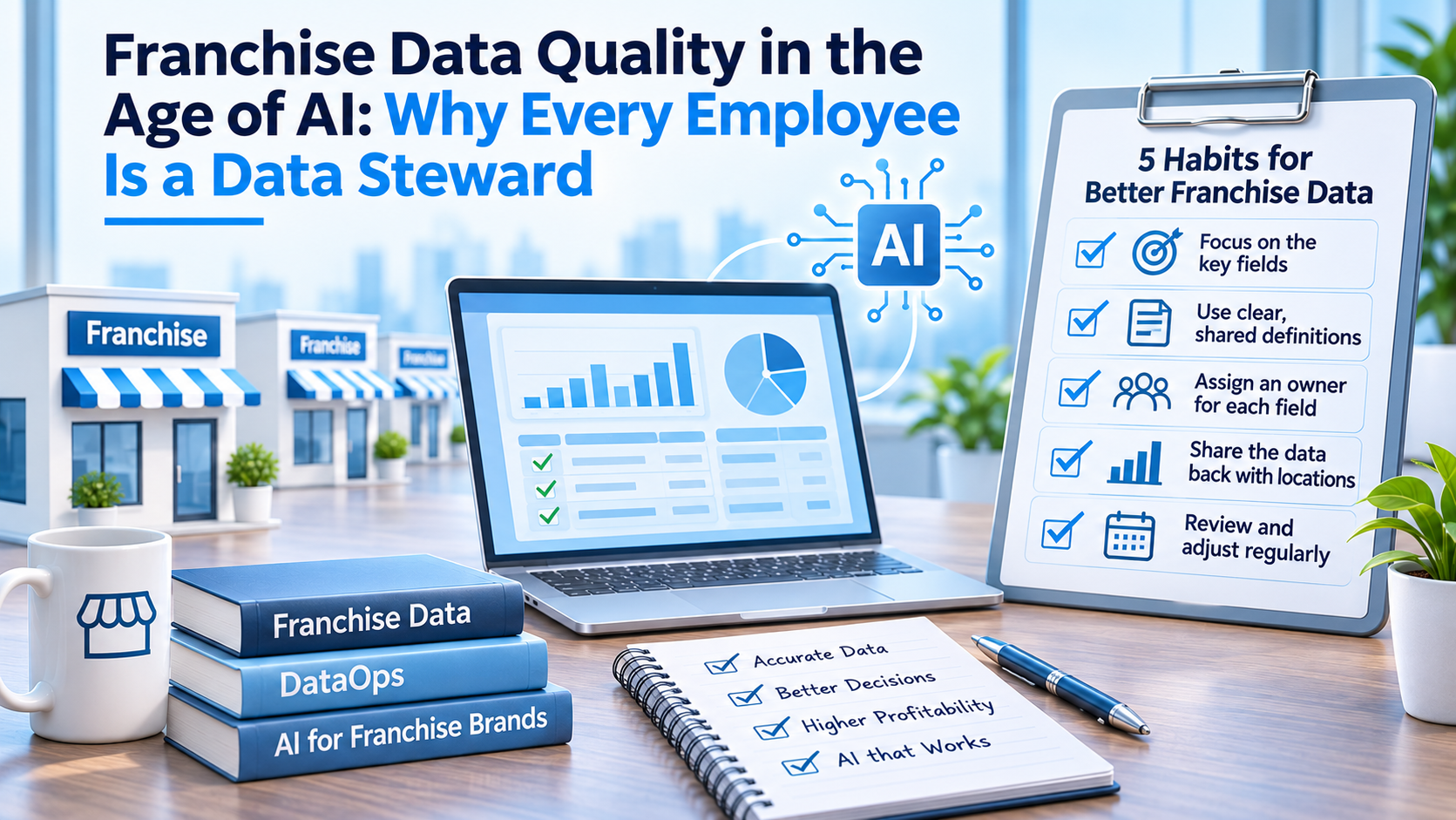
Where to start: five habits for better franchise data
None of this requires a new platform. It requires a few deliberate habits:
- Pick the five fields that matter most to the decisions the system makes, and leave the rest optional.
- Write one plain definition for each, and agree on it across marketing, operations and the field.
- Name an owner for every field, someone who answers when it looks wrong.
- Show the data back to locations within a month, in a view that helps them run their business.
- Review it every quarter with franchisees, and adjust what is not realistic at the counter.
Once those fields are defined, automate the checks so problems surface the day they are entered, not the quarter after. That is DataOps in practice, and it keeps a one-time cleanup from drifting back to where it started.
There is real anxiety about what AI means for people’s jobs. With data, the case for people is easy to make. Technology can flag anomalies. It cannot decide which distinction matters to the business, which entry is signal and which is noise, or whether a frontline process is realistic. That judgment comes from the people who do the work.
The franchise systems that get the most from AI will not necessarily be the ones that adopt the newest tools first. They will be the ones where every employee knows their part in it.