
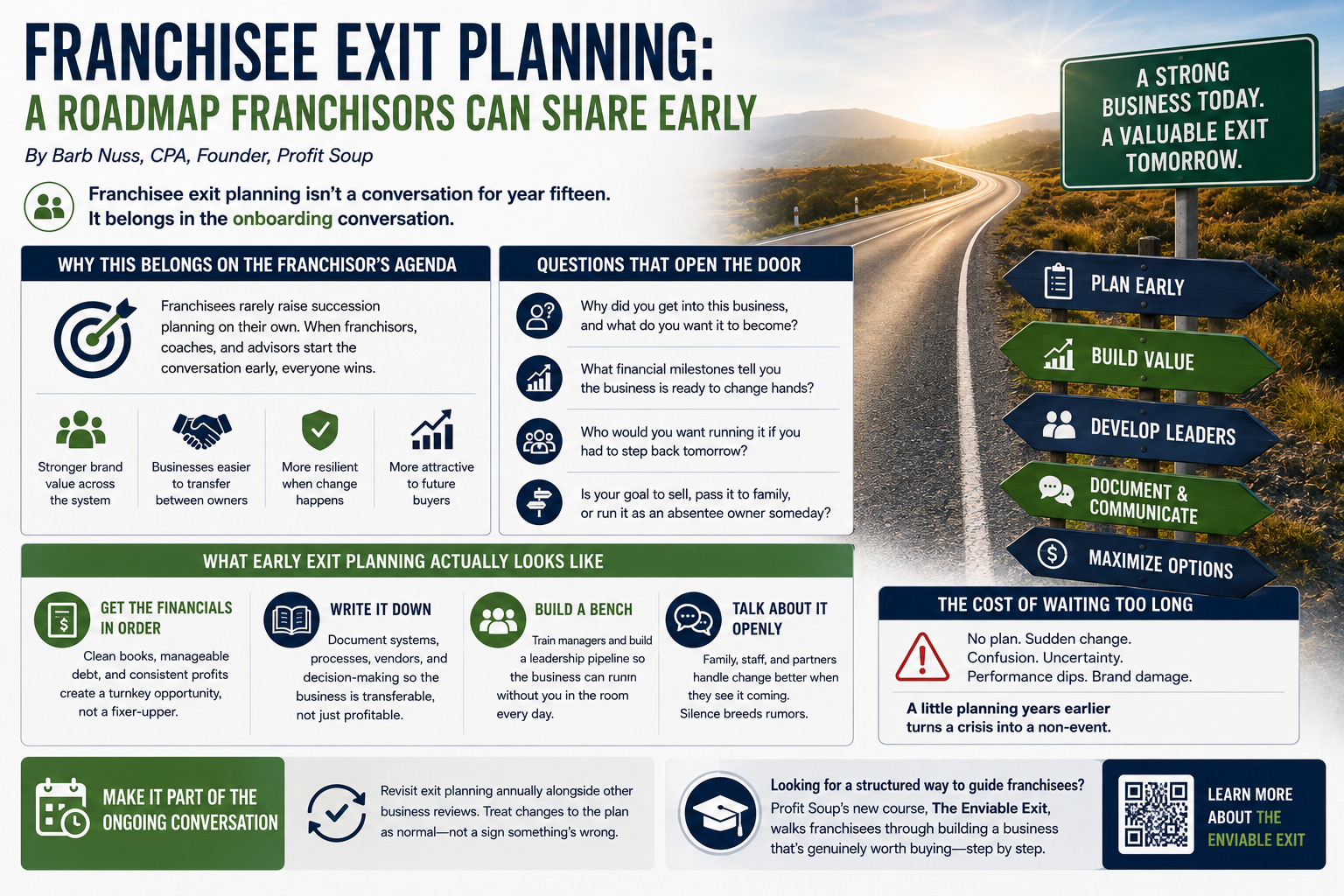
Ask a new franchisee what their exit strategy is, and most will give you a blank stare. They’re focused on opening day, not the day they hand over the keys. That gap is exactly where franchisors, coaches, and advisors can add real value: franchisee exit planning isn’t a conversation for year fifteen. It belongs in the onboarding conversation, right alongside site selection and grand-opening marketing.
Whether an owner runs one location or twenty, the same truth applies. A business built without an eventual transition in mind is harder to sell, harder to hand off, and harder to keep stable if something changes unexpectedly. Building exit planning into your franchisee support from day one protects the owner, the brand, and everyone who works inside that business.
Why this belongs on the franchisor’s agenda
Franchisees rarely raise succession planning on their own. It can feel premature, uncomfortable, or like tempting fate. That’s precisely why it works best as something the franchisor, a coach, an accountant, or other trusted advisor initiates as a normal part of doing business, not as a crisis conversation.
Franchise systems that treat exit planning as a standard part of franchisee support see the benefit in brand value overall. A network of exit-ready businesses is more attractive to future buyers, easier to transfer between owners, and more resilient when a franchisee needs to step away sooner than planned.
A short list of questions can open the door:
● Why did you get into this business, and what do you want it to become?
● What financial milestones tell you the business is ready to change hands?
● Who would you want running it if you had to step back tomorrow?
● Is your goal to sell, pass it to family, or run it as an absentee owner someday?
What early exit planning actually looks like
Franchisees don’t need a finished succession plan on day one. They need a starting framework they can build on.
Get the financials in order. Clean books, manageable debt, and a track record of consistent profits turn a business into a turnkey opportunity rather than a fixer-upper. This is often the single biggest lever an owner controls.
Write it down. Operating procedures, vendor relationships, and the day-to-day judgment calls that make the business run smoothly are easy to overlook until a buyer or successor needs them spelled out. A documented playbook makes the business transferable, not just profitable.
Build a bench. Even a single-unit owner benefits from training a manager or key employee who could step in temporarily. For multi-unit operators, a leadership pipeline across locations is what lets the business run without the owner in the room every day.
Talk about it openly. Family, staff, and business partners handle change better when they see it coming. Silence around succession breeds rumors, and rumors erode the trust that keeps a team together.
The cost of waiting too long
Picture a franchisee who built a solid business over a decade with no transition plan in place. When circumstances force a sudden change in leadership, the fallout isn’t financial at first. It’s confusion among staff, uncertainty among vendors, and a dip in the day-to-day performance that took years to build. By the time the numbers reflect the disruption, the damage is already done. A little planning years earlier would have made that transition a non-event instead of a scramble.
Make it part of the ongoing conversation
Franchisee exit planning works best as a recurring check-in, not a one-time form to fill out. Revisit it annually alongside other business reviews, and treat changes to the plan as normal rather than a sign something’s wrong.
If you’re looking for a structured way to guide franchisees through this instead of leaving it to chance, Profit Soup’s new course, The Enviable Exit, walks franchisees through building a business that’s genuinely worth buying, step by step, well before they’re ready to sell.