
By William (Bill) Edwards, CFE AFS · Founding Member, Franchise Consortium
What franchisors going global need to know now
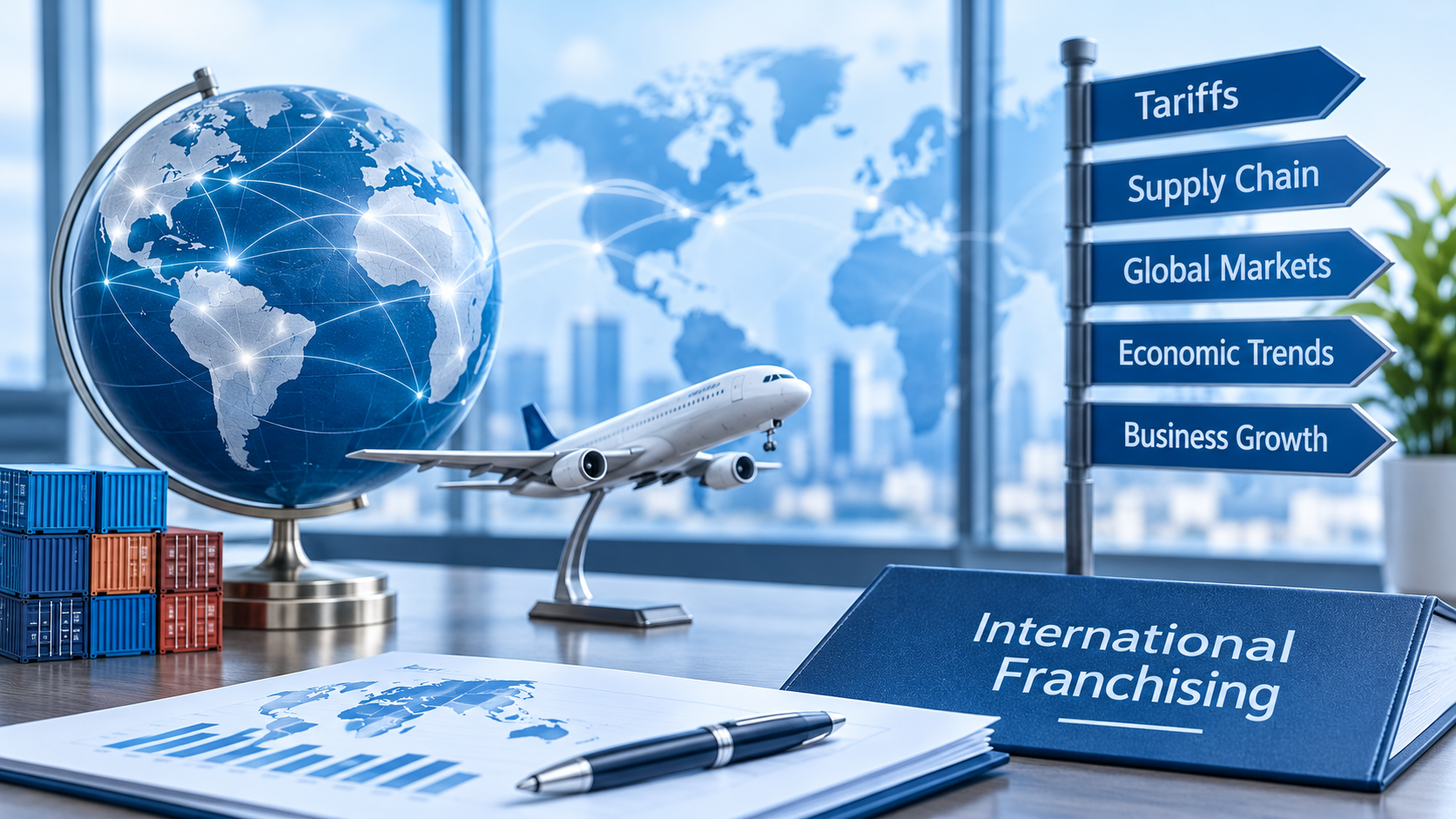
Over 36 years of doing global franchising as. Country master franchisee, a franchisor and since 2001 assisting more than 40 franchise brands across 12 different business sectors enter 30+ countries, I have not seen so many global business factors changing at the same time. It is not one crisis to wait out. Several are stacking up at once. For franchisors with international units, or plans for them, each one lands somewhere in your system: in a franchisee’s build-out cost, in the price of imported equipment and supplies, or in a deal that looked solid 90 days ago and is now going away.
Here is where things stand as of early November 2026, followed by an update on international franchising and the practices I am recommending to clients.
Five forces moving at once
1. Tariffs: the rules keep changing
• The courts struck down the IEEPA tariffs, and importers are now in a refund process covering roughly $138 billion in potential and certified refunds.
• That is not the end of tariffs. The U.S. Trade Representative plans new Section 301
recommendations on “structural overcapacity” by the end of 2026 and has said current tariffs may not be “as high as they will go.”
• Canada: a 50% Section 338 tariff applies to a list of Canadian goods, regardless of USMCA origin. The list changed again on October 30.
2. Freight: still about three times January
• A 40-foot container from Shanghai to Los Angeles cost about $2,500 in January. On October 29 it was $7,514 — easing week to week, but still roughly triple.
3. Energy: Asia pays more than ten times what we do
• Asian LNG is trading around $34 per MMBtu, up from about $22 in August. U.S. Henry Hub gas is about $2.90.
• European gas is around $34 as well, with EU storage about 10% below last year heading into winter.
• Higher energy costs in Asian and European factories show up in the price of everything we import — and in the operating costs of franchisees in those markets.
4. Supply chain realignment
• Companies are moving sourcing away from dependence on any single country, spreading production across Mexico, Southeast Asia and India. Resilience now matters as much as lowest cost.
5. Business travel
• International business travelers remain hesitant — not just over cost, but over geopolitical unrest and safety. That slows site visits, training trips and partner meetings.
International franchise update
U.S. franchising is still growing
• The IFA’s 2026 Franchising Economic Outlook projects about 845,000 U.S. franchise units (more than 12,000 new), nearly 8.9 million jobs and about $921 billion in output this year. Growth is steady, not spectacular — one more reason franchisors are looking abroad.
China re-emerges as a market for U.S. brands
After several quiet years, China is back on the map for U.S. food and beverage franchisors — and this time the deals are coming through large, well-capitalized local operators.
• Popeyes returned to China in April 2026 — its third entry — opening in Beijing’s Wangfujing and expanding to Shanghai, Nanjing and Hangzhou, with a delivery partnership with Taobao Flash Purchase.
• Wendy’s signed a franchise agreement in May 2026 targeting up to 1,000 stores over ten years.
• Church’s Texas Chicken entered through an exclusive agreement with operator Deke Shengtang, with plans for 600+ restaurants, starting in Shanghai.
• Five Guys opened two Beijing restaurants in August, and Cinnabon opened its first mainland store in Shanghai in June.
• Capital is following: Starbucks sold a 60% stake in its China business to Boyu Capital, and Burger King’s China business was acquired by CPE Yuanfeng — both with plans to accelerate growth.
• The U.S. Commercial Service in Beijing has been hosting online “U.S. Franchise Promotion” events connecting U.S. brands with pre-screened Chinese multi-unit investors.
• The caution: local competition is enormous — Mixue has more than 60,000 stores and Wallace about 20,000 — and a delivery-subsidy war has squeezed margins. China rewards brands that partner with a proven, large-scale local operator.
Mexico: the busiest market right now
• Chipotle opened its first Mexican restaurant in Monterrey in July 2026, and Dog Haus entered with a first restaurant in Mérida as the start of a multi-unit expansion.
• Proximity, familiarity with U.S. brands, strong multi-unit operators and nearshoring-driven growth in the north make Mexico the first international market for many U.S. food and beverage brands. Watch the USMCA review and peso volatility in your unit economics.
Asia-Pacific: steady demand for U.S. chicken and casual brands
• Chipotle opened in Seoul in September 2026 with partner SPC, with Singapore (Jewel Changi Airport) to follow in 2027.
• Japan, South Korea, Singapore and the Philippines remain the most receptive Asian markets for U.S. chicken, burger and casual concepts, typically through multi-brand, multi-unit operators. Thailand, Indonesia and India offer scale, with more complexity.
• Australia has strong consumer appeal but some of the world’s toughest franchise entry regulations — plan time for compliance.
UK, Ireland and Europe
• The UK and Ireland remain natural first markets for U.S. brands: Jersey Mike’s has announced major expansion plans there, and Houston TX Hot Chicken has made its UK debut. Dave’s Hot Chicken® has opened more than 15 restaurant in the United Kingdom and Ireland in less than two years.
• Central and Eastern Europe is gaining attention – Strong Pilates signed a master franchise partnership with Xtreme Brands for the region. Poland stands out for new franchise growth and operator capacity; France and Germany are the large prizes.
Middle East: a pause on new development
• Because of the Iran war, new franchise development in the Middle East has effectively stopped. The unit growth we are seeing comes from brands already in the region and their existing partners. Franchisors with Gulf plans should keep relationships warm and revisit timing as conditions settle. 2026 is the first year in almost 20 that I have not traveled to the Middle East on a business trip.
It is now a two-way street
• Asian brands are coming to the USA big time. Mixue, the world’s largest restaurant chain by unit count with more than 60,000 locations, opened in Los Angeles and New York. Luckin Coffee has 16 Manhattan stores and more than 33,000 worldwide. Chagee, Heytea and Cotti Coffee are opening U.S. locations too.
• These brands learned from U.S. franchisors and they now compete with them for consumers, real estate and master franchisees in third markets such as Southeast Asia.
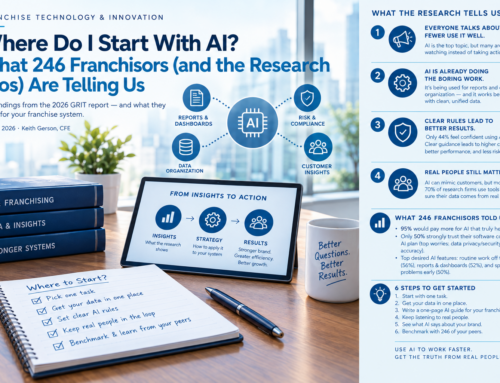
AI in global franchising
I have seen technologies reshape global business, from telex machines and overnight couriers to email, the internet and video conferencing. None has been adopted as quickly as AI. When I asked international franchise experts for my recent ‘Franchise Update’ magazine column how AI is being used, the answer was a landscape where enthusiasm, experimentation, caution and innovation exist side by side.
Beyond experiments
• Australia: Doug Downer of Franchise Ready reports that two years of experimentation led his company to a dedicated AI Transformation Team, using AI for everything from recruitment lead scoring to financial due diligence and buyer matching.
• United Kingdom: Michael Hulmes of The Franchising Centre sees franchisors training AI on their operations manuals, turning a rarely consulted document into a living knowledge base franchisees can query in plain English.
• In the field: AI-powered drive-thru ordering, demand forecasting and labor scheduling are increasingly common in restaurants; retailers use AI to understand purchasing behavior; service brands use it to streamline administration.
Adoption is uneven
• New Zealand’s 2024 franchising survey found roughly 72% of franchises used or planned to implement AI, according to franchise attorney Stewart Germann. Countries with strong technology ecosystems move faster; privacy rules, regulation and cost slow adoption elsewhere. A one-size-fits-all AI strategy across your international system may not work.
• Sectors matter: quick-service restaurants, retail and hospitality are the most active adopters. Home care, education and coaching rely more on human interaction.
Changing support — and new risks
• Greg Nathan of the Franchise Relationships Institute notes that AI outperforms field consultants at analyzing unit-level data but cannot motivate people to act. That remains the consultant’s real value.
• Callum Floyd of Franchize Consultants (New Zealand) cautions that large, established networks must fund legacy systems and new AI at the same time, and franchisees who see better tools elsewhere may feel their franchisor is not innovating fast enough.
• The risks: data privacy rules differ by country, AI-generated content is not always accurate, and translation tools can miss cultural nuance. Human review is still required.
• The bottom line: franchising remains a relationship business. The best international systems will use AI to augment their people’s knowledge and experience, not to replace them.
What the five forces mean for franchisors
• Build-out and supply costs are up for international franchisees that import equipment, packaging or proprietary ingredients. Revisit the unit economics you showed prospective master franchisees a year ago.
• Approved-supplier lists need a second source in a second country, wherever possible.
• Register your trademarks first. Many countries are first-to-file, and with more Asian brands competing globally, protect your marks in target markets before you announce plans there.
• Due diligence on master franchisees matters more than ever. Confirm they can absorb cost swings and currency moves, not just fund the development fee.
BOTTOM LINE: “In today’s world, global business success belongs less to the companies that predict the future than to those that prepare for multiple futures.”
William (Bill) Edwards, CFE AFS, is a founding member of the Franchise Consortium and CEO of Edwards Global Services, Inc. (EGS), Irvine, California. He publishes the quarterly GlobalVie™ country ranking chat and the biweekly Geowizard newsletter on global business at geowizard.substack.com. Contact: bedwards@edwardsglobal.com · +1 949 375 1896.
Sources
1. Foley & Lardner, “Tariff-ied! This Week in International Trade,” National Law Review, Nov. 2, 2026.
https://natlawreview.com/article/tariff-ied-week-international-trade-november-2-2026
2. Drewry, World Container Index, Oct. 29, 2026. https://www.drewry.co.uk/supply-chain-advisors/supply-chain-expertise/world-container-index-assessed-by-drewry
3. Global LNG Hub, “Natural gas prices weekly update: JKM, TTF and Henry Hub,” Nov. 2, 2026.
https://globallnghub.com/natural-gas-prices-weekly-update-jkm-ttf-and-henry-hub-2-november-2026/
4. International Franchise Association, “IFA Predicts Steady Growth for Franchising in 2026 Economic Outlook.”
https://www.prnewswire.com/news-releases/ifa-predicts-steady-growth-for-franchising-in-2026-economic-outlook-302692895.html
5. China Briefing, “China Food Franchising Chains in 2026: Market Outlook and Opportunities.” https://www.china-briefing.com/news/chinas-food-franchising-market-in-2026/
6. 36Kr, “Top U.S. Fast Food Sensations: Leading American Chains Entering the Chinese Market,” Aug. 10, 2026. https://eu.36kr.com/en/p/3932986147880326
7. Franchising.com, “International Franchise News, Deals & Opportunities in the Summer of 2026,” Aug. 14, 2026.
https://www.franchising.com/articles/20260814_international_franchise_news_deals__opportunities_in_the_summer_of_2026.html
8. CNBC, “Chipotle’s new Seoul restaurant tests its Asian expansion strategy,” Sept. 9, 2026.
https://www.cnbc.com/2026/09/09/chipotles-new-seoul-restaurant-tests-its-asian-expansion-strategy-.html
9. Franchising.com, “International Franchise News, Deals & Opportunities Through the Third Quarter,” Oct. 7, 2026.
https://www.franchising.com/articles/20261007_international_franchise_news_deals__opportunities_through_the_third_qua.html
10. Fast Company, “Chinese chains Luckin Coffee and Mixue are coming for U.S. customers,” May 20, 2026.
https://www.fastcompany.com/91543560/luckin-coffee-mixue-chinese-fast-food-chain-america-u-s-customers-starbucks-mcdonalds
11. William “Bill” Edwards, “A Global Force: Franchise leaders around the world embrace artificial intelligence,” Franchise Update, Issue 3, 2026, p. 70.