

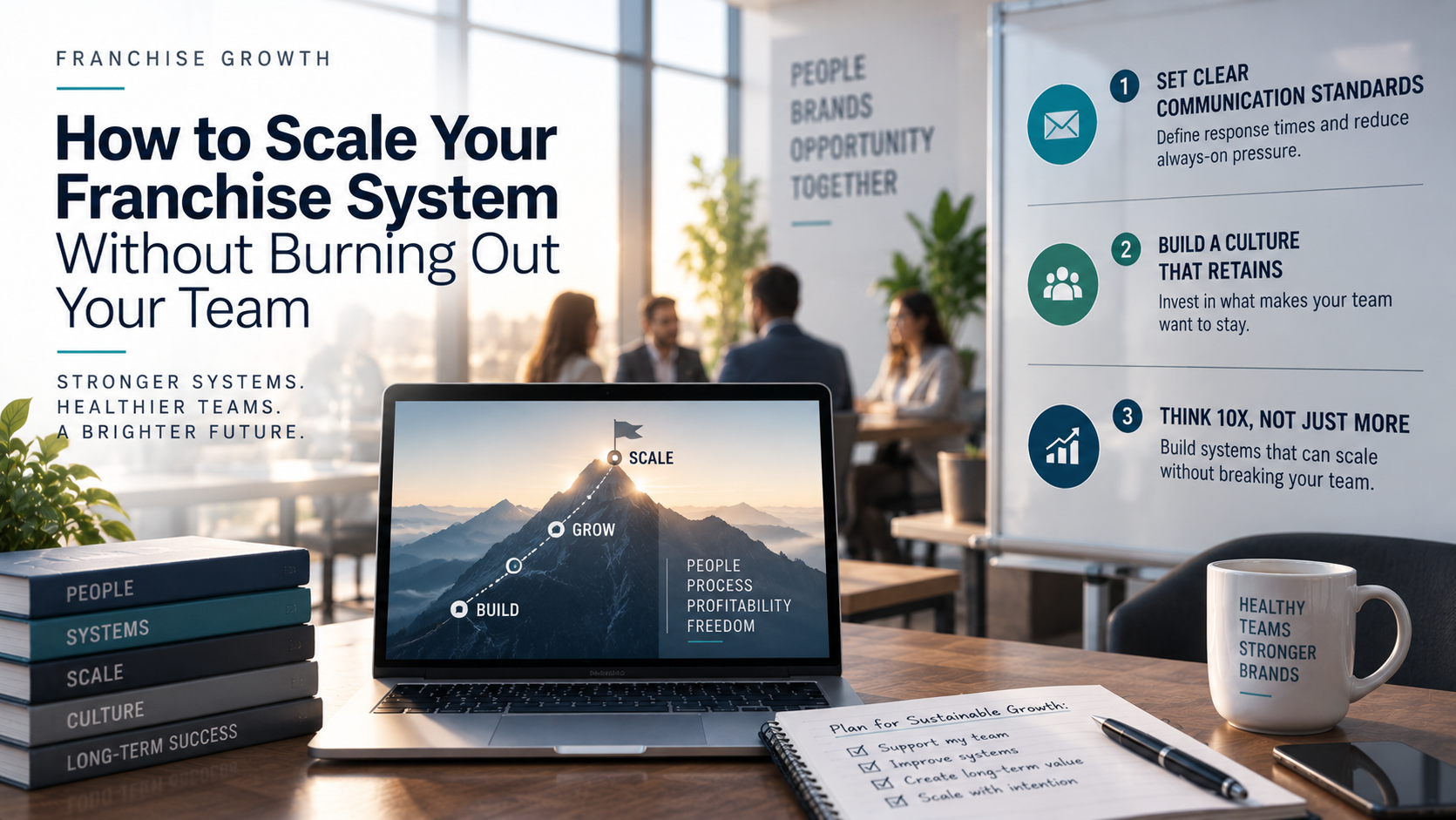
Franchise growth and franchise burnout tend to arrive on the same timeline. The systems that make scaling possible, however, aren’t the wellness perks most leaders reach for first.
The Real Cause of Burnout in a Growing Franchise System
Ask most franchisors what causes burnout on their team and you’ll hear about workload: too many locations, too few people, too little time. That’s real, but it’s rarely the actual trigger. The deeper cause is almost always structural: no shared agreement on how the team communicates, no habit of acknowledging wins before chasing the next one, and no clear distinction between adding more of the same thing and building something that can hold ten times the weight.
A group of franchisors I work with inside a peer mastermind recently spent a full session on this exact problem: how to keep a business development team functioning as the brand scales, without quietly running everyone into the ground. What came out of that conversation wasn’t a list of self-care tips. It was three specific, structural changes that any growing franchise system can put in place this month.
1. Publish a Response-Time Standard
Most burnout on a leadership team starts with an unspoken rule: every message deserves an instant reply. Nobody agreed to that rule, but everyone’s behaving as if they did.
The fix is to make the rule explicit instead of assumed. One franchisor in the group uses a simple three-tier standard with her team: an email gets a response within 24 hours, a text signals same-day urgency, and a phone call means something genuinely needs a live conversation right now. Nothing more complicated than that. Once it’s written down and shared, even informally, people stop treating every notification like an emergency, and the team gets permission to actually finish what they’re working on before switching tasks.
2. Let a Culture Decision Do Double Duty
The best retention tools aren’t retention tools at all. They’re culture decisions that happen to solve two problems at once.
One franchisor in the room runs a kids’ cooking concept alongside her husband’s restaurant. For 32 years running, that restaurant has closed for two weeks every year and taken the entire staff to Italy, together. It isn’t a line item in the employee handbook. It’s simply what the business does. The direct result is almost no turnover; people don’t walk away from a team that travels the world together. The indirect result is just as valuable: the trip has become one of their strongest marketing stories, the kind of thing people talk about unprompted, which no paid campaign can fully replicate. One decision, both problems solved.
Not every franchise can fund an annual trip abroad. The principle scales down fine: find the one cultural commitment your team would genuinely miss if it disappeared, and protect it like it’s load-bearing. It probably is.
3. Ask “What Would This Look Like at 10x?”
The idea I keep coming back to with coaching clients is this: growth is addition, scale is a multiplier, and most resistance to new systems is really a scale problem wearing a growth costume.
When someone on the team pushes back on a new CRM, a new training platform, or a new process, on the grounds that the current approach “works fine,” the useful question isn’t whether they’re right today. It’s whether the current approach survives at ten times the size. Twenty-five locations doesn’t behave like two hundred fifty. Fifty franchisees doesn’t behave like five hundred. Asking the question directly, in those terms, usually reveals within a minute whether someone is thinking about growth (more of what already works) or scale (a system built to hold weight that doesn’t exist yet). Only one of those two mindsets survives contact with real expansion, and it’s worth knowing which one you’re building for before growth forces the answer on you.
Quick FAQ
Isn’t burnout really an HR or wellness issue?
Sometimes, but treating it only as an HR issue misses the structural half of the problem. A team can have excellent benefits and still burn out fast if there’s no shared communication standard and no distinction between growth and scale. Fix the structure first; wellness programs work far better once the structure underneath them is sound.
Where should a franchisor start if they only have bandwidth to change one thing?
Start with the response-time standard. It costs nothing, takes a single conversation to implement, and immediately reduces the number of things competing for everyone’s attention. The other two changes tend to follow more naturally once that pressure valve is open.
The Bottom Line
None of these three ideas came from a book or a keynote stage. They came from franchisors comparing notes on what actually works when the pressure is real, inside a working group built for exactly that kind of exchange. That’s the value of getting operators in a room together: not theory, but what’s currently true for people doing the job under real conditions.
If your team is scaling and starting to feel the strain, the fix probably isn’t another wellness perk. It’s picking one of these three structural changes and putting it in place before the next growth spurt makes the decision for you.
John W. Francis is a 30-plus year franchise industry veteran, advisor, and board member, and the founder of Johnny Franchise, an advisory practice for franchisors in founder-to-CEO transition. He also leads Next Level Franchise, a peer mastermind community for franchisors and franchise suppliers.
Reach John at john@johnnyfranchise.com, www.johnnyfranchise.com, or 612-868-0745.