

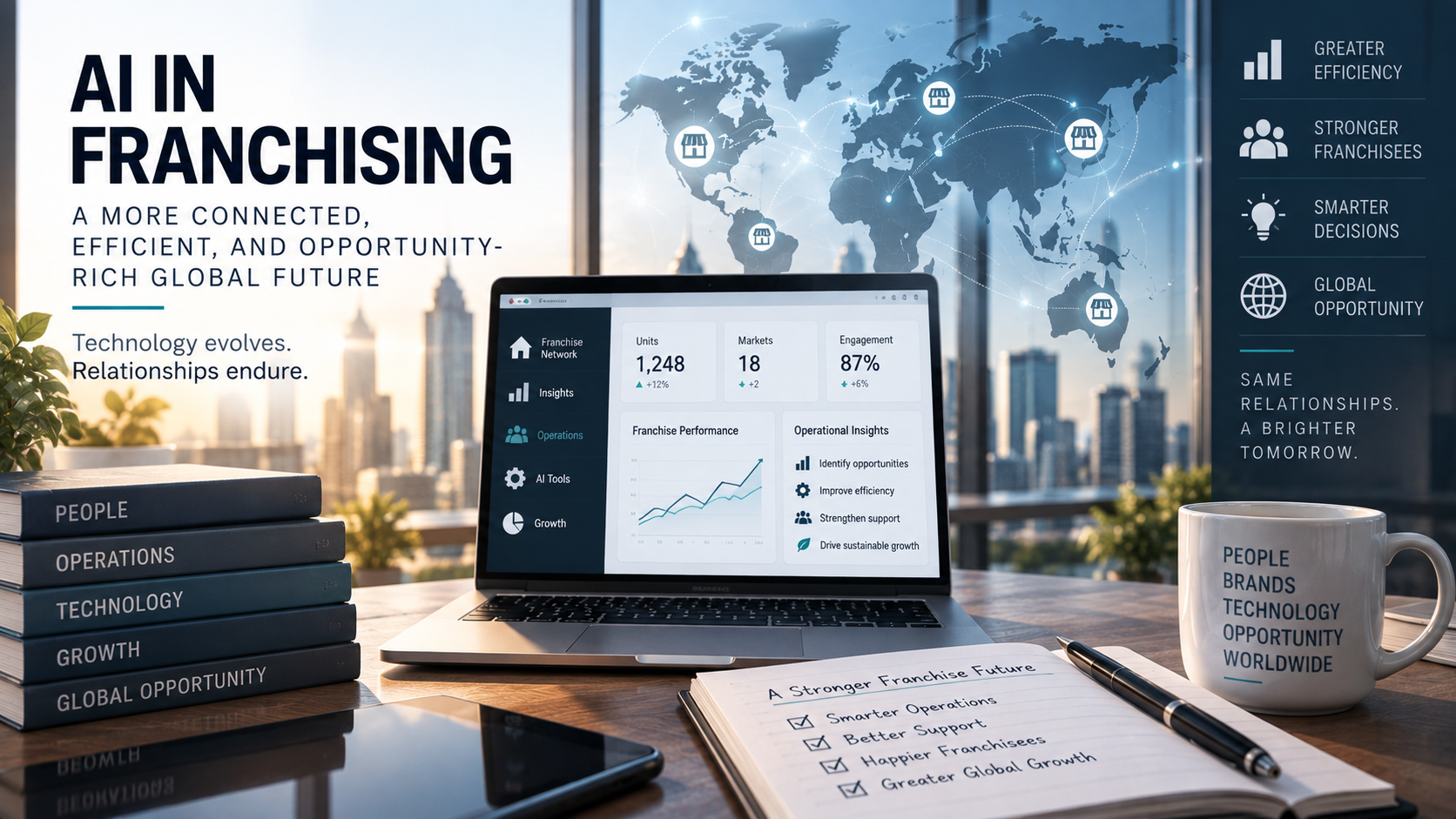
I have seen technologies reshape global business, going from telex machines and overnight couriers to email, the internet, and video conferencing. Each transformed communication and improved productivity. None has been adopted as quickly as AI. Over the past three years, AI has moved from being a technology discussed primarily by software companies to a tool being explored by businesses of every size and in virtually every industry.
I reached out to international franchise experts for input on how AI is being used in franchising. It is a rapidly evolving landscape in which enthusiasm, experimentation, caution, and innovation exist simultaneously.
BEYOND EXPERIMENTS
Doug Downer with Franchise Ready notes that Australia has embraced AI but still lags in adoption. Within his company, two years of experimentation led to a dedicated AI Transformation Team charged with building AI-driven operational improvements across four business divisions. It affects everything from recruitment lead scoring to financial due diligence and buyer-matching tools. Downer believes AI will become integral to every successful business and that organizations investing now in structured AI transformation will gain a real competitive advantage.
Michael Hulmes, co-owner of The Franchising Centre in the United Kingdom, is seeing franchisors move past AI-generated marketing content to train large language models on their operations manuals and policies, turning a rarely consulted document into a living knowledge base that franchisees can query in plain English. AI is also being embedded into CRM and business management systems, surfacing missed follow-ups, declining conversion, or under-target sales. Hulmes expects this to free consultants to spend more time coaching and less time interpreting data.
AI-powered drive-thru ordering, predictive demand forecasting, and labor optimization systems are increasingly common. Retail franchises use AI to better understand customer purchasing behavior while service franchises explore ways to streamline administrative functions. Franchise systems are asking how quickly they should adopt and where it can create the greatest value.
UNEQUAL ADOPTION
AI acceptance appears to vary across countries and regions.
Stewart Germann, a New Zealand-based franchise attorney, reports that AI is an integral force in franchising and that New Zealand’s isolated, innovation-driven market is especially fertile ground. The 2024 New Zealand Survey of Franchising found roughly 72% of franchises used or planned to implement AI. Germann predicts AI use in franchise systems will grow worldwide, driving greater efficiency and lower costs.
Countries with strong technology ecosystems and supportive government policies tend to experiment more readily while privacy, regulatory, and cost concerns slow adoption elsewhere. A one-size-fits-all AI strategy may not be effective.
SECTORS MATTER
Quick-service restaurants, retail, and hospitality brands are among the most active adopters, generating significant customer and operational data. Home care, education, and coaching rely heavily on human interaction. Successful systems will use AI to improve efficiency while preserving the human relationships customers value.
CHANGING SUPPORT
Greg Nathan, founder and director of the Franchise Relationships Institute, sees AI increasingly reviewing unit-level metrics to help franchisees spot ways to improve KPIs and margins. AI outperforms field consultants at data analysis, he notes, but cannot motivate people to act, which remains the human consultant’s real value.
Local innovation by franchisees can identify best practices for an entire system. Franchisors must ensure AI use remains consistent with brand standards, data security, and legal obligations.
Callum Floyd, managing director of Franchize Consultants in New Zealand, cautions that this shift is disruptive for large, established networks with heavy legacy technology investments, which must now fund both legacy system support and new AI customization simultaneously. New systems often cannot match every capability franchisees see available elsewhere. The gap can breed dissatisfaction among franchisees who feel their franchisor is not innovating fast enough.
THE RISKS
Data privacy concerns continue to attract attention globally, and regulatory frameworks differ from one country to another. AI-generated content is not always accurate, translation tools can miss cultural nuances, and automated systems occasionally require human review.
There are broader questions regarding workforce impact, intellectual property, and governance that grow more complex internationally. Most experts agree AI should be viewed as a tool, not a substitute for sound management judgment.
THE HUMAN ELEMENT
Franchising remains a relationship business. Technology can improve communication, accelerate analysis, and automate routine tasks. It cannot build trust.
Successful international franchising depends upon strong relationships, effective support systems, and shared commitment to long-term success. The systems that thrive will use AI to strengthen communication and better support franchisees.
THE BOTTOM LINE
The AI adoption curve may vary by country and sector, but the direction is unmistakable. The technology will continue to evolve. The importance of trust, relationships, and collaboration will not. The best practitioners will use AI to augment their knowledge and experience, not as a replacement for staff.