
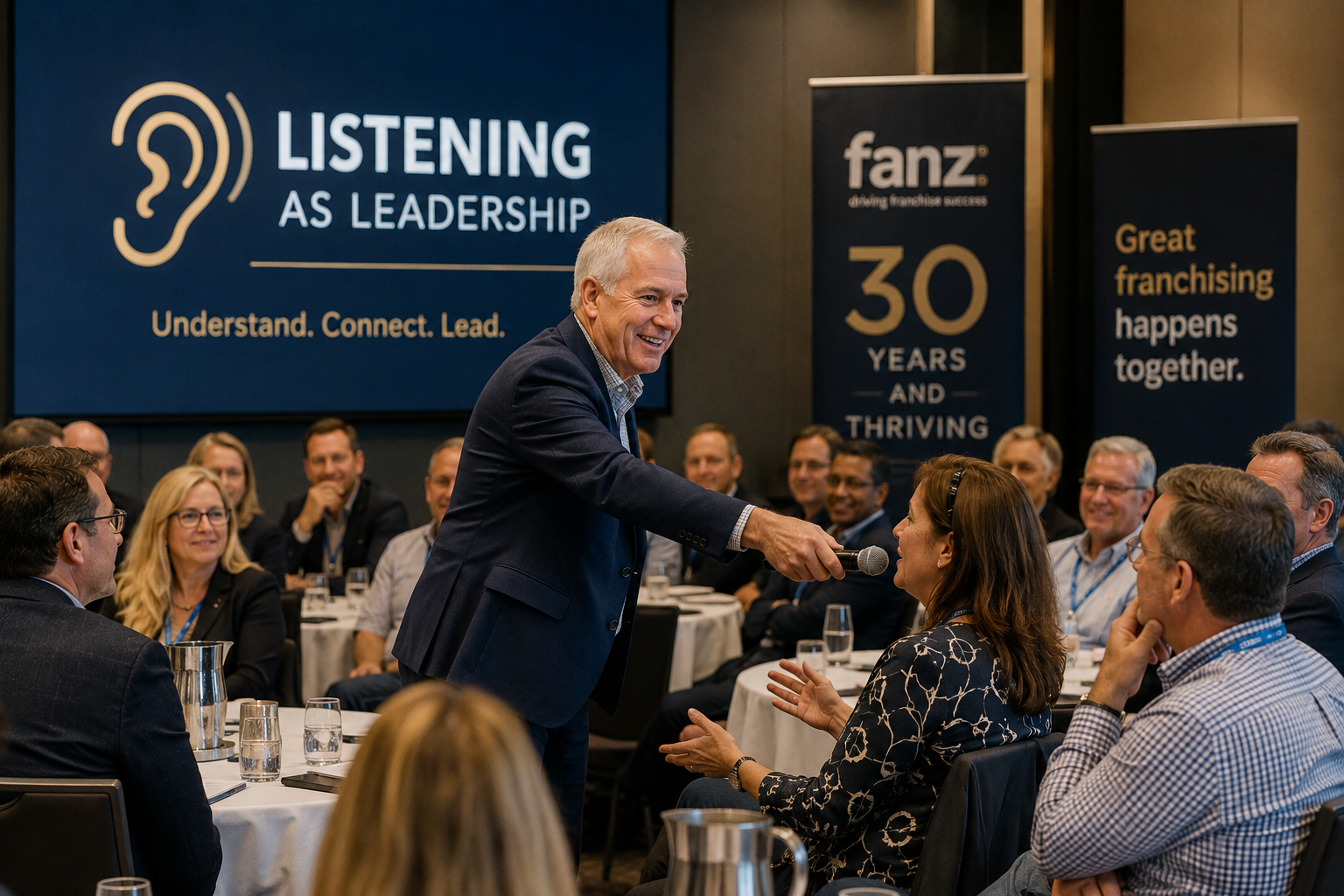
Greg Nathan’s keynote, Listening as Leadership, was the 29th time Greg or a member of the FRI team has been invited to speak at the Franchise Association of New Zealand (FANZ) conference. Coming up with something fresh each year has certainly made us better researchers and educators.
Given the nature of this year’s topic, instead of talking at the room, Greg listened to the room using a number of interactive processes. There were just three slides, each with a question: What is listening? Why is it good to listen? How do we listen?
Adem Hyssoli from Operandio kindly used AI to capture what was happening in the room, and with his help, we’ve provided this summary.
What is listening?
Greg opened by inviting everyone to sing Happy Birthday (as the conference coincided with FANZ’s 30th birthday celebrations). The only directions were, “Please sing Happy Birthday to FANZ in tune and in time. Start whenever you’re ready”.
“It was amazing”, says Greg. “The whole room came in together on time, stayed in unison and sang beautifully in tune”.
During an open-mic debrief on what helped, people mentioned paying attention, adapting to the situation, and supporting each other. For instance, when Stewart Germann jumped up at the end and shouted “Hip Pip”, everyone responded with a resounding “Hooray!”
Greg then suggested a useful definition of effective listening as “paying attention to others with the right intention” and reminded the room that our success as communicators is not so much determined by what we say, as by what people do with our message!
Why it’s good to listen (and why we don’t)
Greg explained that over 100 years ago, the famous psychologist, Alfred Adler, identified that humans are driven by two powerful forces – the drive to belong and the drive to be respected.
“When people behave badly, it is usually because they feel disrespected or alienated. Listening is how we can meet both these needs at once.”
Using FRI’s Group Scoop technique, the room then workshopped two powerful questions, shared below along with their answers.
Why invest time and energy in listening?
- It builds trust, which helps things move faster
- It signals respect
- It eliminates noise and distraction so we can concentrate
- It stimulates new ideas and useful feedback from others
- It creates a sense of belonging, inclusion and empowerment
- It generates fresh perspectives and an openness to change
- It enables you to respond intelligently, rather than react emotionally
- Listening precedes learning
- It helps to prevent and resolve conflict
Why don’t we listen to others?
- We feel overwhelmed, “the red mist” takes over
- We come in with a predetermined mindset or agenda
- We lose focus and get sidetracked
- We prejudge others or assume bad intent
- We lack curiosity, or are not interested
- We are impatient or feel we don’t have time
- We don’t respect or care about others
- We ask for ideas, but then tell others what to do
- We fear the feedback and see it as criticism
How to improve our listening
The room then workshopped how to improve listening, based on people’s real experiences and shared these tips.
- Give your full attention and focus
- Maintain eye contact and friendly body language
- Be comfortable with silence and don’t interrupt
- Provide timely affirmations, and encourage them to keep going
- Seek to understand, and ask clarifying questions
- Pause before responding
- Hold a helpful intention; you are not proving a point
- Keep your phone out of sight; just seeing it lowers the conversation
- Treat feedback or challenging questions as a gift
Thanks to New Zealand Franchise Magazine for sponsoring our presentations for 29 years!