
The corporate balance sheet is not a spreadsheet. It is a reflection of operational reality, and right now, a quiet decay is rotting the foundations of mid-market franchise systems. Corporate leadership often sits comfortably behind the illusion of third-party indemnification, believing that a 1099 tax designation absolves the brand from unit-level liabilities. This is a foundational error. Every time a franchisee shortcuts compliance by swapping structural safety for administrative convenience, they inject unrated exposures straight up the corporate ladder. When an uninsured subcontractor vanishes from a job site following a catastrophic loss, the financial obligation does not evaporate. It rolls upward, bypassing paper barriers, until it strikes the deepest pockets available. For a scaling franchise network, allowing these structural vulnerabilities to persist under the guise of entrepreneurial flexibility is a fast track to systemic insolvency.
This systemic vulnerability expands exponentially through operational drift. Operational drift occurs when unit-level operators modify their core service delivery models without updating their corporate risk frameworks. Consider a residential pool sanitation franchise where a local operator begins offering high-pressure concrete washing to boost margin. Or a commercial lawn care partner who silently branches into roof gutter clearance using seasonal, undocumented labor crews. These shifts happen completely outside the view of traditional annual insurance underwriting. The brand believes it is guiding a low-risk hospitality or maintenance concept, while the field reality has evolved into a heavy-exposure contracting operation. Every unmonitored deviation from the standard operating manual creates a compounding risk trajectory. As a network scales its footprint, the probability of an unrated loss transforming into a brand-level crisis approaches absolute certainty.
Key Takeaways
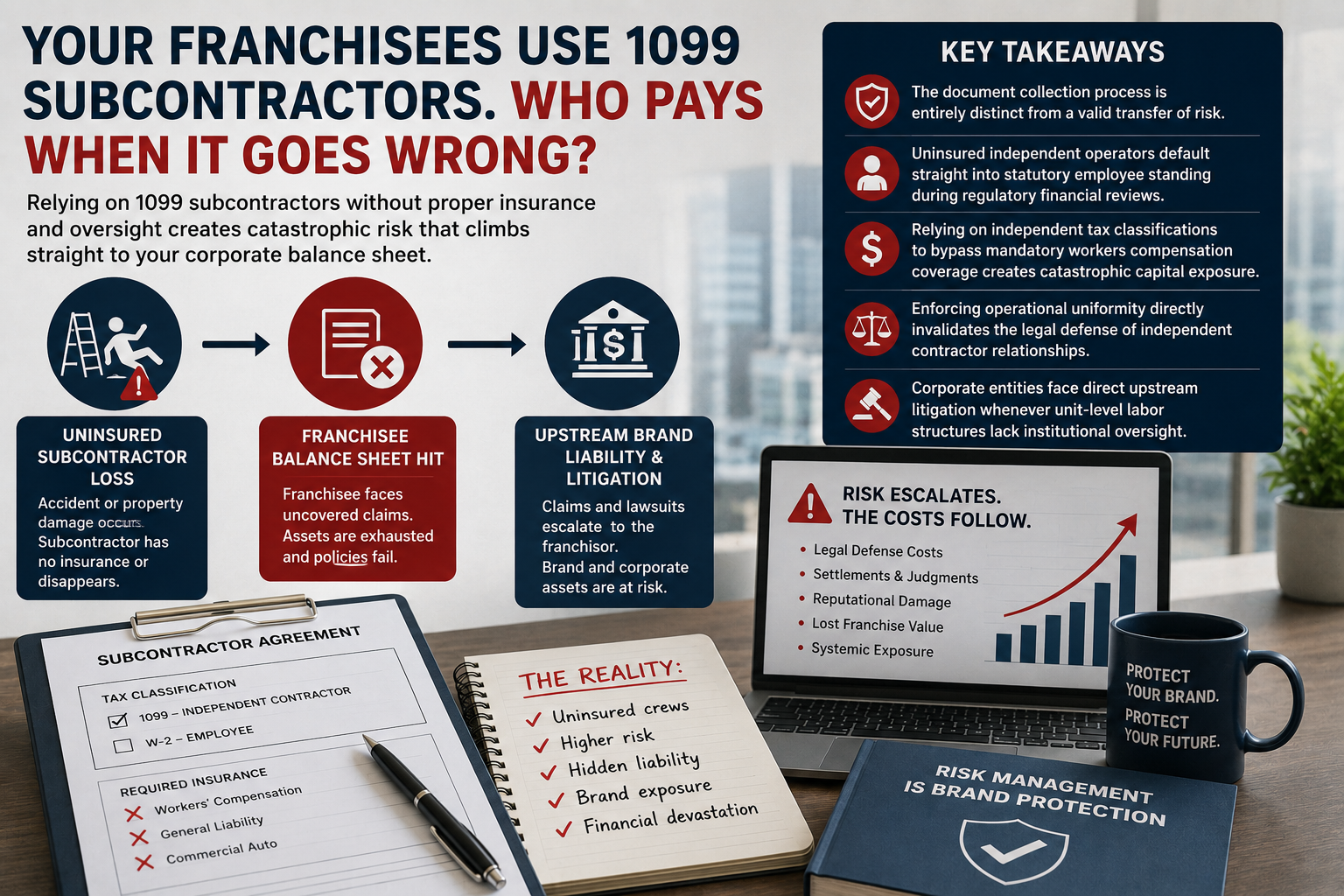
● The document collection process is entirely distinct from a valid transfer of risk.
● Uninsured independent operators default straight into statutory employee standing during regulatory financial reviews.
● Relying on independent tax classifications to bypass mandatory workers compensation coverage creates catastrophic capital exposure.
● Enforcing operational uniformity directly invalidates the legal defense of independent contractor relationships.
● Corporate entities face direct upstream litigation whenever unit-level labor structures lack institutional oversight.
How Does Subcontractor Exposure Undermine Unit-Level Economics and Systemic Brand Health?
A franchise system functions as a unified economic ecosystem. When a local operator chooses to utilize independent labor crews without validating their underlying insurance structures, they are not optimizing their margin. They are taking an unhedged short position against a catastrophic operational loss. In high-velocity service sectors, the reliance on independent contractors creates an immediate, volatile exposure landscape. If a service team causes severe structural damage or suffers a major bodily injury while operating under the brand’s trademark, the financial consequences materialize instantly. Because transient, uninsured labor operations lack the capital depth to survive a major claim, they routinely abandon the project site the moment an incident occurs. This leaves the immediate financial obligation sitting squarely with the local business owner.
[Uninsured Subcontractor Loss]
│
▼ (Subcontractor goes AWOL / No Coverage)
[Franchisee Balance Sheet Hit]
│
▼ (Franchisee Assets Exhausted / Policy Fails)
[Upstream Brand Liability & Litigation]
When a local operation is hit with an uninsured seventy-five thousand dollar property damage claim or a multi-million dollar bodily injury event, its cash reserves are wiped out. The unit-level economic model collapses. This disruption quickly creates a cascading failure across the broader network. A distressed operator stops paying royalty fees, fails to invest in local marketing, and degrades service quality. If the financial shock forces bankruptcy, the territory goes dark, devaluing adjacent markets and eroding system-wide brand equity.
Furthermore, the legal fallout rarely stays contained within local borders. Plaintiffs’ attorneys do not view a local franchise outlet as an isolated corporate island. They view it as a distribution channel for a national enterprise. When local insurance assets fail to cover a loss, the legal focus shifts directly to the franchisor’s balance sheet. The brand faces a dual threat: direct financial depletion from defense costs and severe reputational damage that can halt future franchise sales. What began as a local operator trying to save a few dollars on payroll quickly transforms into a systemic threat that compromises the enterprise value of the entire brand.
Why Do Franchisees and Internal Corporate Teams Resist Centralized Labor Controls?
Implementing rigorous labor and risk controls across a decentralized network always meets intense operational pushback. This friction typically stems from three to five distinct systemic misconceptions held by both local operators and corporate field teams.
The Administrative Velocity Myth
Local operators frequently argue that mandated insurance validation slows down their sales cycle. In high-demand markets, a franchisee wants to sign a contract, source a field crew on Monday, and begin production on Tuesday. They view corporate compliance demands—such as verifying entity registrations, confirming active workers compensation policies, and demanding explicit policy endorsements—as bureaucratic bottlenecks that benefit competitors. Field teams often side with the operator, prioritizing near-term top-line revenue over long-term risk management.
The Misunderstood Financial Exemption Belief
There is a widespread, mistaken belief among operators that choosing a 1099 model eliminates the need for workers compensation policies entirely. Franchisees often believe that if an individual signs a waiver or provides an independent tax form, they have legally signed away their right to pursue the business for workplace injuries. This perspective completely ignores the reality of statutory employment laws, which routinely override private contracts when an uninsured worker is injured on a job site.
The Supervised Uniformity Paradox
Corporate operations teams often push for strict brand alignment without considering the legal side effects. They demand that every field worker wear the corporate uniform, drive vehicles with identical wraps, and follow a rigid, hour-by-hour schedule. When risk managers point out that this level of daily operational control destroys the legal definition of an independent contractor, operations teams resist. They are hesitant to loosen brand standards, yet they fail to realize that enforcing strict uniformity while allowing unverified 1099 labor creates a massive compliance trap.
The Paperwork Sufficiency Illusion
Many corporate leaders believe their current exposure management is perfectly fine simply because they require franchisees to collect a Certificate of Insurance (COI) from their vendors. They treat the collection of a static piece of paper as a completed task. Explaining to an executive team that a COI is merely a snapshot in time—and that a policy can be canceled within days of issuance—is often met with skepticism. Teams prefer the comfort of a completed checklist over the active work required for true, continuous risk monitoring.
What Is the Operational Playbook for Rolling Out True Risk Transfer Across a Multi-Unit Network?
Transitioning a scaling franchise network from passive paperwork collection to active, verifiable risk transfer requires a deliberate operational playbook. You cannot fix a systemic vulnerability by simply issuing a corporate memo or updating a page in the operations manual. The transformation must be hardcoded into the daily workflow of every territory
Phase 1: Foundation (FDD Align & Policy Audit)
│
▼
Phase 2: Standardization (Mandatory Joinder & Master Agreements)
│
▼
Phase 3: Execution (Continuous Multi-Tier Monitoring)
Phase 1: Establish the Legal and Insurance Foundation
The initial phase requires aligning your Franchise Disclosure Document (FDD) with real-world exposure dynamics. Your insurance mandates must explicitly detail the required policy forms, acceptable deductibles, and the complete elimination of restrictive subcontractor exclusions. Concurrently, you must audit the current insurance placements of your existing network.
Ensure that operators are utilizing commercial general liability forms that do not feature restrictive warranties or hidden penalties for utilizing independent labor. If a policy contains a clause that voids coverage when a franchisee fails to preserve vendor paperwork, that policy must be replaced.
Phase 2: Implement Mandatory Standardized Documentation
Every independent labor relationship within the network must be governed by a master subcontractor agreement. This document cannot be a generic template downloaded online. It must feature explicit hold-harmless provisions, clear indemnification language, and a mandatory joinder clause that binds the subcontractor’s insurance assets directly to both the franchisee and the franchisor.
The agreement must state that the subcontractor’s coverage operates on a primary and non-contributory basis. This ensures that if a claim arises, the subcontractor’s insurance carrier is legally required to respond first, shielding the franchise system’s primary policies from early financial losses.
Phase 3: Execute Continuous Multi-Tier Monitoring
True risk transfer requires a reliable validation process. The franchise system must move away from annual compliance checks and transition to a continuous monitoring cadence. At a minimum, subcontractor insurance statuses must be verified quarterly. For high-exposure service networks, verification should occur on a per-project basis.
This process requires confirming not just general liability limits, but also checking active workers compensation status directly with state rating bureaus. This continuous validation ensures that if an independent crew lets their policy lapse mid-season, their access to corporate projects is automatically paused until valid coverage is restored.
What Strategic Advantages Do Real Risk Management Controls Offer to Franchisors and Local Operators?
Building an airtight risk management program is often viewed as a defensive cost center. In reality, it delivers a distinct competitive advantage that improves the financial health of both the corporate entity and individual unit owners.
| Operational Element | Loose Compliance Model |
Robust Risk Transfer Model |
|---|---|---|
| Worker Classification | Unverified 1099 operators |
Validated W-2 staff or fully insured subs |
| Annual Audit Impact | Unpredictable premium penalties |
Standardized, predictable labor costs |
| Worker Injury Exposure |
Statutory employee liability risks |
Complete policy transfer via active comp |
| Long-Term Premium Outlook |
Compounding Experience Modifiers |
Continuous discounts via controlled claims |
| Brand Protection Level |
High vulnerability to upstream suits |
Insulated through primary endorsements |
For the local operator, implementing a rigorous validation process or transitioning to a dedicated W-2 employment model provides immediate structural financial benefits. When an operator runs real employees within a controlled safety framework, they gain long-term control over their workers compensation pricing.
As their safety record improves, their Experience Modification Rate drops below the industry average baseline. This lower rate acts as a direct, compounding discount on their annual insurance costs. Conversely, operators who rely on unverified 1099 crews face unpredictable premium penalties during annual audits, missing out on these systematic savings.
For the franchisor, institutionalized risk transfer provides a significant boost to enterprise value. When private equity firms or institutional buyers evaluate a franchise system for acquisition or capital injection, they look closely at unrated liabilities. A network that can prove 100% compliance across its labor force is valued much higher than a system with unmonitored independent labor exposures.
A disciplined risk framework protects the corporate balance sheet from defense cost erosion and insulates the brand’s reputation. This stability allows the executive team to focus capital on strategic growth, technology deployment, and market expansion, rather than managing active litigation crises.
Is Your System Prepared? An Executive Decision-Making Framework
To evaluate whether your franchise system is truly insulated from independent labor exposures or exposed to a major financial shock, run your organization through this diagnostic framework:
1. The Operational Control Assessment
● Do your brand standards require independent labor crews to wear corporate uniforms or operate fully wrapped corporate vehicles?
● Are unit-level operators dictating the exact daily schedules and specific execution methods for 1099 workers?
● Decision Path: If you answered yes to these questions, your system has established operational control. You must either mandate a full transition to W-2 employees or implement an immediate, continuous subcontractor insurance monitoring program to counter the increased risk of worker reclassification.
2. The Policy Architecture Review
● Do your franchisees’ current liability policies contain specific subcontractor exclusions or elevated deductibles for subcontractor-caused damage?
● Are there warranty clauses within the unit-level policies that void coverage if a specific piece of vendor paperwork is missing during a claim review?
● Decision Path: If these restrictive clauses exist within your network’s policies, your paper risk transfer is compromised. You need to establish a mandated system-wide insurance program that eliminates these hidden penalties and standardizes true coverage across all territories.
3. The Financial Audit Verification
● Are your franchisees regularly hit with unexpected premium adjustments during their annual workers compensation audits due to 1099 utilization?
● Does your corporate compliance team check the actual remuneration definitions used by auditors across different state jurisdictions?
● Decision Path: Recurrent audit penalties indicate that your operators do not understand the financial reality of utilizing unverified independent labor. You must launch a mandatory educational initiative regarding statutory employee definitions and tie territory expansion approvals directly to clean audit histories.
4. The Monitoring Cadence Validation
● Does your corporate office rely on a static database of annual Certificates of Insurance to verify network compliance?
● Can an operator assign a project to an independent crew without verifying that the vendor’s policy is active that specific week?
● Decision Path: Static data collection leaves your brand exposed to mid-term policy cancellations. You must replace manual, annual collections with an automated, project-level or quarterly validation system that connects directly with primary insurance carriers.
Executive Frequently Asked Questions
If our franchisee collects a certificate of insurance from every subcontractor, why isn’t the system protected?
A Certificate of Insurance is simply a static record of coverage on the specific day it was generated. It possesses no legal authority to bind an insurance company, nor does it guarantee that the underlying policy remains active. Subcontractors frequently pay an initial premium installment to secure a certificate, land a project, and then intentionally let the policy cancel for non-payment. If a loss occurs after the cancellation, the certificate is worthless. True protection requires a continuous monitoring process backed by a franchisee policy built without restrictive subcontractor exclusions or warranty penalties.
Our franchisees use 1099 subcontractors, so isn’t workers compensation entirely the sub’s responsibility?
No, that is an expensive misunderstanding. If a subcontractor fails to maintain an active workers compensation policy and an independent field hand gets injured on a project, state laws override standard tax forms. In most jurisdictions, statutory employment provisions dictate that the financial liability moves directly up to the hiring organization. This means the franchisee becomes legally responsible for medical bills and lost wages. Additionally, during annual insurance audits, rating bureaus will look at unverified 1099 payments, redefine that spend as remuneration, and assess retroactive premium adjustments against the franchisee.
Can an independent 1099 worker really be reclassified as a corporate employee?
Yes, and it happens frequently. Regulatory agencies and insurance underwriters assess relationships based on operational control rather than tax labels. If a franchise network requires field workers to wear brand apparel, utilize proprietary software, follow strict corporate operational manuals, and maintain fixed schedules, the relationship fails the legal test for independent contractor status. Many states start with the legal presumption that a worker is an employee, placing the burden of proof entirely on the business. The very uniformity that makes a franchise successful makes a loose 1099 labor model legally indefensible.
How can a franchisee’s subcontractor establish a direct legal claim against the franchisor?
Plaintiffs’ attorneys consistently move up the chain of operational command to find viable financial assets. If an independent worker suffers a catastrophic injury or causes widespread property damage, the lawsuit will target both the local operator and the parent brand. The litigation will argue that the franchisor established the specific operational methods, safety standards, or project playbooks that led to the incident. Even if a court ultimately finds the brand non-liable, the franchisor must still dedicate substantial capital to legal defense fees. If the brand has exercised direct control over day-to-day safety procedures, it faces real exposure to vicarious liability judgments.
What is the most cost-effective approach for managing network labor long-term?
Over a standard business cycle, building a disciplined W-2 employee model supported by an institutional safety culture is more cost-effective than running unverified independent crews. While a 1099 approach may look cheaper on a weekly spreadsheet, it carries unhedged exposures. A single unexpected workers compensation audit penalty or an uninsured liability claim can easily wipe out years of projected savings. Conversely, focusing on real employees allows a local operator to systematically lower their Experience Modification Rate, which secures predictable, discounted insurance pricing and builds permanent asset value across the network.
Conclusion
The franchise executive who allows their network to rely on unverified 1099 labor is operating on a fundamentally flawed premise: that risk can be permanently transferred through passive administrative box-checking. Regulatory bodies do not accept this premise, worker compensation auditors routinely reject it, and plaintiffs’ attorneys actively exploit it. A franchise system is defined entirely by its standards. The precise moment a brand enforces its operational playbook on independent workers without verifying their underlying insurance assets, it takes ownership of their liabilities. In a scaling network, there is no room for operational drift or casual shortcuts. You must build an explicit, repeatable process for validating risk transfer, or accept that your corporate balance sheet will eventually pay for the missing coverage.