
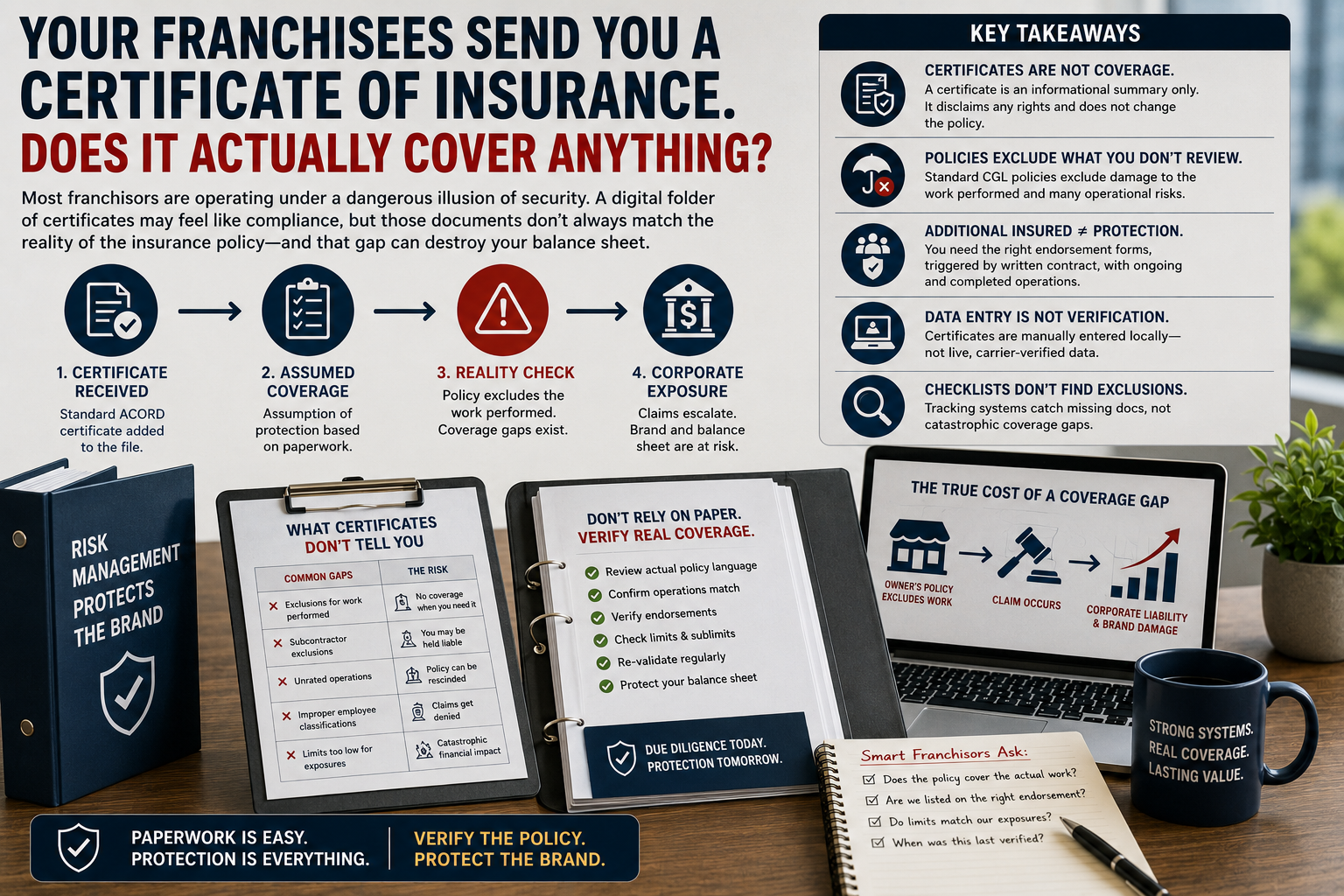
Most franchisors are operating under a dangerous illusion of security. They believe that a digital folder filled with standardized PDF documents means their corporate balance sheet is protected from third-party lawsuits. It is not. The standard collection of operational paperwork creates a false sense of administrative closure while leaving the actual financial core of the brand entirely exposed to devastating uninsured losses. When a catastrophic field-level failure occurs, the legal mechanisms designed to insulate the parent company frequently dissolve because the underlying policy text contradicts the administrative summary. This structural vulnerability exists because corporate executives prioritize the completion of an administrative checklist over the deep verification of actual asset protection. Relying on an unverified document to defend a multi-million-dollar corporation is a direct failure of fiduciary responsibility.
The immediate consequence of this administrative shortcut is a massive exposure on the corporate balance sheet. When a major loss occurs at the local level, the injured party does not stop at the limits of the individual operator. They look for the deepest pockets available, which inevitably leads to the franchisor via legal mechanisms like a joinder in a vicarious liability lawsuit. If the franchisee’s policy contains hidden exclusions that void coverage for that specific incident, the financial defense and ultimate settlement costs fall directly onto the corporate entity. This means that a single paperwork shortcut taken by a regional manager can bypass all corporate shields, directly impacting corporate cash reserves, driving up system-wide premium costs, and damaging the overall valuation of the brand.
Operational drift is the quiet killer of franchise networks. It happens when an owner expands their service menu to juice top-line revenue without updating their commercial underwriting profile. For example, a local pool cleaning business starts offering high-pressure concrete washing and roof scaling to its residential accounts. A residential maid service begins handling commercial post-construction cleanups inside active, heavy-machinery environments. A retail boutique decides to launch an unrated home delivery service using employee-owned personal vehicles, which activates unrated exposures under commercial auto definitions like Symbol 7. In every single scenario, the existing certificates of insurance look pristine, but the actual insurance policies exclude the newly adopted field activities entirely. The business grows, the revenue increases, but the risk profile becomes completely unrated and uninsured.
The reality of system growth is that administrative compliance is completely different from true risk transfer.
Key Takeaways
● Administrative summaries do not alter the legal reality of insurance policy text. A standard informational form disclaims its own validity right at the top of the page. It confers zero legal rights to your corporate entity and cannot modify the actual exclusions written into the policy by the underwriter.
● Standard general liability policies are never built to guarantee the quality of a franchisee’s work. Corporate leaders often confuse operational liability with a baseline performance warranty. If an owner damages the specific item they were hired to service, standard policy forms explicitly exclude the cost of repair, leaving the brand to face the financial fallout.
● Additional insured status is completely worthless without the correct underlying endorsement forms. Merely appearing as a named entity on a piece of paper does not grant liability protection. Without a matching written contract that triggers the endorsement, and without verifying that the policy includes both ongoing and completed operations, the brand remains completely unprotected.
● Relying on human-entered data from local agencies introduces systemic error into your compliance network. The documents sent to your corporate office are manual summaries typed into local database systems. They are not live, verified feeds from the actual insurance carriers, making them highly prone to omissions, errors, and unauthorized changes.
● Basic tracking systems catch simple administrative omissions but fail to detect catastrophic policy exclusions. Checking boxes will tell you if an owner forgot to buy a policy entirely. It will never reveal a hidden subcontractor exclusion or an unrated payroll classification that allows a carrier to deny a massive vicarious liability claim.
What Happens to Corporate Equity When an Owner’s Policy Excludes the Very Work They Perform?
True risk transfer occurs only when the actual policy text matches the operational reality in the field, while basic paperwork compliance is simply the administrative act of filing unverified summaries. When an individual owner operates with a policy that excludes their primary daily activities, the entire franchise system suffers. The unit-level economics disintegrate immediately when an uncovered claim hits, forcing the local owner to pull capital out of their operating cash flow to fund legal defenses. This sudden drain on cash reserves stops local marketing spend, halts equipment upgrades, and prevents the owner from paying their royalty fees to the corporate office.
Beyond the immediate financial damage to the individual unit, the health of the entire brand is placed in jeopardy. When a high-profile incident occurs, the public does not distinguish between a locally owned franchise and the corporate headquarters. If the local owner’s insurance carrier issues a formal denial of coverage based on an operational exclusion, the public blowback hits the entire national network. A single local failure turns into a systemic brand crisis that can depress franchise sales, lower customer foot traffic across all territories, and invite intense regulatory scrutiny.
The legal fiction of corporate separation vanishes the moment a plaintiff file a lawsuit utilizing a joinder to pull the franchisor into the litigation. Plaintiffs’ attorneys understand that the franchisor holds the true financial assets of the system. They will argue that the corporate office maintains strict operational control through its brand standards and manuals, making the franchisor vicariously liable for the local incident. If the franchisee’s underlying insurance policy fails to respond due to an exclusion, the corporate entity must use its own balance sheet to defend the lawsuit, turning a local operational mistake into a direct drain on corporate equity.
Why Do Local Franchisees and Corporate Operations Teams Fight Real Risk Verification?
Franchisees and internal corporate operations teams resist deep policy verification because they view the insurance process as an expensive administrative hurdle rather than a critical asset protection mechanism. Local owners operate on tight margins and are highly sensitive to any requirement that might increase their overhead expenses. When corporate introduces deeper verification protocols, owners immediately assume it will lead to higher premium costs or force them to buy additional coverage they believe they do not need. They often rely on their local insurance agents, who may not understand the specific risk profile of the franchise system, to reassure them that their basic policies are completely sufficient.
Internal operations teams often push back because they are evaluated on speed, unit openings, and immediate revenue generation. To an operations director, a delayed franchise opening due to an insurance policy review looks like a failure to meet growth targets. They see the collection of a standard certificate as a quick way to check a box and move the onboarding process forward. Introducing a comprehensive review of endorsements, policy forms, and exclusions adds time to the pipeline, creating friction between the development team and the risk management team.
This resistance is further complicated by a widespread misunderstanding of insurance mechanics across both groups. Many managers believe that if a document lists a million-dollar limit, that million dollars is readily available for any type of loss. They do not realize that an underwriter can completely gut that limit using specific exclusions, such as excluding all work performed by independent contractors or sub-agents. Education is the only way to break this resistance, as teams must realize that a cheap, non-compliant policy is actually the most expensive option when a claim is denied.
How Can a Growing Multi-Unit Network Rebuild Its Risk Strategy Without Halting Field Operations?
Transitioning a large multi-unit network from basic administrative tracking to true risk verification requires a phased, systematic playbook that prioritizes high-exposure areas without interrupting daily business operations. The first step is to establish a clear baseline by gathering the complete policy documents, not just the certificates, from every active location. This collection process should be integrated into existing annual renewal cycles or franchise compliance audits to minimize operational friction. The corporate team must clearly communicate to the entire network that this is a protective measure designed to safeguard every owner’s individual investment from systemic liabilities.
Once the documents are gathered, the review must focus heavily on the policy endorsements and exclusions that directly impact the brand’s safety. This means verifying that the additional insured endorsement specifically includes both ongoing operations and completed operations through standard industry forms. The review team must also look closely at the workers’ compensation policies to ensure that the reported remuneration matches the actual payroll size and employee classifications of the business. Any policy that contains a total subcontractor exclusion or restricts coverage to specifically listed vehicles under a restrictive commercial auto definition must be flagged for immediate correction.
RISK VERIFICATION RE-ENGINEERING
[Phase 1: Baseline Audit]
│
▼
[Phase 2: Text Verification] -> Focus: Exclusions, Remuneration, Symbol
│
▼
[Phase 3: Alignment] -> Mandate proper endorsement forms
│
▼
[Phase 4: Continuous Review] -> Automate direct-from-carrier validation
The final phase of the rollout involves embedding these verification steps into the permanent infrastructure of the franchise system. This means updating the Insurance section of the Franchise Disclosure Document to specify the exact policy forms and endorsements required, leaving no room for local interpretation or agent manipulation. The corporate office should partner with a specialized risk management provider to handle the continuous review of these complex policy documents. By offloading the heavy analytical work to automated platforms, the corporate team can maintain total visibility into system-wide vulnerabilities without adding administrative burdens to their regional field managers.
What Does Real Risk Transfer Do for Unit Economics and System Valuations?
Implementing a rigorous risk transfer program delivers immediate economic benefits to individual franchise owners by securing their cash flows against unexpected operational shocks. When a franchisee operates with a fully verified policy that contains no hidden exclusions, they are completely insulated from out-of-pocket legal expenses and settlement costs. If a major property damage or personal injury claim occurs, the insurance carrier steps in to handle both the defense and the indemnity payments. This preservation of capital allows the local business to maintain its operational momentum, keep its staff employed, and continue investing in local market expansion.
For the franchisor, a robust risk transfer system acts as a direct driver of corporate valuation and long-term financial stability. When private equity firms or institutional investors evaluate a franchise network for potential acquisition or investment, they look closely at the system’s contingent liabilities. A brand that can prove one hundred percent compliance at the deep policy level is worth far more than a brand that only tracks basic administrative paper. True risk verification demonstrates to investors that the corporate balance sheet is completely insulated from field-level operational failures, making the entire system a much safer and more predictable asset.
Furthermore, a system-wide commitment to true risk transfer creates significant downward pressure on insurance costs over time. When an entire franchise network can prove to the insurance marketplace that its policies are thoroughly vetted and its risk profile is tightly controlled, carriers are much more willing to offer preferential underwriting terms. This can lead to the creation of exclusive, system-wide insurance programs that offer broader coverage and lower premiums than what individual owners could find on the open market. This turns risk management from a corporate enforcement headache into a tangible, value-added benefit for every owner who joins the brand.
Is Your Corporate Infrastructure Capable of Moving Past Basic Administrative Verification?
Evaluating whether a franchise system is ready to move beyond basic paperwork tracking requires an honest appraisal of current corporate workflows, legal agreements, and risk management capabilities. Many brands discover that while their legal agreements contain excellent indemnification language, their operational teams lack the training to verify if those legal promises are backed by real insurance capital. A franchisor must analyze their internal processes to determine if they are truly protecting the brand or simply filing papers to create an illusion of compliance.
This structured evaluation checklist allows executive teams to measure their actual operational readiness against the requirements of true risk transfer:
| Operational Area |
Weak Infrastructure (Checklist Mentality) |
Strong Infrastructure (True Risk Transfer) |
|---|---|---|
| Document Collection |
Accepts standard informational certificates via email and stores them in a basic digital folder. |
Mandates submission of full policy declarations, schedules, and specific endorsement forms. |
| Contract Integration |
FDD insurance language uses vague, generic terms like “adequate insurance” or “standard limits.” |
FDD specifies exact industry form numbers, required endorsements, and prohibited exclusions. |
| Audit Frequency |
Certificates are reviewed once a year at renewal, with no follow-up on mid-term cancellations. |
Continuous monitoring of policy status with direct alerts from carriers regarding modifications. |
| Staff Training | Regional managers or administrative assistants handle insurance tracking as a minor secondary task. |
Vetting is managed by dedicated risk professionals or specialized technology platforms. |
| Operational Drift Tracking |
Changes in local service offerings or vehicle usage are completely unmonitored by corporate. |
Menu updates and territory expansions automatically trigger a full review of policy coverages. |
If your system falls into the weak category across multiple areas, your brand is highly vulnerable to an uncovered field loss. Moving to a strong infrastructure does not require a massive increase in corporate headcount, but it does require a fundamental shift in how your executive team views operational data. It requires replacing manual, error-prone human tracking with automated verification systems that can read policy text and identify hidden exclusions before a claim ever occurs.
FAQ
Is a standard certificate of insurance a legally binding contract that guarantees coverage for our brand?
No. A standard certificate of insurance is purely an informational document that confers no legal rights upon the holder. It states explicitly on its face that it does not amend, extend, or alter the coverage afforded by the underlying policies. It is a human-entered summary of a policy at a single point in time, and it cannot be used to force an insurance carrier to pay a claim if the actual policy text contains an exclusion.
If our franchise agreement requires owners to name us as an additional insured, aren’t we automatically protected against lawsuits?
No. Naming a franchisor as an additional insured on a certificate means nothing if the correct endorsement forms are not attached to the actual policy. Furthermore, most blanket additional insured endorsements require a executed written contract to become active. If your operational agreements are outdated, unsigned, or lack specific language mandating both ongoing and completed operations coverage, the endorsement may provide zero protection when a claim is filed.
Why do standard liability policies frequently fail to cover property damage caused by a franchisee’s primary services?
Standard commercial general liability policies are designed to cover third-party bodily injury and damage to other property, but they contain strict exclusions regarding damage to the specific item or property being worked on. If a technician damages the exact piece of equipment or structure they were hired to service, the carrier will deny the claim based on standard care, custody, or control exclusions. To cover these risks, the policy must be specifically endorsed with specialized coverage extensions.
How does operational drift create uninsured exposures if the franchisee’s total coverage limits remain unchanged?
Operational drift occurs when a franchisee introduces new services or tools that fall outside the original classification codes used by the insurance underwriter. For example, if a home services owner adds a new line of business involving heavy commercial equipment, their existing general liability and workers’ compensation policies may exclude claims arising from that unrated activity. The certificate will still show the correct limits, but the policy will fail to respond because the underwriter never accepted that specific operational exposure.
Why is relying on a local insurance agent’s certificate verification a dangerous practice for a national franchisor?
Local insurance agents represent the franchisee and the insurance carrier, not the franchisor corporation. They use local agency management software to manually type out certificates, which introduces a high rate of data entry errors and omissions. A multi-year audit of contractor certificates published by the International Risk Management Institute revealed a material misrepresentation rate above ninety percent when certificates were compared against actual policies. The only way to ensure accuracy is to verify the actual policy documents directly.
Conclusion
Relying on a standard certificate of insurance to protect a corporate franchise network is a fundamental breakdown of operational risk management. These informational documents are designed to simplify data sharing, but they explicitly disclaim their own authority and provide no legal guarantee that an insurance carrier will respond to a catastrophic claim. The true security of a brand does not live in a digital folder filled with unchecked PDF summaries. It lives within the complex text of policy forms, endorsements, and exclusions that define the boundary between true risk transfer and severe corporate liability. Franchisors who wish to protect their equity, preserve their unit economics, and secure their system valuations must move past basic administrative checklists and build infrastructure capable of verifying the actual policy text behind the paper.