
Platform brands do not run one territory check process. They run one per brand, and then they run a coordination process on top of those to keep the whole thing from contradicting itself.
That is the part single-brand software never accounts for. It assumes one map logic, one registration calendar, one set of broker agreements, one development team. A platform has all of those multiplied by the number of concepts owned, and none of them line up neatly.
Multi-brand territory checks are not the same task performed more times. They are a structurally different problem.
The Friction Platform Brands Face
Ask a Fran Dev leader at a platform brand what makes territory checks hard and you rarely hear “volume.” You hear about the differences between concepts. The friction usually comes from a handful of mismatches:
- Different map logic. One brand is ZIP-based, another radius, another population, another DMA. Brand four counts population differently than the other three.
- Different registration calendars. FDD renewals and amendments do not land on the same schedule, so state status varies by brand on any given week.
- Different broker agreements. Broker relationships are rarely portfolio-wide. A broker who represents two of your concepts should not be answered on the other six.
- Different resale situations. Carve-outs and resale exceptions exist per brand and are usually documented nowhere in particular.
- Different teams and voices. Each brand has its own development rep, sender name, and reply tone that brokers recognize.
Any one of those is manageable. Together, they create a coordination tax that grows with every brand you add.
The Multi-Brand, Multi-Email Problem
This is the moment that tells you your process does not scale. A state registration changes for one of your brands. Somebody now has to tell everyone who answers territory checks for that brand. This means an email to several brokers, an update to a file, and a mental note for the next few weeks so nobody answers from stale information.
Multiply that by all of your brands and a normal renewal calendar. You are sending those emails constantly, and each one depends on every recipient reading it and remembering.
The alternative is a single change in one place. Toggle the state for that brand, and every future check for that brand answers correctly. No email chain. No memory required.
Update once. Answer everywhere. Franchise Ninja gives you that power.
Both Views, From the Same Data
The reporting problem at a platform is not a shortage of numbers. It is that the numbers come from different places and rarely reconcile.
Brand presidents pull their own. Platform leadership asks for a consolidated view. Somebody merges files, formats don’t match, and the meeting turns into a discussion of methodology instead of demand.
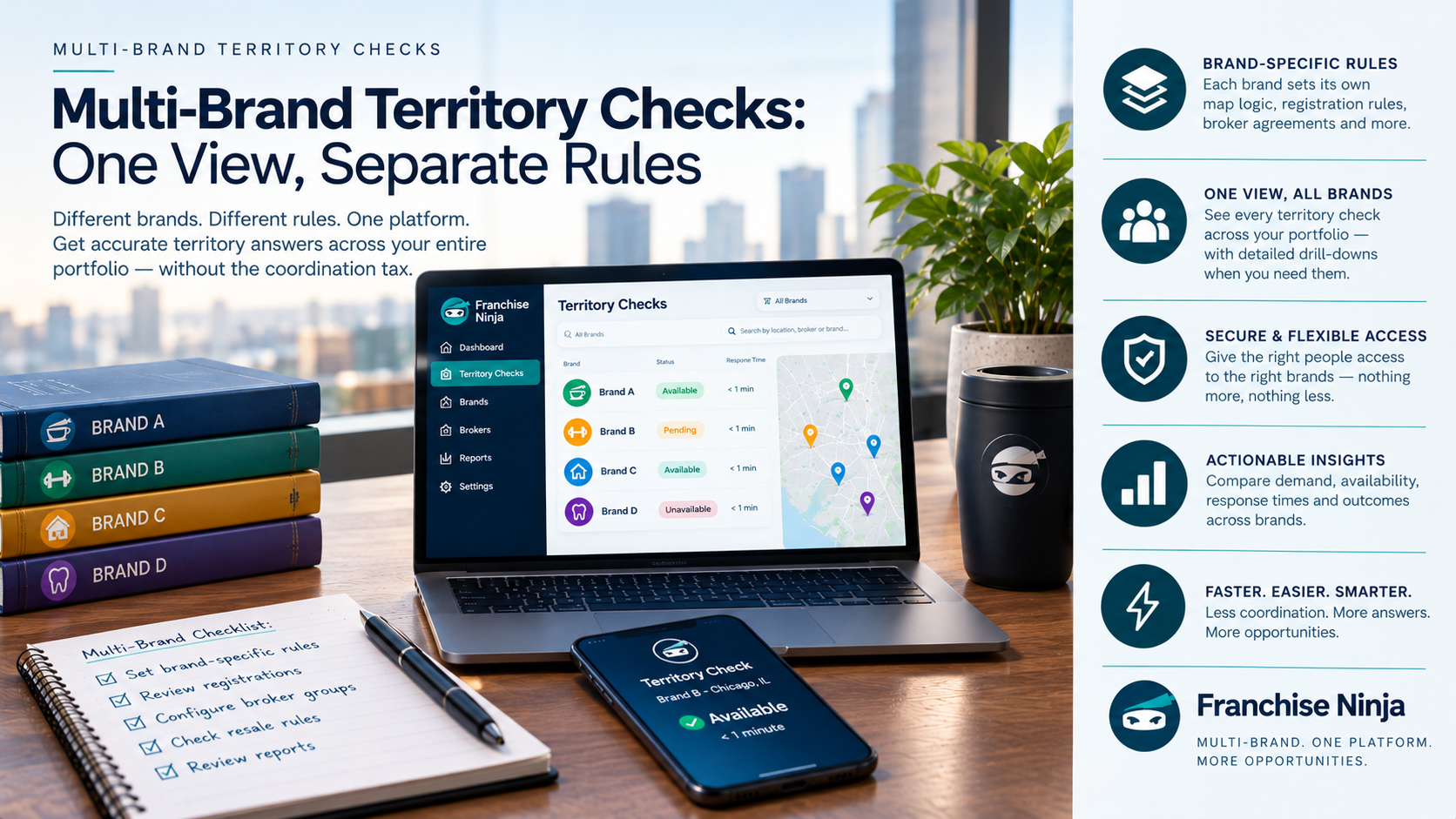
What a platform structure should give you instead is one data set with two altitudes. Portfolio-wide territory check volume at the top, then a drill-down into a single brand, broker, consultant, state, or individual request without switching accounts or waiting on a report.
Platform leadership gets the rollup. Brand presidents get their own numbers. Same source, no reconciliation.
The Patterns Only a Platform Can See
When every concept reports into one view, you can compare demand, availability, response speed, and outcomes across brands. Which concept is generating the most broker interest this quarter. Which one has an availability problem forming in its top states. Which brand answers fastest and why.
Those comparisons inform portfolio decisions, not just brand decisions. Where to invest development resources. Which concept is closest to saturation. Which brand needs registration expansion to keep up with where brokers are asking.
Brand-Level Control with Centralized Visibility
The failure mode of centralization is flattening. A system that makes reporting easy by forcing every brand into the same playbook has solved leadership’s problem and created a new one for every brand team.
Multi-brand territory checks require centralized visibility with decentralized configuration. In practice that means each brand independently controls its own settings. At a minimum, these should be set per brand rather than globally:
- Availability rules and territory methodology
- State registration status, tracked separately from availability
- Which sibling brands may be offered as alternates
- Broker eligibility and exclusions
- Sender names and reply routing
- Custom notes and pending language
- CC recipients and exception escalation paths
The notification piece matters more than people expect. The development rep who owns a brand should see replies for that brand land in their inbox, without a dashboard login and without notifications from the other seven concepts. Otherwise they stop reading any of it.
Access Without Exposure
Platform structures also create a permissions problem that single-brand tools were never built for. Not everyone should see everything. A brand president may have no business viewing another concept’s broker activity. A regional director may be authorized for two brands out of six. A platform administrator needs all of it.
Parent-child access handles this with one login and scoped visibility. Assign access to every brand, or only the concepts each person is authorized to manage. Consultants and CC recipients can be looped into specific responses without being handed the full dashboard.
Follow-Up Across Brands, In One Update
Brokers do not organize their questions by your org chart. A single broker network might have six open requests spread across four of your brands and three consultants.
Handled brand by brand, that broker gets four separate partial updates, or more likely, four partial silences. Handled at the platform level, you can review every open request tied to that broker network, see what is waiting on consultant follow-up, and consolidate it into one actionable update.
One broker update instead of another inbox scavenger hunt. The broker experiences you as a coordinated organization, which is the whole point of being a platform.
Talk To a Product Ninja
If you manage two or more franchise brands, your territory check process is carrying a coordination tax that nobody budgeted for.
Schedule a meeting with a Product Ninja. We’ll map your platform structure, your per-brand rules, and what centralized reporting would look like across your portfolio.
Our engineers build the platform structure, rules, routing, and supported integrations before there is an agreement. You run real territory checks across your brands for two weeks, then sign only if you like what you see.