
Part One of a four-part series on joint-employer liability and the future of franchising
Picture a franchisee on a Monday morning. Before the doors open, she has interviewed a job candidate, rebuilt the week’s schedule around a manager’s vacation, approved overtime for a shift lead, and had a hard conversation with an employee who keeps showing up late. She made none of those decisions on a call with headquarters. Her franchisor wasn’t consulted and, in a well-run system, wouldn’t expect to be.
Yet under the shifting federal rules of the past decade, her franchisor could still be named as the employer of every person on her payroll.
The American Franchise Act (H.R. 5267) is Congress’s attempt to fix that. Strip away the lobbying and the headlines and the bill asks a narrow question: when should a franchisor be legally treated as the employer of people its franchisee hired? Its answer is that the franchisor becomes a joint employer when it actually acts like one, and not simply because it runs a franchise system.
After decades of advising franchisors and franchisees, I believe that answer is correct, and I want to explain why.
Why Joint-Employer Liability Became Franchising’s Central Legal Question
Franchising works because it divides responsibility. The franchisor builds and protects the brand, develops the operating system, trains owners, and runs system-wide marketing. The franchisee puts up the capital, signs the lease, personally guarantees the loans, and runs the local business, including every decision about the people who work there.
Joint-employer doctrine blurs that division. When a franchisor is treated as a co-employer, it can share liability for wage-and-hour claims, unfair labor practice charges, and collective bargaining obligations at locations it doesn’t own or manage. For plaintiffs, the appeal is obvious: the franchisor is usually the larger, better-capitalized party. That is a form of vicarious liability, but one that attaches to a brand rather than to the decision-maker.
The deeper problem has been instability. The standard has changed repeatedly across administrations and between the National Labor Relations Board and the Department of Labor. A franchisor that designs its support programs carefully under one rule can find the same programs treated as evidence of control under the next one. No one can plan a business, or a career as a franchisee, around a definition that shifts with the election cycle.
What H.R. 5267 Would Actually Do
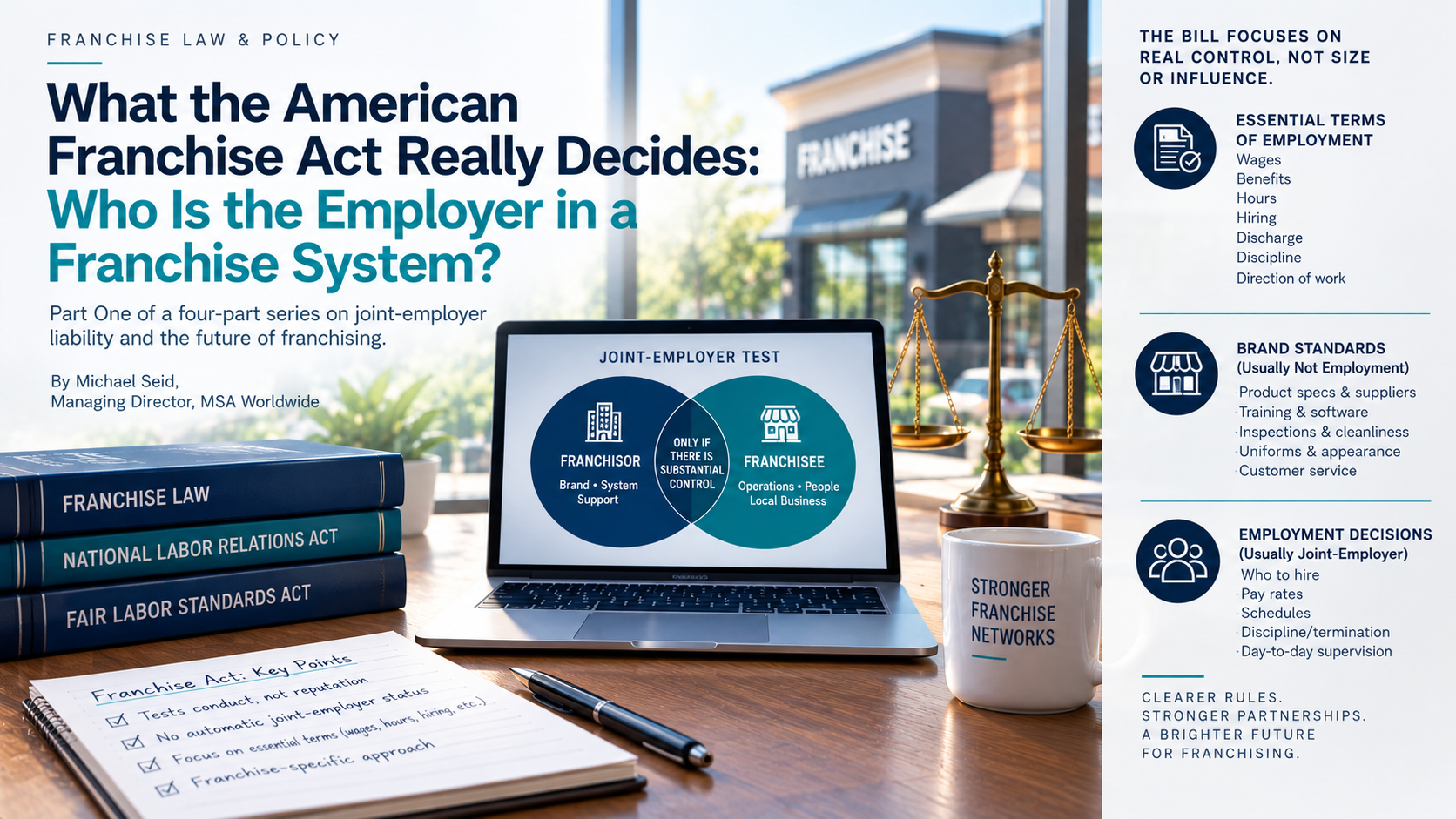
The committee-approved version of the bill amends both the National Labor Relations Act and the Fair Labor Standards Act. Under it, a franchisor could be considered a joint employer of a franchisee’s workers only if it possesses and exercises substantial, direct, and immediate control over one or more essential terms and conditions of employment.
Those essential terms are the ones any business owner would recognize: wages, benefits, hours, hiring, discharge, discipline, supervision, and direction of work.
Three features deserve emphasis:
- The bill tests conduct, not reputation. It does not ask whether the franchisor is large, influential, or economically important to the franchisee. It asks who made the employment decision.
- It does not give franchisors immunity. A franchisor that picks individual hires, sets pay rates, writes schedules, or disciplines a franchisee’s staff can still be held liable as an employer.
- It is deliberately franchise-specific. Supporters should say so plainly. Franchising is the one business relationship where extensive standards, training, inspections, and required systems are built into the model itself. Without a rule written for that reality, ordinary franchise features keep getting mistaken for workforce control.
Brand Standards Are the Product, Not a Payroll Decision
Here is where much of the public debate goes wrong. Critics point to franchise operations manuals, mandatory training, and field inspections as proof that franchisors “control” their franchisees. They are describing the franchise relationship, not an employment relationship.
Federal trademark law under the Lanham Act expects a trademark owner to control the quality of goods and services sold under its mark. A franchisor that stops enforcing standards doesn’t become a better partner; it risks weakening its trademark and breaking the promise consumers rely on when they walk into any location of the brand.
Examples of the distinction between brand standards and employment decisions:
Typically a Brand Standard
- Product specifications and approved suppliers
- Required point-of-sale and reporting software
- Food safety and customer service training content
- Uniform and appearance requirements
- Periodic quality and cleanliness inspections
Typically an Employment Decision
- Choosing which applicant to hire
- Setting an individual employee’s pay rate
- Writing the weekly work schedule
- Disciplining or terminating an employee
- Directing employees’ work shift by shift
Influence Is Not the Same as Employment
Franchisors influence franchisees. So do lenders that impose financial covenants, landlords that dictate operating hours in a lease, insurers that require safety protocols, and major customers that set delivery terms. No one argues that a landlord employs its tenant’s staff because the lease says the store must open by 10 a.m.
Commercial influence is everywhere in business. Employment is a specific legal relationship with specific content, and the right test asks specific questions:
• Who selected this worker?
• Who set the pay?
• Who decided the schedule?
• Who supervised the work?
• Who issued the discipline?
• Who actually exercised the authority to change those terms?
These questions don’t weaken worker protections. They make sure claims are directed at the party that made the decision, which is how accountability is supposed to work.
A practical note for franchisors
Whatever happens in Congress, your conduct matters. Review how your field consultants operate. A consultant who “suggests” which employee should be let go, or who adjusts a franchisee’s schedule in the system, can create exposure that no statute will cure. Keep HR templates and wage guidance clearly optional, and separate employment matters from brand standards in your manuals and training. Under the American Franchise Act, a franchisor’s actual behavior determines its exposure, so it should be disciplined about where its people step in.
Why the Stakes Reach Far Beyond Headquarters
The International Franchise Association’s 2026 economic outlook projects roughly 845,000 franchised establishments, nearly 8.9 million jobs, $921.4 billion in output, and $558.4 billion in franchise-related GDP this year. These are industry-sponsored projections, but they show the scale of what Congress is regulating.
The figure that concerns me most is the individual owner who has signed the personal guarantee and has to cover payroll in a slow month. When the joint-employer rule is unclear, franchisors face a bad choice: provide strong support and standards and take on legal risk, or pull back to protect themselves. When franchisors pull back, franchisees lose the training, systems, and guidance they paid for, and workers don’t gain any protection from it.
Where the American Franchise Act Stands Now
The bill has moved further than earlier versions of this legislation. The House Committee on Education and Workforce reported H.R. 5267 with an amendment on September 8, 2026, and it was committed to the Committee of the Whole House on the State of the Union, clearing a procedural step ahead of consideration by the full House. That followed committee approval on July 21, 2026. The bill has 142 bipartisan House cosponsors, and companion legislation has been introduced in the Senate as S. 3525, referred to the Senate Committee on Health, Education, Labor, and Pensions. In September, the White House Domestic Policy Council director announced the Trump Administration’s full support for the bill.
To become law, the American Franchise Act still has to:
1. Pass the full House in a floor vote, which has not yet been scheduled.
2. Move through the Senate, either through the HELP Committee’s companion bill or by the Senate taking up the House-passed version. Most Senate legislation needs 60 votes to end debate, so bipartisan support is essential.
3. Reconcile any differences between the House and Senate versions.
4. Be signed by the President.
The time pressure is real. Congress has a compressed calendar for the rest of 2026, and the bill is competing for floor time with many other priorities. If the 119th Congress ends without final passage, the process starts over from the beginning next session.
What You Can Do This Week
Members of Congress respond to their constituents, and they especially pay attention to the people who run businesses and create jobs in their districts. If you are a franchisor, franchisee, supplier, or advisor to the franchise community:
• Call or email your U.S. Representative (find yours at house.gov) and ask them to support bringing H.R. 5267 to the House floor and voting for it. If they’re already a cosponsor, thank them and ask them to push for a vote this year.
• Contact both of your U.S. Senators (find them at senate.gov) and ask them to cosponsor S. 3525 and support Senate action.
• Make it specific. Say where your business is located, how many people you employ or support, and what a clear joint-employer rule would mean for you. A specific constituent story is more persuasive than a form letter.
Frequently Asked Questions
Does the American Franchise Act remove protections for workers?
No. Minimum wage, overtime, collective bargaining rights, and other employment laws still apply. The franchisee remains the employer and remains responsible for complying with them.
Does the bill protect a franchisor that actually controls employees?
No. A franchisor that exercises substantial, direct, and immediate control over essential employment terms can still be a joint employer.
Why not use one joint-employer standard for every industry?
Franchising is the one relationship where detailed operating standards are a legal and commercial necessity. A general standard keeps treating those necessary features as evidence of employment.
The Line Worth Drawing
The American Franchise Act will not resolve every disagreement between franchisors and franchisees, and nobody should claim it will. What it does is answer a question that has gone unanswered for too long: is a franchisor an employer because it maintains a brand, or because it makes employment decisions?
The law should hold responsible whoever actually exercises employer authority and leave independent business owners in charge of their own businesses. Congress has a chance to put that into statute this session.
In Part Two, we look at why brand standards are neither employment decisions nor optional for a franchisor that wants to protect its trademark.
Michael Seid is Managing Director of MSA Worldwide. He can be reached at mseid@msaworldwide.com or 860-523-4257.