
Conference season is when franchise supplier budgets quietly leak. A booth, travel, a sponsorship, and a few days of your best people’s time add up fast, and most of it gets justified with one word: relationships. Relationships matter in franchising, and I have built a career on them. But a relationship is a result, not a budget line. If you cannot say what an event is supposed to produce, you cannot tell afterward whether it did.
Here is a simple franchise conference ROI test that grew out of conversations with suppliers in my mastermind groups. It has five parts, and none of them requires a spreadsheet wizard.
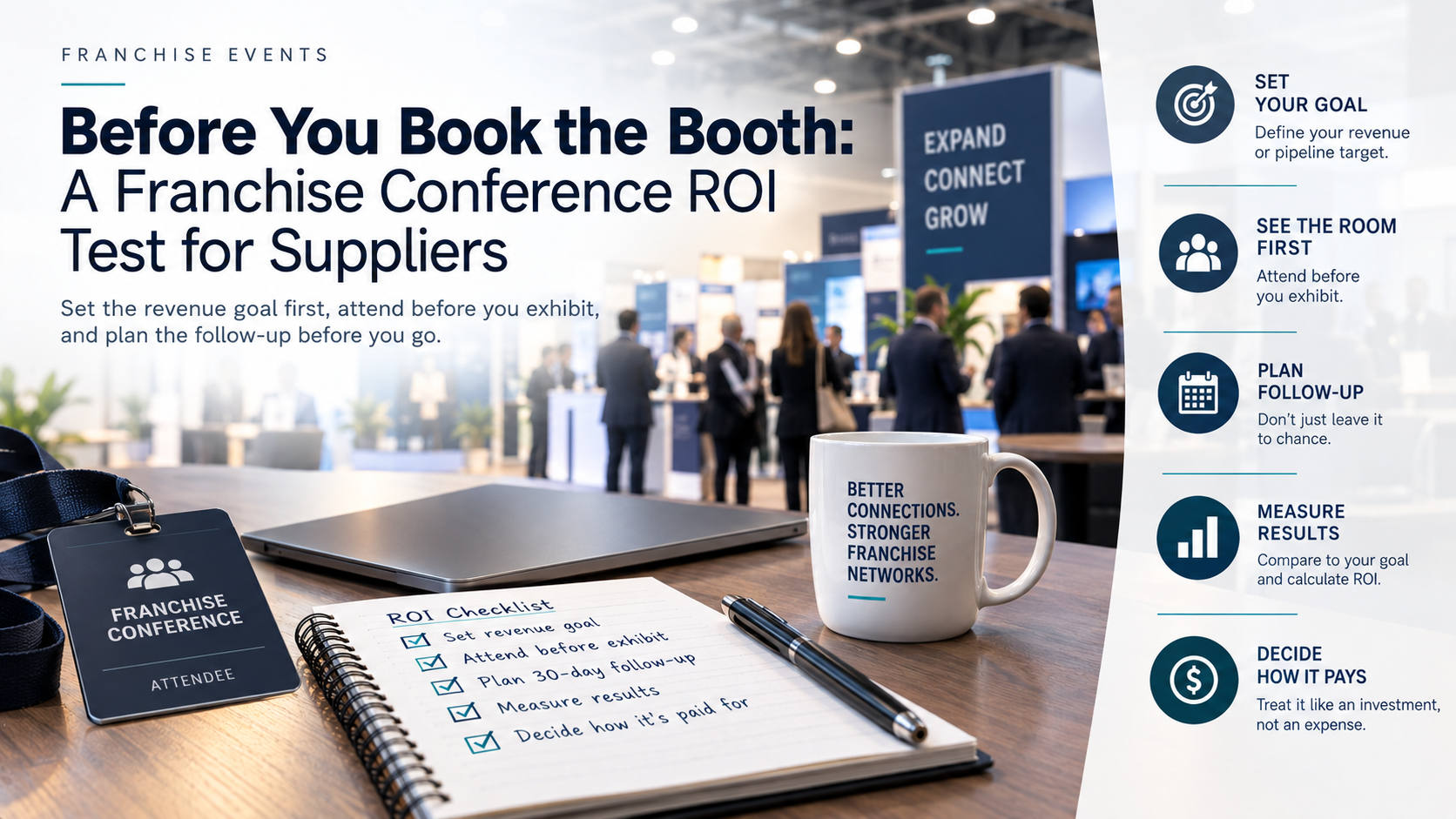
1. Write the revenue goal before you register
Before anyone clicks “register,” put one sentence on paper: what revenue or pipeline this event should create, and who on your team owns it. Be specific. “Meet franchisors” is a wish. “Book eight meetings with franchisor decision-makers and turn two of them into proposals” is a goal.
Then have someone other than the person who wants to go approve it. A business partner or a trusted peer works well. The point is not to say no. The point is to make the case out loud, which filters out most events that sounded better in the brochure than they do in a sentence.
2. Attend before you exhibit
Exhibiting is a big commitment to an audience you may not have seen yet. If a conference is new to you, go once as an attendee. Walk the floor. Notice who is actually in the room: franchisor executives, franchisees, other suppliers, or advisors. Notice who gets real conversations and who is just handing out pens.
Ask a few exhibitors what they would do differently. A ticket costs a fraction of a booth, and the lesson usually pays for itself.
3. Budget for the 30 days after, not just the days of
The event is the cheap part. The expensive part is the follow-up, and it is where most suppliers fall down. Franchisors run on their own calendars. Decisions wait for a board meeting, a convention, or the next budget cycle, and pushing for an answer in week two can cost you the relationship.
So plan the follow-up before you go: who contacts whom, with what, by when, and what happens with the people who are interested but not ready. One supplier I work with cut back from six or seven events a year to three or four so the team could follow up on the leads they already had. Fewer events and better follow-through is often the winning trade.
4. Measure actual results against the goal you wrote
After each event, compare what happened with the sentence you wrote in step one. Count conversations, meetings, proposals, and closed business, then add up the real cost: fees, travel, materials, and staff time.
Then look back further. If you have attended the same events for a couple of years, run a simple retrospective: what did each one produce, and what did it cost? Do this before you renew a sponsorship or a booth. It turns a vague feeling about whether events work into a decision.
5. Decide how it gets paid for
Treat event spend as an investment with a payback window, not an expense that sorts itself out. Decide in advance how much you will spend, how long you will give an event to pay back, and what you will do if it does not. If a line of credit is quietly carrying your event budget, you will feel it later. Growth that outruns your cash discipline is still a problem, even when revenue looks great.
A simple scorecard
Keep this on one page for every event you consider.
| Before you go | After you return |
|---|---|
| The revenue or pipeline goal, in one sentence | Conversations, meetings, proposals, and closed
business |
| One owner on your team | Total cost, including travel and staff time |
| A second person who approved it | Actual results compared with the written goal |
| Budget and a payback window | Keep, change, or drop, with the reason |
| A written 30-day follow-up plan | What you would do differently next time |
Common mistakes
• Going everywhere because your competitors do.
• Counting badge scans as leads.
• Sending one generic email to everyone a week later.
• Renewing a sponsorship because it is a habit.
• Letting the person who loves the event decide whether it was worth it.
The bottom line
The suppliers who win in franchising are rarely the ones with the biggest booth. They are the ones franchisors trust, and trust comes from showing up for the right reasons and following through. A conference should earn its place on your calendar like any other investment. Set the goal, see the room first, plan the follow-up, measure the result, and decide how it gets paid for. If an event cannot pass those five questions, you have your answer.
If you want to talk through your event plan for the coming year, grab a quick 15-minute call with me.