
By Gerry Henley
Why Franchisee Performance—Not System Averages—Should Define a System’s Health
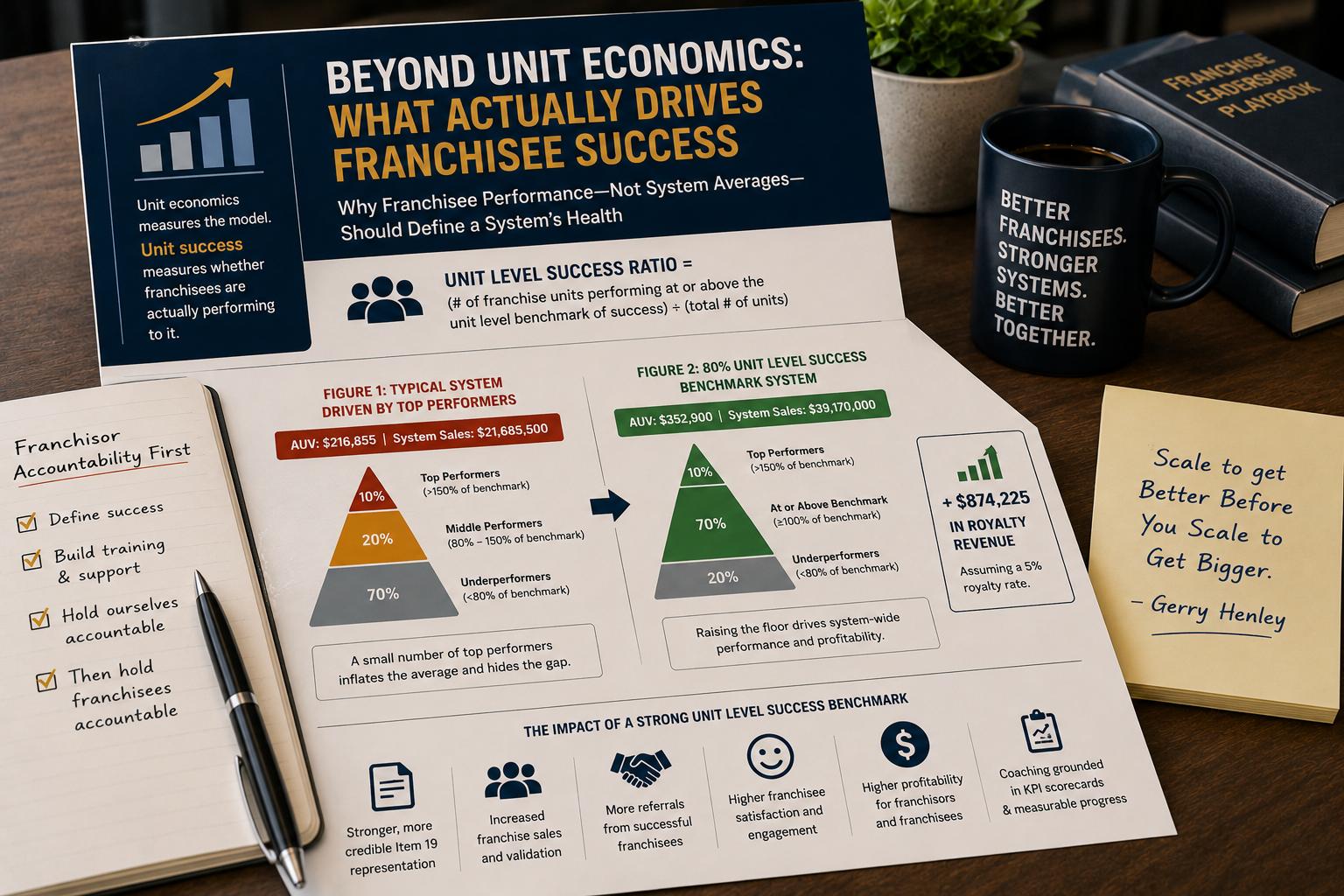
Unit level economics measures the model. Unit level success measures whether franchisees
are actually preforming to it.
Most franchise organizations lead with unit economics, and for good reason: it is widely treated as the foundational building block of a franchise business. Unit economics is typically defined as the direct revenues and costs associated with a business model, expressed on a per-unit basis. It tells a franchisor what the model is capable of producing.
But unit economics describes potential. It does not tell you how many franchisees are actually achieving it. That is the gap unit level success is designed to close, and it is the metric that matters most when the goal is franchisee performance, not just system-level projections.
Accountability Starts With the Franchisor
Franchisors can only hold franchisees accountable to a benchmark of success once they have first held themselves accountable to help franchisees reach it. That means defining what success looks like, and building the training and support infrastructure required to get every franchisee there—not just the top performers.
Unit Level Success Ratio = (# of franchise units performing at or above the unit level benchmark of success) ÷ (total # of units)
This raises two questions every franchisor should be able to answer with confidence: What is your plan for training and support, from the day a franchisee signs the franchise agreement through the end of the ramp-up period? And how are you holding yourself accountable to delivering it?
The starting point is defining unit level success itself: the pace of sales and profitability a franchisee should reasonably reach by the end of ramp-up. A well-built business plan pro forma is central to this step, giving both franchisor and franchisee a shared, realistic model of what performance should look like month over month. From there, franchisors design and implement a training and support plan that holds the franchisor accountable first, and the franchisee second.
Setting the Bar at 80 Percent
At Launch to Growth, we work with franchisors toward a unit-level success rate of 80 percent, supported by a training and support plan built specifically to hold franchisees accountable to that outcome. Each franchisee is paired with a dedicated launch coach who guides them through ramp-up, working the plan to keep performance at pace toward the unit level benchmark. Coaching is tied directly to KPI scorecards, so franchisee progress toward the unit level benchmark is tracked consistently and every coaching conversation is grounded in real performance data rather than guesswork. It is a different model than the typical franchise business-coach engagement: by focusing on structured execution up front, a Launch to Growth program reduces a system's long-term dependency on continuous business coaching.
This distinction matters because the metric most franchisors rely on—average unit volume (AUV)—can be misleading. AUV is calculated by dividing total system sales by the number of units that have operated
for at least one year. On its own, it does not show how performance is actually distributed across the system, and a small group of top performers can inflate the average enough to obscure how the rest of the franchisee base is doing.
What the Numbers Show
Consider a typical 100-unit franchise system with an AUV of $216,855 and total system sales of $21,685,500. As the chart below illustrates, that figure is driven disproportionately by a small number of top performers, while a large share of the system trails well behind.
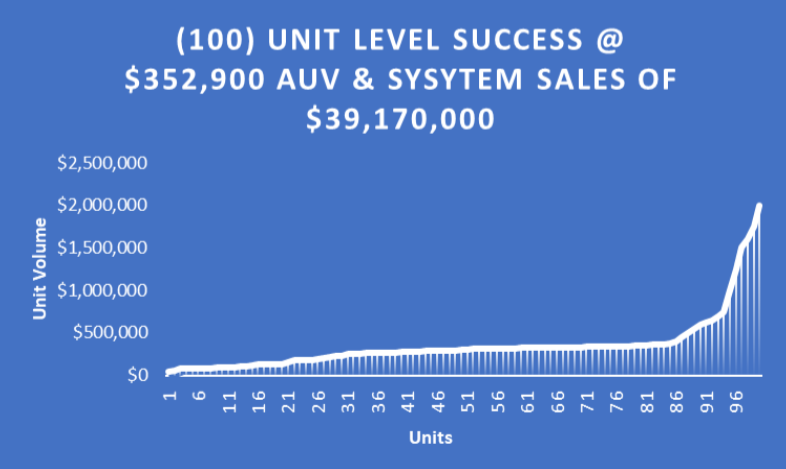
Figure 1: Unit performance distribution driven by top performers
Now compare that to a system built around a defined unit level benchmark, achieved within the first year of ramp-up, with 80 percent of franchisees hitting it. Using the same 100 units, AUV rises to $352,900 and system sales rise to $39,170,000.
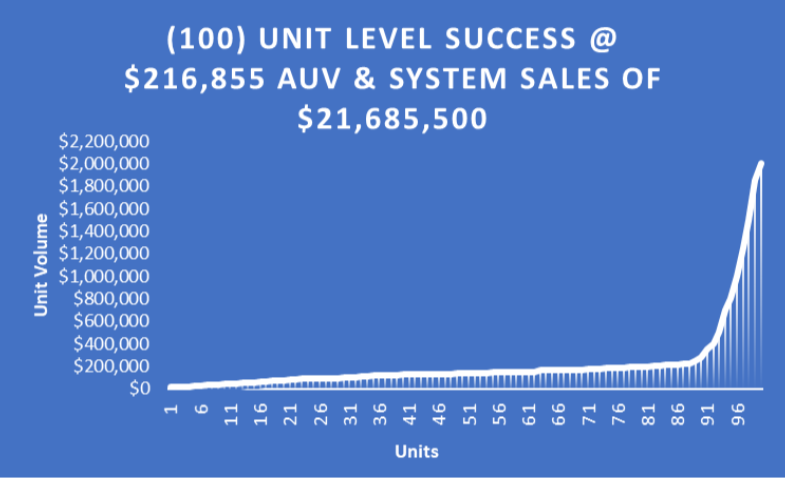
Figure 2: Unit performance distribution under an 80% unit level success benchmark
Assuming a 5 percent royalty rate, that shift represents a gain of $874,225 in royalty revenue for the franchisor—generated not by adding units, but by helping existing franchisees perform closer to their potential.
Why This Matters Beyond Revenue
Every franchise system will have top and bottom performers; that is a normal feature of any distributed business. The goal is not to eliminate variation, but to raise the floor—to get 80 percent of franchisees performing at or above the defined benchmark of unit level success. Beyond the direct increase in system-wide revenue, franchisors who prioritize this benchmark typically see:
• A stronger, more credible Item 19 financial performance representation
• Increased franchise sales, driven by validation from existing franchisees
• More referrals from franchisees who are meeting or exceeding expectations
• Higher franchisee satisfaction and engagement across the system
• Increased profitability for both franchisors and franchisees
• Coaching grounded in KPI scorecards, so support is targeted and progress is measurable
“Scale to get Better Before You Scale to Get Bigger”
— Gerry Henley
Gerry is passionate about establishing and helping Franchisor leadership teams achieve operational excellence through effective coaching and mentoring
Utilizing FOS – Franchise Operating System, Launch to Growth creates custom solutions for all Franchisors we partner with and ensure you can not only overcome your current challenges but provide you with the skills and tools you need to improve and scale your system through Unit Level Performance.
Gerry has more than 30 years’ experience as a strategic, results-driven business development and leadership executive and more than 15 years with franchise systems. He uses his expertise in franchise leadership, operations, strategic planning, financial management, process improvement and team building to help teams execute their organizational vision.