

Chitty on Contracts states that a “force majeure clause” is normally used to describe a contractual term by which one (or both) of the parties is entitled to cancel the contract or is excused from performance of the contract, in whole or in part, or is entitled to suspend performance or to claim an extension of time for performance, upon a happening of a specified event or events beyond the party’s control. Such clauses may assume a variety of forms, but in New Zealand, the term “the usual force majeure clauses to apply” has been held void for uncertainty. Force majeure clauses have been said not to be exemption clauses, although it is difficult to draw any clear line of demarcation between the two types of clauses, since the effect of each may relieve a contracting party of an obligation or liability to which the party would otherwise be subject.
The Laws of New Zealand state that “in practice, many contracts expressly provide for performance to be excused if rendered impossible by unavoidable causes such as of acts of God, the Queen’s enemies, force majeure, or vis major.” Stipulations of this nature (often generally called force majeure clauses) are effective, provided that such clauses are not uncertain in their terms. A force majeure clause must be construed in each case with due regard to the nature and general terms of the contract and in particular with regard to the precise words of the clause.
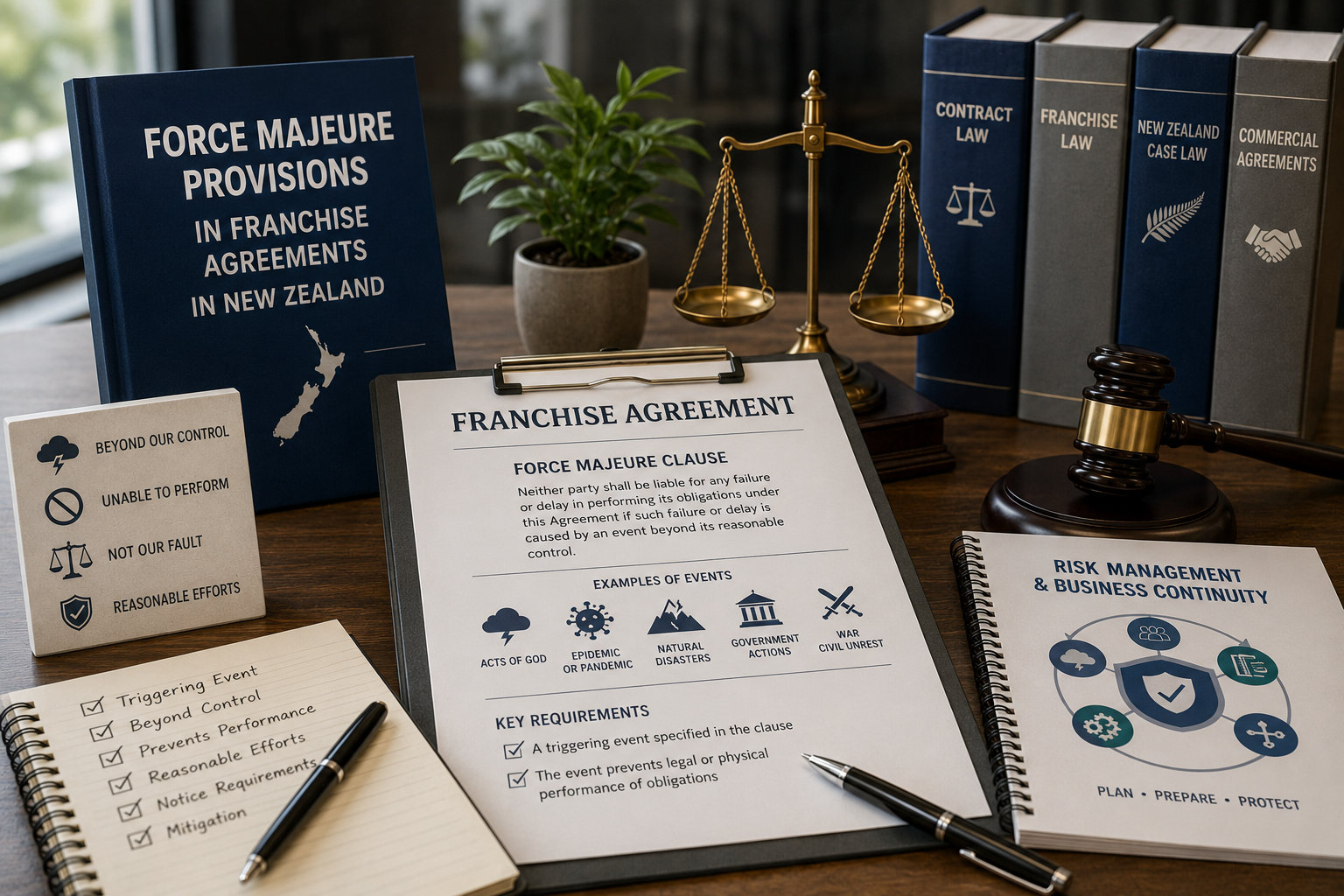
Many franchise agreements contain a force majeure clause; i.e., a clause governing events happening beyond one’s control like an act of God or a pandemic. Each force majeure clause may be different, but the effect is the same—it relieves the party that is unable to perform, or is delayed from performing, their obligations under an agreement. In the author’s opinion successful initiation of force majeure clause requires:
(a) A triggering event. Each clause will detail a variety of triggering events. Some examples include an act of God, a natural event, or epidemic or pandemic; and
(b) The required effect of the triggering event is that you are unable to legally or physically perform your obligations under the agreement.
Both of the above elements must be proven in order to successfully use the force majeure clause to get out of any obligation. What will count as a triggering event will depend on the exact wording of the clause in the document in the author’s opinion.
II. Force Majeure Clauses in General
A contract might specifically provide for and manage the legal effect of external events by the inclusion of a force majeure clause. “Force majeure” literally translates from the French as “superior force.” Although there is no authoritative common law definition, the court in Matsoukis v Priestman & Co. described force majeure as meaning: “A circumstance beyond the control of a party to a contract, which enables that party to escape liability for failing to perform the contract as the result of the circumstance.”
The concept of force majeure has been formulated in various ways, but generally involves the following elements: (1) the event must be outside the control of the parties; (2) the performance of the relevant contractual obligations must be prevented, hindered or delayed; and (3) the effect the event cannot be avoided or overcome by reasonable efforts to mitigate.
The concepts of force majeure and frustration are similar because they both hinge upon external events that are beyond the control of the parties. However, they are fundamentally different in nature because frustration is a doctrine of the common law, whereas force majeure is a creature of contract with no common law existence outside the contract. Parties cannot rely upon force majeure to excuse failed performance, if there is no clause in the contract. Force majeure provisions must be express, and will not ordinarily be implied in the contract. Consequently, force majeure clauses are ultimately a matter of agreement between the parties which can be drafted to suit the particular circumstances.
III. Events of Force Majeure
A force majeure clause must first define the “events of force majeure.” The parties might agree upon a list of specific events. By itself, force majeure has been construed to include diverse events of natural or human intervention, such as “acts of God,” earthquakes, epidemics, the complete dislocation of a business or breakdown of machinery due to a universal strike. Other frequent examples of force majeure include wars, public disorder, embargoes, and changes of law or government policy. However, the diversity of the cases makes any exhaustive list impossible.
Contracts sometimes refer to force majeure clauses as hardship clauses. Such a clause has the effect of defining the relevant party or parties’ primary obligations so that, if the relevant event occurs, there will be no breach and hence no contractual liability to pay compensation. Typically, a force majeure clause operates to qualify an obligation so that upon the occurrence of a particular event, no contractual default arises; but, in addition, such a clause might have the effect of suspending the contract or allowing a party to cancel the contract.
For example, in Gemcorp Commodities Trading SA v Zeefacto Oil & Gas Co., the court considered a summary judgment application concerning a debt. The underlying debt involved a sale requiring the buyer to pay in dollars. Subsequent to formation of the contract, the value of the relevant foreign exchange rates for the buyer fell. As a result the buyer experienced personal difficulty in converting its funds from one currency into dollars. The buyer pleaded both frustration and a defense under a force majeure clause. The force majeure clause in the contract stated as follows:
Neither seller nor buyer shall be liable in damages or otherwise for any failure or delay in performance of any obligation hereunder, other than the obligation to make payment, where such failure or delay is caused by force majeure, being any event, recurrence or circumstance reasonably beyond the control of the respective parties, including without prejudice to the generality of the foregoing … restrictions imposed by any governmental authority.
The seller obtained an award on summary judgment because the court found that both defenses had no real prospect of success. The judge held that fall in exchange rates did not frustrate the buyer’s obligation to pay in US dollars. The judge noted that it contained a carve-out which had the effect that the clause expressly excluded from the scope of the clause the buyer’s obligation to pay for goods supplied.
For an abundance of caution in drafting, a non-exhaustive list of specific majeure events is often followed by a catch-all phrase, such as “any other events beyond the control of the parties.” However, such drafting runs the risk of attracting the ejusdem generis rule of contractual interpretation, whereby general words may be read down by reference to the type of events listed before them. Adverse changes in economic or business circumstances, unless expressly provided for in the contract, are generally not recognised as events of force majeure.
It is often said that force majeure events must be unforeseeable to the parties. If the parties anticipated the risk they might have taken a voluntary assumption of risk, which excludes reliance upon force majeure.
IV. Recent Cases
The recent case of Meetfresh Franchising Pty Ltd v Ivanman Pty Ltd., decided September 25, 2020, by the New South Wales Supreme Court (Aus), discusses force majeure clauses.
On July 9, 2015, the franchisee, Ivanman Pty Ltd, contracted to purchase from CJ Tang Pty Ltd a ”Meet Fresh” franchise business operating in Burwood. The Meetfresh business involved the sale of traditional Taiwanese desserts, beverages, snacks, and other food products. Easy Way Station Co Ltd, a Taiwanese company, was the owner of the Meet Fresh intellectual property. It granted to Meetfresh Australia Pty Ltd, the franchisor, the right to grant franchises to carry on that business in Australia using that intellectual property. Meetfresh Australia granted that right to the appellant, Meetfresh Franchising Pty Ltd, which in turn granted a franchise to Ivanman as franchisee in respect of the Burwood premises.
Soon after its acquisition of the business, Ivanman obtained a franchise agreement from Meetfresh Franchising (the first franchise agreement), to expire on October 31, 2017, and also a licence from Meetfresh Franchising to conduct the business at the premises (the licence agreement). The franchisor held a lease of the premises, due to expire on August 14, 2017. The sub-franchisee, Mr Yifan Wu, guaranteed Ivanman’s obligations.
In January 2016, well prior to the dates fixed for the expiration of the first franchise agreement and the associated licence, the franchisor required Ivanman to undertake a new renovation of the premises, representing that it would not renew the franchise agreement and licence if this was not done. After the renovation was completed at a cost to Ivanman of (AUD) 119,579.88, the parties entered into a second franchise agreement for a term of five years commencing November 1, 2017 (the second franchise agreement). By a Disclosure Statement provided by the franchisor to Ivanman prior to entry into this second franchise agreement, the franchisor represented that the agreement would not be affected by any termination of the head franchise agreement between Meetfresh Australia and the franchisor.
Both the first and second franchise agreements contained the following force majeure provision:
EVENTS BEYOND MEETFRESH’S CONTROL
Meetfresh . . .shall not be liable to the Franchisee (Ivanman) for any loss sustained by the Franchisee caused by Meetfresh’s failure to honour the terms of the Franchise Agreement where such failure has occurred because of an event which is beyond Meetfresh’s reasonable control including but not limited to strikes, war, fire, flooding, earthquakes and other natural disasters.
On January 10, 2017, Ivanman received a notice in writing from Easy Way (with whom it did not have any direct contractual relationship) stating that Meetfresh Australia was no longer entitled to use the Meet Fresh intellectual property, with the consequence that sub-franchisees of Meetfresh Australia were similarly disentitled. Thereafter, however, the franchisor nevertheless purported to authorise Ivanman to continue to use the Meet Fresh intellectual property. On July 27, 2017, it advised Ivanman that the name of the business was to be changed to “Meet Desserts” and that Ivanman was no longer able to use the “Meet Fresh” intellectual property. The franchisor then began supplying Ivanman with Meet Desserts rather than Meetfresh products. When the licence for the Burwood premises expired on August 14, 2017, the franchisor did not offer a renewal or extension to Ivanman and November 10, 2017, it served a notice of termination of any “holding over” licence then in existence and of the franchise agreement. As a result, Ivanman surrendered possession of the premises to the franchisor.
Ivanman subsequently sued Meetfresh Franchising in the district court claiming damages for breach of contract and unconscionable conduct. By cross claim, Meetfresh Franchising claimed from Ivanman, and from Mr. Wu under his guarantee, unpaid licence fees and other amounts payable under the licence of the premises. Ivanman argued that his surrender of the premises constituted a force majeure event, and that as a result, he had no obligation to pay fees or any other amount..
In a 70 page ex tempore judgment of November 30, 2019, the district court found that Ivanman was entitled to a judgment for (AUD) 113,171 and held that the cross claim should be dismissed. The franchisor appealed both aspects of the judgment.
The Judge in the appellant court found that the force majeure clause argument failed because the facts did not support the application of the force majeure provisions. Specifically, the Judge looked at the grounds of unconscionable conduct within the meaning of section 21 of Schedule 2 of the Competition and Consumer Act 2010 (Cth) (Austl.). The Judge would not entertain the allegation of unconscionable conduct that the evidence did not support. The Judge also looked at the grounds for the claimed damages and again concluded dismissal was proper, finding that the court did “not consider that on appeal the franchisor has established that its request to Ivanman to undertake the refit was reasonable for the purposes of this clause.” Further, the cross claim failed. The Judge concluded that the franchisor’s grounds of appeal had been unsuccessful and he proposed the following orders: to dismiss the appeal except to the extent that the franchisee admitted to owing the franchisor (AUD) 6,146.23 and for the franchisor to pay the franchisee’s costs of appeal.
It was vital for Ivanman to operate its business from the premises but since Ivanman could not access the premises, and was prevented from doing so, he claimed an event of force majeure. It followed that because he could not conduct the business no fees or other amounts owing should be payable to Meetfresh.
In another recent case, Seadrill Ghana Operations Ltd v Tullow Ghana Ltd., Seadrill hired a sixth generation deep water semi-submersible rig from Tullow Ghana to carry out drilling offshore Ghana in locations where Tullow had interests, including operations for the “TEN” and “Jubilee” fields on behalf of joint venture partners. In 2014 Ghana referred a long-standing dispute with Cote d’Ivoire concerning the position of their maritime border to arbitration before the International Tribunal for the Law of the Sea (ITLOS). The border dispute covered the whole of the TEN field but not Jubilee. In 2015 the ITLOS Tribunal made a provisional measures order that prohibited “new drillings” in the disputed area covering the whole of TEN. Ghana directed Tullow to comply with the provisional measures order, interpreting it as prohibiting the spudding of new wells but allowing for completion of wells that had already been drilled and workovers.
Tullow contended that the drilling moratorium was a force majeure event and that it was entitled to terminate the contract under the relevant force majeure clause. The parties disagreed that the drilling moratorium was a force majeure event under the clause. However, the clause only applied if and to the extent that fulfilment of the contract was “prevented by the occurrence.” The issue was whether the drilling moratorium prevented Tullow from providing a drilling programme to Seadrill.
Seadrill contended that it did not because a further cause of Tullow’s failure to perform was the Ghanaian government’s decision not to approve the Jubilee plan of development. Seadrill relied on Tullow’s rig schedules indicating that Tullow planned to move the rig from TEN to Jubilee to drill wells there pursuant to the Jubilee plan of development, which it had expected the government to approve.
The English court held that both the moratorium and the government’s failure to approve the Jubilee development plan were “on a broad common sense view of the position” causative to Tullow’s inability to perform. But given that that there were multiple causes of the inability to perform, one being force majeure (the drilling moratorium) and the other not the government’s failure to approve the Jubilee development, the court held that Tullow could not rely on the force majeure clause because the moratorium did not prevent it from drilling at Jubilee and was not, therefore, the effective cause of Tullow’s failure to perform. The English court was confident that the facts supported Tullow’s inability to give effect to the contract, and an important aspect was the force majeure argument. In the author’s opinion, this case supports other Commonwealth legal decisions in relation to the important aspect of the force majeure argument. Under New Zealand law the decision in that case should be followed but a judge might determine otherwise.
V. COVID-19 Pandemic
The COVID-19 pandemic is a global and unprecedented event in modern times. Application of the doctrine of frustration to contractual disputes arising out of its impacts is untested. The global COVID-19 pandemic and New Zealand’s Alert Level 4 lockdown had placed heavy restrictions on the operation of all but essential services, as well as on travel, both international and domestic. Parties who entered into contracts prior to the escalation of the crisis may be left unable to perform their obligations the way originally contemplated by their agreement, if at all. Coupled with challenging economic times, it is likely that there will be an increase in clients questioning the ability to cancel or vary contracts entered into prior to the implementation of COVID-19 restrictions.
While some contracts will include provisions that contemplate circumstances where parties are unable to perform their obligations through no fault of their own, many will not. In those circumstances, the doctrine of frustration will apply. That doctrine applies where unforeseen events occur that render performance of a contract impossible or only possible in a radically different way from that originally contemplated.
In New Zealand, Part 2, Subpart 4 of the Contract and Commercial Law Act 2017 (N.Z.) applies to frustrated contracts and as a general rule, the doctrine operates to discharge the contract where: “[I]t appears from the nature of the contract and the surrounding circumstances that the parties have contracted on the basis that some fundamental thing or state of things will continue to exist, or that some person will continue to be available, or that some future event which forms the basis of the contract will take place; and an event in relation to this underlying basis of the contract renders performance impossible or only possible in a very different way from that contemplated, but without default of either party.”
The party seeking to apply the doctrine needs to show that there has been a failure at the heart of the contract, and that the relationship contemplated by the parties is fundamentally altered by events outside their control. It is not enough to demonstrate that the party has been deprived of some benefit or that the changed circumstances will create hardship or inconvenience.
Covid-19 had a dramatic effect on commercial leases in New Zealand. Some commercial leases were on a modern form of Deed of Lease which contained the important “No Access clause”; but older leases did not contain that clause. The “no access clause” is contained in the Deed of Lease published by the Auckland District Law Society. The meaning of “no access” is best explained by quoting clause 27.5 below:
If there is an emergency and the Tenant is unable to gain access to the premises to fully conduct the Tenant’s business from the premises because of reasons of safety of the public or property or the need to prevent reduce or overcome any hazard, harm or loss that may be associated with the emergency including:
(a) a prohibited or restricted access cordon applying to the premises; or
(b) prohibition on the use of the premises pending the completion of structural engineering
or other reports and appropriate certifications required by any competent authority that the premises are fit for use; or
(c) restriction on occupation of the premises by any competent authority,
then a fair proportion of the rent and outgoings shall cease to be payable for the period commencing on the date when the Tenant became unable to gain access to the premises to fully conduct the Tenant’s business from the premises until the inability ceases.
For renters that could not rely on a “no access” clause, some landlords showed no empathy, were greedy and charged full rental during the lockdown period, notwithstanding that the tenant could not access the premises and had zero turnover. In the author’s experience, other landlords decided to charge fifty percent or twenty-five percent. The best and most popular landlords were those who charged zero during the lockdown period, and those landlords often offered an extra month rent free for tenants. Those acts of kindness will not be forgotten, and franchisors that those that lease franchised premises to franchisees are more likely to retain good franchisees at the time of renewal.
While the effects of a global pandemic do not specifically feature in previous case law, it may still be possible to draw inferences from the existing body of cases about how the doctrine of frustration may apply to the effects of COVID-19.
VI. COVID-19 and Force Majeure
Many contracts contain express provision stating that performance will be excused if rendered impossible by unavoidable causes such as acts of God, the Queen’s enemies, vis major, or force majeure, as discussed earlier. Clauses of this type are effective if they are drafted precisely and unambiguously.
Whether the outbreak of COVID-19 constituted a force majeure event will depend on the wording of the force majeure clause in question. In the absence of reference to a disease or pandemic in the clause, general terms such as “act of God” or “government restrictions” may apply. Determining this will require careful consideration of the contract and surrounding circumstances.
The term “act of God” is a common legal term meaning an extraordinary occurrence or circumstance which could not have been foreseen or guarded against. It is not necessary that the event has never happened before, only that it is extraordinary and could not reasonably be anticipated. To be an “act of God,” and not merely an accidental circumstance, the effect must be wide-reaching and overwhelming. Some examples of what have been construed as acts of God include the following:
- Violent storms;
- Extraordinarily high tide;
- Unprecedented rainfall;
- Fire caused by lightning;
- Earthquake; and
- Extraordinary snowfall.
The common being that the event is sudden or more severe than previous instances of the same event. A regular snowfall or fire is unlikely to be treated as an act of God.
In addition, determining whether the pandemic crisis has “prevented, hindered or delayed performance” of the contract will also depend on the specific facts and terms of contract. Often force majeure clauses will require that performances rendered legally or physically impossible, although some clauses have a lesser standard.
VII. Franchise Agreements
All franchise agreements in New Zealand should contain a robust force majeure clause. The author would go so far to say that if any franchise agreement does not contain a force majeure clause then the drafter of the document may be negligent. The type of force majeure clause that the author invariably includes in his franchise agreements states:
Neither party shall be liable to the other and neither party shall be deemed to be in default for any failure or delay to observe or perform any of the terms and conditions applicable to the party under this Agreement (other than the payment of money) caused or arising out of any act beyond the control of that party including (but not limited to) fire, flood, lightning, storm and tempest, earthquake, strikes, lock-outs or other industrial disputes, acts of war, acts of terrorism, riots, civil commotion, explosion, malicious damage, government restriction, unavailability of equipment or product, disease and/or virus of epidemic or pandemic proportions or other causes whether the kind enumerated above or otherwise which are beyond the control of that party and where such failure or delay is caused by one of the events above then all times provided for in this Agreement shall be extended for a period commensurate with the period of the delay.
The purpose of the above clause is to ensure that neither party will be liable to the other for any events outside their control. Common events are listed in the clause like fire, flood, lightning, storm and tempest and, of particular relevance to current events, the phrase “disease and/or virus of epidemic or pandemic proportions.”
No one can predict the future and all parties, especially a franchisor and a franchisee, should be afforded the protection of a well-drafted force majeure clause. COVID-19 is merely a symptom of the greater problem of unexpected or unanticipated events, be they in the form of the next pandemic or some other future disaster. Uncertainty will always pose a risk to interference with contractual relations, and a well-drafted force majeure clause is a necessary component of mitigating contractual risk.